


Page 55 - JSOM Fall 2018
P. 55
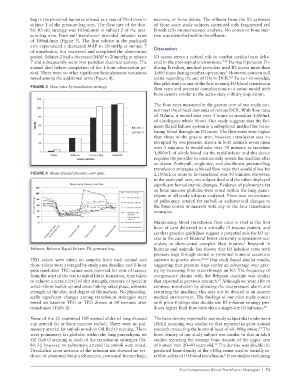
bag in the proximal humerus infused at a rate of 70mL/min in necrosis, or bone debris. The effluent from the IO catheters
subject 1 of the pressurebag arm. The flow rate of the dou of those same study subjects contained only fragmented red
ble IO site strategy was 103mL/min in subject 2 of the pres bloods cells on microscopic analysis. No cortex or bone mar
surebag arm. Pushpull transfusion provided infusion rates row was identified within the effluent.
of 109mL/min (Figure 3). The first subject in the pushpull
arm experienced a decreased MAP to 20mmHg at minute 7 Discussion
of transfusion, but recovered and completed the observation
period. Subject 2 had a decreased MAP to 20mmHg at minute IO access serves a critical role in combat medical care deliv
7 and subsequently went into pulseless electrical activity. The ered in the prehospital environment. 7,24 During Operation En
animal died before completion of the 1hour observation pe during Freedom, medical providers used IO access more than
riod. There were no other significant hemodynamic variations 1,000 times during combat operations. However, concern still
1
noted among the additional arms (Figure 4). exists regarding the use of IOs in DCR. To our knowledge,
8,9
this pilot study is one of the first to study IO blood transfusion
FIGURE 3 Flow rates by transfusion strategy.
flow rates and potential complications in a swine model with
bone density similar to the activeduty military population.
The flow rates measured in the gravity arm of our study can
not meet the clinical demands of remote DCR. With flow rates
of 5L/min, it would take over 3 hours to transfuse 1,000mL
of autologous whole blood. Our study suggests that the Bel
mont Rapid Infuser system is a suboptimal method for trans
fusing blood through an IO route. The flow rates were higher
than those in the gravity arm; however, transfusion was in
terrupted by overpressure alarms in both animals seven times
over 5 minutes. It would take over 30 minutes to transfuse
1,000mL of whole blood via the rapid infuser and this device
requires the provider to continuously restart the machine after
an alarm. Pushpull, singlesite, and doublesite pressurebag
transfusion strategies achieved flow rates that would allow for
FIGURE 4 Mean arterial pressure over time. 2,100mL or more to be transfused over 30 minutes. However,
in the pushpull arm, one subject died and the other displayed
significant hemodynamic changes. Evidence of pulmonary fat
or bone marrow globules were noted within the lung paren
chyma of all study subjects analyzed. There was no evidence
of pulmonary arterial fat emboli or architectural changes to
the bone cortex or marrow with any of the four transfusion
strategies.
Maximizing blood transfusion flow rates is vital in the first
hour of care delivered to a critically ill trauma patient, and
combat practice guidelines suggest a potential role for IO ac
cess in the care of bilateral lower extremity amputations sec
ondary to dismounted complex blast injuries. Research in
3
Belmont, Belmont Rapid Infuser; PB, pressure bag. humans and animals has shown that IO infusion rates with
pressure bags through sternal or proximal humeral access are
TEG values were taken on samples from each animal and superior to gravity alone. 25–29 Our study found similar results,
those values were averaged by study arm. Baseline and 1hour suggesting that pressure bags confer an advantage over grav
posttransfusion TEG values were reported for time of latency ity by increasing flow rates through an IO. The frequency of
from the start of the test to initial fibrin formation, time taken overpressure alarms with the Belmont machine was similar
to achieve a certain level of clot strength, measure of speed at that reported in previous research. Although we were able to
21
which fibrin builds up and cross linking takes place, ultimate continue transfusion by silencing the overpressure alarm and
strength of the clot, and degree of fibrinolysis. No physiolog restarting the machine, this may not be desired in an austere
ically significant changes among transfusion strategies were medical environment. The findings of our pilot study concur
noted on baseline TEG or TEG drawn at 60 minutes after with prior findings that doublesite IO infusion strategy pro
transfusion (Table 2). duces higher fluid flow rates than a singlesite IO infusion. 30
None of the 32 examined H/Estained slides of lung showed The bone density reported in our study subject that underwent
any arterial fat or bone marrow emboli. There were no pul DEXA scanning was similar to that reported in prior animal
monary arterial fat emboli noted on Oil Red O staining. There research evaluating the humeral head of 60–90kg swine. The
19
were pulmonary fat globules within the lung parenchyma on bone density of our study subject was similar to that in adult
Oil Red O staining in each of the transfusion strategies (Ta studies reporting the average bone density of the upper arm
ble 3); however, no pulmonary arterial fat emboli were noted. of human men 20–40 years old. The density was double the
12
Decalcified crosssections of the infusion site showed no evi predicted bone density of the <10kg swine used to initially es
dence of abnormal bony architecture, periosteal hemorrhage, tablish safety of IO blood transfusion. Prior studies evaluating
8
Four Intraosseous Blood Transfusion Strategies | 53

