


Page 54 - JSOM Fall 2018
P. 54
IO needle (EZIO; Teleflex Medical, www.teleflex.com) was Red O. The other half was submitted in formalin for routine
inserted in the proximal humeral head of the animal with a processing as a control. The highest density of parenchymal fat
device driver (EZIO) from the same manufacturer. Placement globules on stained slides was located and the globules were
was confirmed by successful bone marrow aspiration veri quantified by counting the number of globules in this area per
fication of patency by flushing with 10mL of normal saline 10 contiguous highpower fields. Analysis was conducted by
(0.9% sodium chloride) and, finally, by positively identifying a staff pathologist at Naval Medical Center Portsmouth who
the IO insertion site on fluoroscopy. The IO was flushed with was blinded to transfusion strategy group.
a second 10mL saline flush before initiating the transfusion
strategy by treatment group. Approximately 10–15mL/kg of Results
autologous blood was transfused per animal per treatment
group. Transfusion flow rates were calculated during the first Characteristics of Study Subjects
5 minutes of transfusion. The remainder of the transfusion Nine swine were evaluated during this pilot study. Data from
was completed after this flow rate was documented. the pushpull arm with 60mL syringe were excluded from
data analysis. On tissue collection for the swine undergoing
Tissue Sample Collection and Analysis this technique with the 60mL syringe, it was noted that the
Surviving animals were euthanized while under general an IO access had migrated through the posterior aspect of the
esthesia and tissue samples were collected for analysis. The bony cortex during pushpull transfusion initiation. Given
humerus from subject 5 was analyzed via dual energy xray the accurate position of the IO on fluoroscopy before push
absorptiometry (DEXA) for bone density (Figure 2). The IO pull transfusion, the research team thought direct transfusion
needles from the second subject of each study arm were col from syringe into the needle caused needle migration from its
lected and the residual effluent material within the needle was original pretransfusion position. Our protocol was refined
submitted to pathology for analysis under microscopy. The to transfuse the remaining subjects in the pushpull group
humerus of the second animal in each treatment arm was re through accompanying IV tubing and not directly into the nee
moved for analysis and crosssectioned proximal to transfu dle hub. The remaining two pushpull subjects were transfused
sion site. These specimens were submitted to the laboratory, with 10mL and 20mL syringes through IV tubing connected to
decalcified, and evaluated for changes to the bony matrix. the IO access and no needle migration was observed.
Architectural changes, periosteal hemorrhage, bone debris, or
necrosis within the matrix were reported descriptively. This resulted in a total of eight swine in which the study pro
tocol was completed successfully—two swine in each study
arm. Median weight of the swine was 77.3kg (interquartile
range [IQR], 72.7–88.8kg). Median volume of hemorrhage
was 1,231mL (IQR, 1,143–1,382), which corresponded to an
estimated median 24.2% blood loss (IQR, 21.5–25.2). The
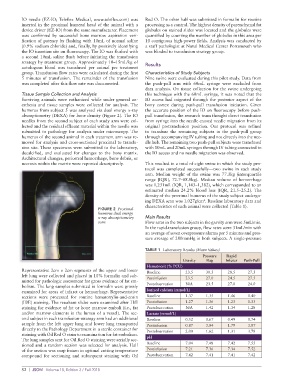
density of the proximal humerus of the study subject undergo
ing DEXA scan was 1.027g/cm . Baseline laboratory data and
2
characteristics of each animal were collected (Table 1).
FIGURE 2 Proximal
humerus dual energy
x-ray absorptiometry Main Results
scan. Flow rates in the two subjects in the gravity arm were 5mL/min.
In the rapidtransfusion group, flow rates were 31mL/min with
an average of seven overpressure alarms per 5 minutes and pres
sure average of 280mmHg in both subjects. A singlepressure
TABLE 1 Laboratory Results (Mean Values)
Pressure Rapid
Gravity Bag Infuser Push-Pull
Hematocrit (% PCU)
Representative 2cm × 2cm segments of the upper and lower Baseline 23.5 30.5 28.5 27.5
left lung were collected and placed in 10% formalin and sub
mitted for pathologic assessment for gross evidence of fat em Postinfusion 23.5 27.0 24.5 27.5
bolism. The lung samples submitted in formalin were grossly Postobservation N/A 23.5 27.0 24.0
examined for areas of infarct or hemorrhage. Representative Ionized calcium (mmol/L)
sections were processed for routine hematoxylinandeosin Baseline 1.37 1.35 1.46 1.40
(H/E) staining. The resultant slides were examined after H/E Postinfusion 1.27 1.36 1.23 1.33
staining for evidence of fat or bone marrow emboli (i.e., fat Postobservation N/A 1.42 1.34 1.28
and/or marrow elements in the lumen of a vessel). The sec Lactate (mmol/L)
ond subject in each transfusionstrategy arm had an additional Baseline 0.52 0.67 0.49 0.74
sample from the left upper lung and lower lung transported Postinfusion 0.87 3.04 1.79 3.07
directly to the Pathology Department in a sterile container for
staining with Oil Red O stain to examination for fat embolism. Postobservation 2.00 1.62 1.31 3.78
The lung samples sent for Oil Red O staining were serially sec pH
tioned and a random section was selected for analysis. Half Baseline 7.04 7.48 7.42 7.55
of the section was snap frozen in optimal cutting temperature Postinfusion 7.21 7.36 7.34 7.52
compound for sectioning and subsequent staining with Oil Postobservation 7.42 7.41 7.41 7.42
52 | JSOM Volume 18, Edition 3 / Fall 2018

