


Page 94 - JSOM Summer 2018
P. 94
Laryngeal Mask                                     Ethics
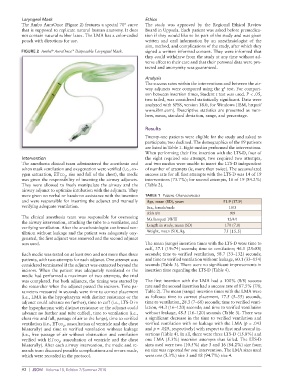
          The Ambu AuraOnce (Figure 2) features a special 70° curve   The study was approved by the Regional Ethical Review
          that is supposed to replicate natural human anatomy. It does   Board in Uppsala. Each patient was asked before premedica-
          not contain natural rubber latex. The LMA has a color-coded   tion if they would like to be part of the study and was given
          pouch with directions for use.                     written and oral information  by an anesthesiologist  of the
                                                             aim, method, and complications of the study, after which they
                               ™
          FIGURE 2  Ambu  AuraOnce  Disposable Laryngeal Mask.  signed a written informed consent. They were informed that
                      ®
                                                             they could withdraw from the study at any time without ad-
                                                             verse effect to their care and that their personal data were pro-
                                                             tected and anonymity was guaranteed.
                                                             Analysis
                                                             The success rates within the interventions and between the air-
                                                             way adjuncts were compared using the χ  test. For compari-
                                                                                              2
                                                             son between insertion times, Student t test was used. P < .05,
                                                             two tailed, was considered statistically significant. Data were
                                                             analyzed with SPSS, version 18.0, for Windows (IBM, https://
                                                             www.ibm.com). Descriptive statistics are presented as num-
                                                             bers, mean, standard deviation, range, and percentage.

                                                             Results
                                                             Twenty-one patients were eligible for the study and asked to
                                                             participate; two declined. The demographics of the 19 patients
                                                             are listed in Table 1. Eight medics performed the interventions.
                                                             When performing their first insertion with the LTS-D, four of
          Intervention                                       the eight required one attempt, two required two attempts,
          The anesthesia clinical team administered the anesthesia and   and two medics were unable to insert the LTS-D independent
          when mask ventilation and oxygenation were verified (i.e., ox-  of number of attempts (ie, more than twice). The accumulated
          ygen saturation, ETco , rise and fall of the chest), the medic   success rate for all first attempts with the LTS-D was 14 of 19
                            2
          was given the responsibility of inserting the airway adjuncts.   interventions (73.7%); for second attempts, 16 of 19 (84.2%)
          They were allowed to freely manipulate the airway and the   (Table 2).
          airway adjunct to optimize intubation with the adjuncts. They
          were given no verbal or hands-on assistance with the insertion   TABLE 1  Patient Characteristics
          and were responsible for inserting the adjunct and manually   Age, mean (SD), years  51.9 (17.9)
          verifying adequate ventilation.                     Sex, female/male                 16/3
                                                              ASA I/II                          9/9
          The clinical anesthesia team was responsible for overseeing
          the airway intervention, attaching the tube to a ventilator, and   Mallampati I/II/III  12/4/1
          verifying ventilation. After the anesthesiologist confirmed ven-  Length in study, mean (SD)  170 (7.0)
          tilation without leakage and the patient was adequately oxy-  Weight, mean (SD), kg  75 (15.5)
          genated, the first adjunct was removed and the second adjunct
          was used.                                          The mean (range) insertion times with the LTS-D were time to
                                                             cuff, 37.1 (19–74) seconds; time to ventilation; 46.1 (25–88)
          Each medic was tested on at least two and not more than three   seconds; time to verified ventilation, 58.7 (33–132) seconds;
          patients, with two attempts for each adjunct. One attempt was   and time to verified ventilation without leakage, 60.1 (33–154)
          considered terminated if the adjunct was extracted beyond the   seconds (Table 3). There were no significant improvements in
          incisors. When the patient was adequately ventilated or the   insertion time regarding the LTS-D (Table 4).
          medic had performed a maximum of two attempts, the trial
          was completed. For both adjuncts, the timing was started by   The first insertion with the LMA had a 100% (8/8) success
          the researcher when the adjunct passed the incisors. Time pa-  rate and the second insertion had a success rate of 87.5% (7/8;
          rameters measured in seconds were time to correct placement   Table 2). The mean (range) insertion times with the LMA were
          (i.e., LMA in the hypopharynx with distinct resistance or the   as  follows:  time  to  correct  placement,  17.5  (5–55)  seconds,
          adjunct could advance no further), time to cuff (i.e., LTS-D in   time to ventilation, 28.3 (7–68) seconds; time to verified venti-
          the hypopharynx with distinct resistance or the adjunct could   lation, 44.3 (16–120) seconds; and time to verified ventilation
          advance no further and tube cuffed), time to ventilation (i.e.,   without leakage, 48.3 (16–120) seconds (Table 3). There was
          chest rise and fall, passage of air to the lungs), time to verified   a significant decrease in the time to verified ventilation and
          ventilation (i.e., ETco , auscultation of ventricle and the chest   verified ventilation with no leakage with the LMA (p = .043
                           2
          bilaterally) and time to verified ventilation without leakage   and p = .029, respectively) with respect to first and second in-
          (i.e., free passage of air without obstruction and ventilation   sertions (Table 4). In all, there were three LTS-D (15.8%) and
          verified with ETco , auscultation of ventricle and the chest   one LMA (5.3%) insertion attempts that failed. The LTS-D
                         2
          bilaterally). After each airway intervention, the medic and re-  sizes used were two (10.5%) size 3 and 16 (84.2%) size four;
          search team discussed possible complications and errors made,   no size was reported for one intervention. The LMA sizes used
          which were recorded in the protocol.               were one (5.3%) size 3 and 18 (94.7%) size 4.


          92  |  JSOM   Volume 18, Edition 2/Summer 2018

