


Page 93 - JSOM Summer 2018
P. 93
be easy to handle and provide reliable protection against aspi-  the manufacturer’s directions. After the initial cuffing of the
              ration.  The findings of multiple studies 16–30  support adequate   tube with a fixed volume of air, a cuff pressure of 60cmH O
                   15
                                                                                                               2
              ventilation with the laryngeal tube (LT) and the LTS-D. Schalk   was used.
              et al.  reported a high success rate of 98.2% with the LTS-D in
                 22
              the prehospital setting. Gahan et al.  reported an 87.8% success   Medics
                                        24
              rate for with LT insertion by inexperienced airway providers.  The medics were part of the Swedish Armed Forces, active
                                                                 or Territorial Army. They were either team medics or first re-
              We conducted a clinical study in which we allowed medics to   sponders, who had received 3 weeks of medical training fo-
              secure the airway of anesthetized, elective patients sequentially   cused on combat trauma care, or combat life savers, who had
              by using the adjuncts LTS-D and disposable LMA. The objec-  received 5–7 weeks of training. In this study, participants with
              tive of this study was to determine if inexperienced medical   either of these types of training were called medics. Indepen-
              personnel such as military medics could provide airway con-  dent of their level of training, they all had a similar amount
              trol using the LTS-D and LMA.                      of airway management training. This consisted of basic air-
                                                                 way maneuvers: chin lift, jaw thrust, recovery position, use
                                                                 of a pocket mask, and insertion of oral and nasal pharyngeal
              Methods
                                                                 airways. Before the study, the medics were given 4 hours of
              Design                                             training with the LMA and LTS-D, 2 hours of theory, and 2
              This was a quantitative, structured observational study with   hours of practical training with manikins. They performed 10
              a crossover design. The study was performed in 19 patients   interventions with each adjunct on a manikin. The training
              undergoing surgery at the Uppsala University Hospital, Up-  was conducted less than 30 days before the study. The medics
              psala, Sweden, a tertiary care center. The patients were se-  had limited previous clinical experience and no clinical experi-
              lected consecutively and the inclusion criteria were American   ence in airway management.
              Society of Anesthesiologists (ASA) classification I–II, Mallam-
              pati classification I–III, and planned for elective surgery with   Laryngeal Tube Suction
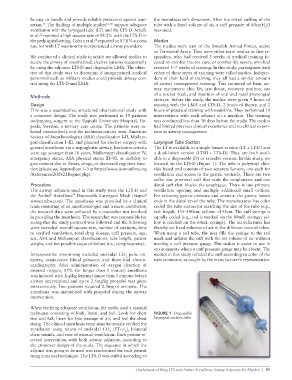
              general anesthesia via a supraglottic airway. Exclusion criteria   The LT is available in a single-lumen version (LT + LT-D) and
              were age younger than 18 years, Mallampati classification IV,   a dual-lumen version (LTSII + LTS-D). They are both avail-
              emergency status, ASA physical status III–VI, or inability to   able in a disposable (D) or reusable version. In this study, we
              give consent due to illness, drugs, or decreased cognitive func-  focused on the LTS-D (Figure 1). The tube is polyvinyl chlo-
              tion (please see Appendices 1–3 at https://www.jsomonline.org   ride based and consists of two separate lumens, one each for
              /References/201821Regner.php).                     ventilation and access to the gastric ventricle. There are two
                                                                 cuffs: one proximal cuff that seals the oropharynx and one
              Procedure                                          distal cuff that blocks the esophagus. There is one primary
              The airway adjuncts used in this study were the LTS-D and   ventilation opening and multiple additional small orifices.
              the Ambu  AuraOnce  Disposable Laryngeal Mask (https://  For releasing gastric pressure and content, the gastric lumen
                               ™
                      ®
              www.ambu.com). The anesthesia was provided by a clinical   ends in the distal tip of the tube. The manufacturer has color
              team consisting of an anesthesiologist and a nurse anesthetist;   coded the tube connector matching the size of the tube (e.g.,
              the research data were collected by a researcher not involved   red: length, 155–180cm; yellow: <155cm. The cuff syringe is
              in providing the anesthesia. The researcher was responsible for   equally coded (e.g., red is marked on the 80mlL syringe; yel-
              seeing that the study protocol was followed and the following   low is marked on the 60mL syringe). The manufacturer has
              were recorded: overall success rate, number of attempts, time   thereby set fixed volumes of air to the different sizes of tubes.
              to verified ventilation, total drug dosage, cuff pressure, age,   When using a red tube, the user fills the syringe to the red
              sex, ASA and Mallampati classifications, tube length, patient   mark and inflates the cuff with the set volume of air without
              weight, and the possible cause of failure (i.e., complications).  needing a cuff pressure gauge. This makes it easier to use in
                                                                 environments where a cuff pressure gauge may be absent. The
              Intraoperative monitoring included end-tidal CO pulse ox-  medics in this study inflated the cuff according to color of the
                                                     2,
              imetry, noninvasive blood pressure, and three-lead electro-  tube connector, as taught by the manufacturer’s representative.
              cardiography. After administration of oxygen (fraction of
              inspired oxygen, 85% for longer than 1 minute) anesthesia
              was induced with 1μg/kg fentanyl (more than 5 minutes before
              airway intervention) and up to 2.5mg/kg propofol was given
              intravenously. Two patients required 0.5mg of atropine. The
              anesthesia was maintained with propofol during the airway
              intervention.
              When verifying adequate ventilation, the medic used a manual
              technique consisting of look, listen, and feel: Look for chest   FIGURE 1  Disposable
              rise and fall, listen for free passage of air, and feel the chest   laryngeal suction tube.
              rising. The clinical anesthesia team simultaneously verified the
              ventilation using  return of end-tidal  CO  (ETco ), bilateral
                                              2
                                                     2
              chest sounds, and ease of manual ventilation. Each patient re-
              ceived intervention with both airway adjuncts, according to
              the crossover design of the study. The sequence in which the
              adjunct was going to be used was randomized for each patient
              using a manual technique. The LTS-D was cuffed according to

                                                         Usefulness of King LTS and Ambu AuraOnce Airway Adjuncts for Medics  |  91

