


Page 87 - JSOM Summer 2018
P. 87
reflecting the views of the Department of the Army or the De-  9.  Robinson JB, Smith MP, Gross KR, et al. Battlefield documenta-
              partment of Defense unless otherwise stated. This document   tion of Tactical Combat Casualty Care in Afghanistan. US Army
              was reviewed by the public affairs officer, operational security   Med Dep J. 2016;Apr–Sep:87–94.
              officer, and commander of the 160th Special Operations Avi-  10.  Schauer SG, April MD, Naylor JF, et al. A descriptive analysis of
              ation Regiment, US Army Special Operations Command, and   data from the Department of Defense Joint Trauma System prehos-
                                                                    pital trauma registry. US Army Med Dep J. 2017;Oct–Dec:92–97.
              approved for public release on 8 June 2017.        11.  Kotwal RS, Montgomery HR, Miles EA, et al. Leadership and
                                                                    a casualty response system for eliminating preventable death.
              Disclosure                                            J Trauma Acute Care Surg. 2017;82(6S suppl 1):S9–S15.
              The authors have nothing to disclose.              12.  Owens BD, Kragh JF Jr, Wenke JC, et al. Combat wounds in
                                                                    Operation Iraqi Freedom and Operation Enduring Freedom.
                                                                    J Trauma. 2008;64(2):295–299.
              Author Contributions                               13.  Belmont PJ Jr, McCriskin BJ, Sieg RN, et al. Combat wounds in
              TR abstracted the data, AM provided data analysis, and TR,   Iraq and Afghanistan from 2005 to 2009. J Trauma Acute Care
              KM, BB, ER, JM, and RK wrote and edited the article.  Surg. 2012;73(1):3–12.
                                                                 14.  Eastridge BJ, Mabry RL, Seguin P, et al. Death on the battlefield
              References                                            (2001–2011): implications for the future of combat casualty care.
              1.  US Army Special Operations Command. 160th Special Operations   J Trauma Acute Care Surg. 2012;73(6 Suppl 5):S431–437.
                Aviation Regiment (Airborne). http://www.soc.mil/USASOAC/160th   15.  Mabry RL, Apodaca A, Penrod J, et al. Impact of critical care-
                .html. Accessed 22 November 2017.                   trained flight paramedics on casualty survival during helicopter
              2.  Joint Chiefs of Staff. Joint Publication 4-02. Health Service Sup-  evacuation in the current war in Afghanistan. J Trauma Acute
                port. 26 July 2012. https://fas.org/irp/doddir/dod/jp4_02.pdf. Ac-  Care Surg. 2012;73(2 suppl 1):S32–37.
                cessed 21 January 2018.                          16.  Clarke JE, Davis PR. Medical evacuation and triage of combat ca-
              3.  Kotwal RS, Staudt AM, Trevino JD, et al. A review of casualties   sualties in Helmand Province, Afghanistan: October 2010-April
                transported to Role 2 medical treatment facilities in Afghanistan.   2011. Mil Med. 2012;177(11):1261–1266.
                Mil Med. In press.                               17.  Morrison JJ, Oh J, DuBose JJ, et al. En-route care capability from
              4.  Kotwal RS, Howard JT, Orman JA, et al. The effect of a golden   point of injury impacts mortality after severe wartime injury. Ann
                hour policy on the morbidity and mortality of combat casualties.   Surg. 2013;257(2):330–334.
                JAMA Surg. 2016;151(1):15–24.                    18.  Apodaca A, Olson CM Jr, Bailey J, et al. Performance improve-
              5.  Bellamy RF. The causes of death in conventional land warfare: im-  ment evaluation of forward aeromedical evacuation platforms in
                plications for combat casualty care research. Mil Med. 1984;149   Operation Enduring Freedom. J Trauma Acute Care Surg. 2013;
                (2):55–62.                                          75(2 suppl 2):S157–S163.
              6.  Butler FK Jr, Hagmann J, Butler EG. Tactical Combat Casualty   19.  Maddry JK, Mora AG, Savell S, et al. Combat MEDEVAC: a
                Care in special operations. Mil Med. 1996;161(suppl):3–16.  comparison of care by provider type for en route trauma care in
              7.  Kotwal RS, Montgomery HR, Mechler KK. A prehospital trauma   theater and 30-day patient outcomes. J Trauma Acute Care Surg.
                registry for Tactical Combat Casualty Care. US Army Med Dep J.   2016;81(5 suppl 2):S104–S110.
                2011;Apr–Jun:15–17.
              8.  Kotwal RS, Montgomery HR, Kotwal BM, et al. Eliminating
                preventable death on the battlefield.  Arch Surg. 2011;146(12):
                1350–1358.


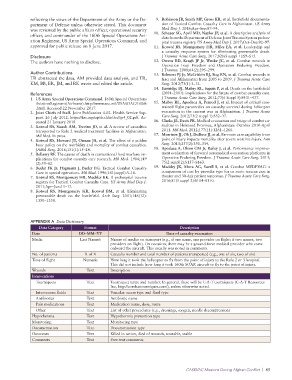
              APPENDIX A  Data Dictionary
                 Data Category      Format                                 Description
              Date                DD–MM–YY                            Date of casualty evacuation
              Medic               Last Name/s  Names of medics on transport (e.g., if one name, one provider on flight; if two names, two
                                               providers on flight). On occasion, there may be a ground-force medical provider who came
                                               onboard the aircraft. This usually was noted in comments.
              No. of patients       X of X     Casualty number and total number of patients transported (e.g., one of six, two of six)
              Time of flight       Numeric     How long it took the helicopter to fly from the point of injury to the Role 2 or 3 hospital.
                                               This did not include how long it took 160th SOAR aircraft to fly to the point of injury.
              Wounds                 Text      Description
              Interventions
                Tourniquets          Text      Tourniquet name and number. In general, these will be C-A-T tourniquets (C-A-T Resources
                                               Inc, http://combattourniquet.com/), unless otherwise noted.
                Intravenous fluids   Text      Vascular access type and fluid type
                Antibiotics          Text      Antibiotic name
                Pain medications     Text      Medication name, dose, route
                Other                Text      List of other procedures (e.g., dressings, oxygen, needle decompression)
              Hypothermia            Text      Hypothermia prevention type
              Monitoring             Text      Monitoring type
              Documentation          Text      Documentation type
              Outcomes               Text      Killed in action, died of wounds, unstable, stable
              Comments               Text      Free-text comments


                                                                              CASEVAC Missions During Afghan Conflict  |  85

