


Page 82 - JSOM Summer 2018
P. 82
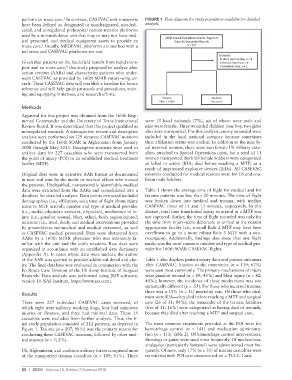
perform en route care.  In contrast, CASEVAC unit transports   FIGURE 1  Flow diagram for study population available for detailed
                           3
          have been defined as designated or nondesignated, nondedi-  analysis.
          cated, and unregulated prehospital patient-transfer platforms
          used by a nonambulance unit that may or may not have med-
          ical personnel and medical equipment assets to provide en
          route care.  Usually, MEDEVAC platforms are marked with a
                  3
          red cross and CASEVAC platforms are not.
          Given that patients on the battlefield benefit from rapid trans-
          port and en route care,  this study proposed to analyze after
                            4
          action reviews (AARs) and characterize patients who under-
          went CASEVAC as provided by 160th SOAR rotary-wing air-
          craft. These CASEVAC data will establish a baseline for future
          reference and will help guide protocols and procedures, train-
          ing and equipping initiatives, and research efforts.

          Methods
          Approval for this project was obtained from the 160th Regi-
          mental Commander and the University of Texas Institutional   were 15 local nationals (7%), six of whom were male and
          Review Board. It was determined that this project qualified as   nine were female. Three wounded children (one boy, two girls)
          nonregulated research. A retrospective review and descriptive   also were transported. For this analysis, enemy wounded were
          analysis were performed on 129 separate CASEVAC missions   included in the local national category because sometimes
          conducted by the 160th SOAR in Afghanistan from January   their affiliation status was unclear. In addition to the nine lo-
          2008 through May 2015. Descriptive statistics were used to   cal national women, there were two female US military casu-
          analyze data for 227 casualties who were transported from   alties attached to Special Operations units, for a total of 11
          the point of injury (POI) to an established medical treatment   women transported. Both US female Soldiers were categorized
          facility (MTF).                                    as killed in action (KIA; died before reaching a MTF) as a
                                                             result of improvised explosive devices (IEDs). All CASEVAC
          Original data were in narrative AAR format as documented   missions conducted for medical reasons were for US and coa-
          in near real time by the medic or medical officer who treated   lition male Soldiers.
          the patients. Unclassified, nonpersonally identifiable medical
          data were extracted from the AARs and consolidated into a   Table 1 shows the average time of flight for medical and for
          database for detailed analysis. Data points extracted included   trauma patients was less than 20 minutes. The time of flight
          demographics (i.e., affiliation, sex); time of flight (from injury   was broken down into medical and trauma, with median
          scene to MTF arrival); number and type of medical provider   CASEVAC times of 11 and 13 minutes, respectively. In this
          (i.e., medic, physician assistant, physician), mechanism of in-  dataset, total time from initial injury to arrival at a MTF was
          jury (i.e., gunshot wound, blast, other), body region injured;   not captured. Rather, the time of flight recorded was only for
          outcome (i.e., lived, died); and medical interventions provided   the time from injury-scene departure to arrival at the nearest
          by ground-force nonmedical and medical personnel, as well   appropriate facility (i.e., a small Role 2 MTF may have been
          as CASEVAC medical personnel. Data were abstracted from   overflown to go to a more robust Role 3 MTF with a neu-
          AARs by a 160th SOAR physician who was intimately fa-  rosurgeon). Additionally, findings also show that one flight
          miliar with the unit and the unit’s missions. Raw data were   medic was the most common number and type of medical pro-
          organized in accordance with an established data dictionary   vider for 160th SOAR CASEVAC flights.
          (Appendix A). In cases where data were unclear, the author
          of the AAR was queried to provide additional detail and clar-  Table 1 also displays patient injury data and patient outcomes
          ity. The final database was evaluated in conjunction with the   after CASEVAC. Injuries to the extremities (n = 139; 67%)
          En Route Care Division of the US Army Institute of Surgical   were seen most commonly. The primary mechanisms of injury
          Research. Data analysis was performed using JMP software,   were gunshot wound (n = 89; 43%) and blast injury (n = 82;
          version 10 (SAS Institute, https://www.sas.com).   40%); however, the incidence of these mechanisms was not
                                                             statistically different (p = .55). For those who incurred trauma,
                                                             there was a 15% (n = 31) mortality rate. Of those who died,
          Results
                                                             most were KIA—they died before reaching a MTF and surgical
          There were 227 individual CASEVAC cases reviewed, of   care (26 of 31; 84%); the remainder of the trauma fatalities
          which eight were military working dogs, four had unknown   (five of 31; 16%) were categorized as having died of wounds,
          injuries  or  illnesses,  and three  had  minimal  data. These  15   because they died after reaching a MTF and surgical care.
          casualties were excluded from further analysis. Thus, the fi-
          nal study population consisted of 212 patients, as depicted in   The most common treatments provided at the POI were for
          Figure 1. Trauma (n = 207; 98%) was the primary reason for   hemorrhage control (n = 141) and medication administra-
          conducting these CASEVAC missions, followed by other med-  tion (n = 113; Table 2). Of hemorrhage control interventions,
          ical reasons (n = 5; 2%).                          dressings or gauze were used most frequently. Of medications,
                                                             analgesics (particularly fentanyl) were administered most fre-
          US, Afghanistan, and coalition military forces comprised most   quently. Of note, only 17% (n = 35) of trauma casualties were
          of the transported trauma casualties (n = 189; 91%). There   transferred with POI care documented on a TCCC Card.


          80  |  JSOM   Volume 18, Edition 2/Summer 2018

