


Page 85 - JSOM Summer 2018
P. 85
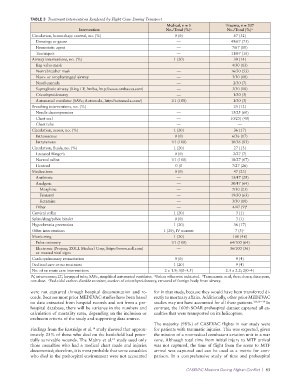
TABLE 3  Treatment Interventions Rendered by Flight Crew During Transport
                                                                      Medical, n = 5          Trauma, n = 207
                                  Intervention                        No./Total (%) a          No./Total (%) a
              Circulation, hemorrhage control, no. (%)                   0 (0)                    67 (32)
                Dressings or gauze                                        —                     49/67 (73)
                Hemostatic agent                                          —                      7/67 (10)
                Tourniquet                                                —                     11/67 (16)
              Airway interventions, no. (%)                              1 (20)                   30 (14)
                Bag-valve-mask                                                                   4/30 (13)
                Nonrebreather mask                                        —                     16/30 (53)
                Naso- or oropharyngeal airway                             —                      3/30 (10)
                Nasal cannula                                             —                      2/30 (7)
                Supraglottic airway (King LT; Ambu, http://www.ambuusa.com)  —                   3/30 (10)
                Cricothyroidotomy                                         —                      1/30 (3)
                Automated ventilator (SAVe; Automedx, http://automedx.com/)  1/1 (100)           1/30 (3)
              Breathing interventions, no. (%)                                                    25 (12)
                Needle decompression                                      —                     15/25 (60)
                Chest seal                                                —                     10/25) (40)
                Chest tube                                                —                        —
              Circulation, access, no. (%)                               1 (20)                   36 (17)
                Intraosseous                                             0 (0)                   6/36 (17)
                Intravenous                                             1/1 (100)               30/36 (83)
              Circulation, fluids, no. (%)                               1 (20)                   27 (13)
                Lactated Ringer’s                                        0 (0)                   2/27 (7)
                Normal saline                                           1/1 (100)               18/27 (67)
                Hextend                                                  0 (0                    7/27 (26)
              Medications                                                0 (0)                    47 (23)
                Antibiotic                                                —                     13/47 (28)
                Analgesic                                                 —                     30/47 (64)
                 Morphine                                                 —                      7/30 (23)
                 Fentanyl                                                 —                     19/30 (63)
                 Ketamine                                                 —                      3/30 (10)
                Other                                                     —                      4/47 (9) b
              Cervical collar                                            1 (20)                   3 (1)
              Splint/sling/pelvic binder                                 0 (0)                    3 (1)
              Hypothermia prevention                                     1 (20)                   36 (17)
              Other interventions                                    1 (20), IV warmer            7 (3)  c
              Monitoring                                                 1 (20)                  100 (48)
                Pulse oximetry                                          1/1 (100)               64/100 (64)
                 Electronic (Propaq; ZOLL Medical Corp, https://www.zoll.com)   —               36/100 (36)
                or manual vital signs
              Cardiopulmonary resuscitation                              0 (0)                    9 (4)
              Declined care or no treatment                              1 (20)                   9 (4)
              No. of en route care interventions                     2 ± 1.9; 3(0–3.5)        2.3 ± 2.2; 2(0–4)
              IV, intravenous; LT, laryngeal tube; SAVe, simplified automated ventilator.   Unless otherwise indicated.   Tranexamic acid, three doses; diazepam,
                                                                                     b
                                                                 a
                     c
              one dose.   End-tidal carbon dioxide monitor, suction of cricothyroidotomy, removal of foreign body from airway.
              were not captured through hospital documentation and re-  for in that study, because they would have been transferred di-
              cords. Because most prior MEDEVAC studies have been based   rectly to mortuary affairs. Additionally, other prior MEDEVAC
              on data extracted from hospital records and not from a pre-  studies may not have accounted for all these patients. 3,4,16-–19  In
              hospital database, there will be variance in the numbers and   contrast, the 160th SOAR prehospital dataset captured all ca-
              calculation of mortality rates, depending on the inclusion or   sualties that were transported on its helicopters.
              exclusion criteria of the study and supporting data source.
                                                                 The majority (98%) of CASEVAC flights in our study were
                                       14
              Findings from the Eastridge et al.  study showed that approx-  for patients with traumatic injuries. This was expected, given
              imately 25% of those who died on the battlefield had poten-  the mission of a nonmedical combatant aviation unit in a war
              tially survivable wounds. The Mabry et al.  study used only   zone. Although total time from initial injury to MTF arrival
                                               15
              those casualties who had a medical chart made and injuries   was not captured, the time of flight from the scene to MTF
              documented; therefore, it is most probable that some casualties   arrival  was  captured  and  can  be  used  as  a  metric  for  com-
              who died in the prehospital environment were not accounted   parison. In a comprehensive study of time and prehospital

                                                                              CASEVAC Missions During Afghan Conflict  |  83

