


Page 74 - JSOM Summer 2018
P. 74
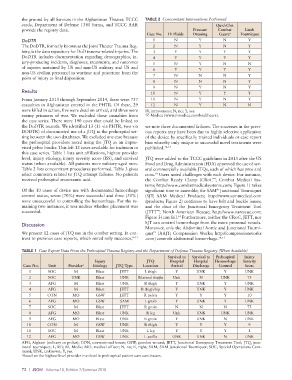
the ground by all Services in the Afghanistan Theater. TCCC   TABLE 2  Concomitant Interventions Performed
          cards, Department of Defense 1380 forms, and TCCC AAR                           QuickClot
          provide the registry data.                                             Pressure   Combat    Limb
                                                              Case No.  IV Fluids  Dressing  Gauze a  Tourniquet
          DoDTR                                                 1        N         Y         N         Y
          The DoDTR, formerly known as the Joint Theater Trauma Reg-  2  N         Y         N         Y
          istry, is the data repository for DoD trauma-related injuries. The   3  Y  Y       Y         Y
          DoDTR includes documentation regarding demographics, in-  4    Y         Y         Y         Y
          jury-producing incidents, diagnoses, treatments, and outcomes   5  N     Y         N         N
          of injuries sustained by US and non-US military and US and   6  Y        Y         Y         Y
          non-US civilian personnel in wartime and peacetime from the
          point of injury to final disposition.                 7        N         N         N         Y
                                                                8        N         N         N         Y
                                                                9        N         Y         N         Y
          Results                                              10        N         Y         Y         Y
          From January 2013 through September 2014, there were 737   11  N         Y         N         Y
          casualties in Afghanistan entered in the PHTR. Of these, 29   12  N      Y         N         N
          were killed in action, five were dead on arrival, and three were   IV, intravenous; N, no; Y, yes.
          enemy prisoners of war. We excluded these casualties from   a Z-Medica (www.z-medica.com/healthcare).
          the case series. There were 190 cases that could be linked to
          the DoDTR records. We identified 13 (11 via PHTR, two via   we note three documented failures. The successes in the previ-
          DODTR) of documented use of a JTQ in the prehospital set-  ous reports may have been due to highly selective application
          ting between the two databases. We excluded one case because   of the device by specifically trained individuals or case report
          the prehospital providers noted using the JTQ as an impro-  bias whereby only unique or successful novel treatments were
          vised pelvic binder. This left 12 cases available for inclusion in   published. 12,13
          this case series. Table 1 lists unit affiliations, highest provider
          level, injury etiology, injury severity score (ISS), and survival   JTQ were added to the TCCC guidelines in 2013 after the US
          status (when available). All patients were military-aged men.   Food and Drug Administration (FDA) approved the use of sev-
          Table 2 lists concomitant procedures performed. Table 3 gives   eral commercially available JTQs, each of which has pros and
          select comments related to JTQ attempt failures. No patients   cons.  Users noted challenges with each device. For instance,
                                                                 14
          received prehospital tranexamic acid.              the Combat Ready Clamp (CRoC ; Combat Medical Sys-
                                                                                         ™
                                                             tems; http://www.combatmedicalsystems.com; Figure 1) takes
          Of the 10 cases of device use with documented hemorrhage   significant time to assemble; the SAM  Junctional Tourniquet
                                                                                          ®
          control status, seven (70%) were successful and three (30%)   (SJT; SAM Medical Products; http://www.sammedical.com
          were unsuccessful in controlling the hemorrhage. For the re-  /products; Figure 2) continues to have belt and buckle issues;
          maining two instances, it was unclear whether placement was   and the discs of the Junctional Emergency Treatment Tool
          successful.                                        (JETT ; North American Rescue; http://www.narescue.com;
                                                                  ™
                                                             Figure 3) can fail.  Furthermore, neither the CRoC, JETT, nor
                                                                           14
          Discussion                                         SJT can control hemorrhage from the more proximal vessels.
                                                             Moreover, only the Abdominal Aortic and Junctional Tourni-
          We present 12 cases of JTQ use in the combat setting. In con-  quet  (AAJT; Compression Works; http://compressionworks
                                                                ™
          trast to previous case reports, which noted only successes, 8–11    .com) controls abdominal hemorrhage. 14,15
          TABLE 1  Case Report Data From the Prehospital Trauma Registry and the Department of Defense Trauma Registry (When Available)
                                                                      Survival to    Survival to    Prehospital    Injury
                                        Injury                JTQ      Hospital   Hospital   Hemorrhage    Severity
           Case No.  Unit    Provider a  Etiology  JTQ Type  Location   Arrival  Discharge  Control   Score
             1       SOC        M        Blast     JETT      L thigh     Y        UNK        Y        UNK
             2       SOC       UNK       Blast     UNK    Bilateral thighs  Unk    N        UNK        75
             3       AFG        M        Blast     UNK       R thigh     Y        UNK        Y        UNK
             4       AFG        M        Blast     JETT    R thigh/hip   Y        UNK        Y        UNK
             5       CON       MO        GSW       JETT     R pelvis     Y         Y         Y         10
             6       AFG       MO        GSW       SAM       L groin     Y        UNK        Y        UNK
             7       SOC        M        Blast     JETT      R groin     N         N         N         75
             8       AFG       MO        Blast     UNK       R leg       Unk      UNK       UNK       UNK
             9       AFG       MO        Blast     UNK       R groin     Y        UNK        N        UNK
            10       CON        M        GSW       UNK       R thigh     Y         Y         Y          9
            11       SOC        M        Blast     UNK        L leg      Y         Y         Y          1
            12       AFG       MO        GSW       UNK       L axilla   UNK       UNK        N        UNK
          AFG, Afghani (military or police); CON, conventional forces; GSW, gunshot wound; JETT, Junctional Emergency Treatment Tool; JTQ, junc-
          tional tourniquet; L, left; M, Medic; MO, medical officer; N, no; R, right; SAM, SAM Junctional Tourniquet; SOC, Special Operations Com-
          mand; UNK, unknown; Y, yes.
          a Based on the highest-level provider involved in prehospital patient care continuum.


          72  |  JSOM   Volume 18, Edition 2/Summer 2018

