


Page 140 - JSOM Summer 2018
P. 140
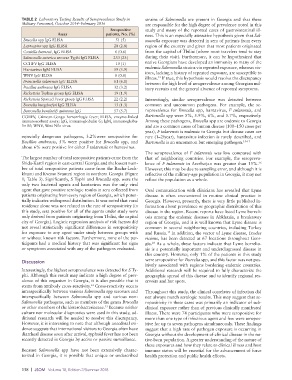
TABLE 2  Laboratory Testing Results of Seroprevalence Study in   strains of  Salmonella are present in Georgia and that these
          Military Personnel, October 2014–February 2016     are responsible for the high degree of prevalence noted in this
                                               Seropositive   study and many of the reported cases of gastrointestinal ill-
                         Assay               patients, No. (%)  ness. This is an especially attractive hypothesis given that Sal-
           Brucella spp IgG ELISA                51 (5)      monella exposure was detected in sera of patients from every
           Leptospira spp IgG ELISA             28 (2.8)     region of the country and given that most patients originated
           Coxiella burnetii, IgG ELISA          6 (0.6)     from the capital of Tbilisi (where most travelers tend to stay
           Salmonella enterica serovar Typhi IgG ELISA  233 (23)   during their visit). Furthermore, it can be hypothesized that
           CCHFV IgG ELISA                       10 (1)      native Georgians have developed an immunity to many of the
           Hantavirus IgM ELISA                 59 (5.9)     endemic Salmonella strains via repeated exposure, whereas vis-
                                                             itors, lacking a history of repeated exposure, are susceptible to
           WNV IgG ELISA                         8 (0.8)     illness.  If true, this hypothesis would resolve the discrepancy
                                                                  14
           Francisella tularensis IgG ELISA     61 (6.1)     between the high level of seroprevalence among Georgian mil-
           Bacillus anthracis IgG ELISA         32 (3.2)     itary recruits and the general absence of reported symptoms.
           Rickettsia Typhus group IgG ELISA    19 (1.9)
           Rickettsia Spotted Fever group IgG ELISA  22 (2.2)  Interestingly, similar seroprevalence was detected between
           Borrelia burgdorferi IgG ELISA       13 (1.3)     common and uncommon pathogens. For example, the se-
           Bartonella henslae/B quintana IgG    57 (5.7)     roprevalence  for  Brucella spp,  hantavirus,  F  tularensis, and
          CCHFV, Crimean-Congo hemorrhagic  fever; ELISA,  enzyme-linked   Bartonella spp were 5%, 5.9%, 6%, and 5.7%, respectively.
          immunosorbent assay; IgG, immunoglobulin G; IgM, immunoglobu-  Among these pathogens, Brucella spp are endemic to Georgia
          lin M; WNV, West Nile virus.                       and are a common cause of human disease (100–150 cases per
                                                             year), F tularensis is endemic to Georgia but disease cases are
          especially dangerous pathogens, 3.2%were seropositive for   rare (1–2/year), hantavirus infection is rarely described, and
          Bacillus  anthracis,  5%  were  positive  for  Brucella  spp, and   Bartonella is an uncommon but emerging pathogen. 15–17
          about 6% were positive for either F tularensis or hantavirus.
                                                             The seroprevalence of  F tularensis  was low compared with
          The largest number of total seropositive patients came from the   that of  neighboring  countries.  For example,  the  seropreva-
          Shida-Kartli region in east-central Georgia and the lowest num-  lence of F tularensis in Azerbaijan was greater than 15%.
                                                                                                            16
          ber of total seropositive patients came from the Racha-Lech-  However, this may be due to sampling error, and although it is
          khumi and Kvemo Svanteti region in northern Georgia (Figure   reflective of the military-age population in Georgia, it may not
          1; Table 3). Significantly, S Typhi and Brucella spp. were the   reflect the population as a whole.
          only two bacterial agents and hantavirus was the only viral
          agent that gave positive serologic results in sera collected from   Oral communication with clinicians has revealed that Lyme
          patients originating from every region of Georgia, which poten-  disease  is  often  encountered  in  routine  clinical  practice  in
          tially indicates widespread distribution. It was noted that rural   Georgia. However, presently, there is very little published in-
          residence alone was not related to the rate of seropositivity (in   formation about prevalence or geographic distribution of this
          this study, sera positive for all of the agents under study were   disease in the region. Recent reports have listed Lyme borreli-
          only derived from patients originating from Tbilisi, the capital   osis among the endemic diseases in Abkhazia, a breakaway
          city of Georgia). Logistic regression analysis of risk factors did   region of Georgia, and it is well known that Lyme disease is
          not reveal statistically significant differences in seropositivity   common in several neighboring countries, including Turkey
          for exposure to any agent under study between groups with   and Russia.  In addition, the vector of Lyme disease, Ixodes
                                                                      17
          or without known risk factors. Furthermore, none of the par-  ricinus, has been detected at 67 locations throughout Geor-
          ticipants had a medical history that was significant for signs   gia.  As a whole, these factors indicate that Lyme borrelio-
                                                                18
          or symptoms associated with any of the pathogens evaluated.  sis is a potentially important and underdiagnosed disease in
                                                             this country. However, only 1% of the patients in this study
          Discussion                                         were seropositive for Borrelia spp, and this factor was not pos-
                                                             itively associated with regions bordering endemic countries.
          Interestingly, the highest seroprevalence was detected for S Ty-  Additional research will be required to fully characterize the
          phi. Although this result may indicate a high degree of prev-  geographic spread of this disease and to identify regional res-
          alence of this organism in Georgia, it is also possible that it   ervoirs and hot spots.
                                       12
          stems from antibody cross-reactivity.  Cross-reactivity occurs
          intraspecifically between various Salmonella spp serovars and   Throughout this study, the clinical correlates of infection did
          interspecifically between  Salmonella spp and various non-   not always match serologic results. This may suggest that se-
          Salmonella pathogens, such as members of the genus Brucella   ropositivity in these cases was primarily an indicator of sub-
          or other members of the Enterobacteriaceae.  Because neither   clinical exposure rather than of previous clinically manifested
                                            13
          culture nor molecular diagnostics were used in this study, ad-  illness. There were 74 participants who were seropositive for
          ditional research will be needed to resolve this discrepancy.   more than one type of infectious agent and few were seropos-
          However, it is interesting to note that although anecdotal evi-  itive for up to seven pathogens simultaneously. These findings
          dence suggests that international visitors to Georgia often have   suggest that a high rate of pathogen exposure is occurring in
          diarrheal disease soon after arrival, typhoid fever has not been   Georgia without the development of clinical disease in the na-
          recently detected in Georgia by active or passive surveillance.  tive-born population. A greater understanding of the nature of
                                                             these exposures and how they relate to clinical illness and host
          Because  Salmonella  spp  have not been extensively charac-  immune status will be essential for the advancement of force
          terized in Georgia, it is possible that unique or undescribed   health protection and public health efforts.


          138  |  JSOM   Volume 18, Edition 2/Summer 2018

