


Page 145 - JSOM Summer 2018
P. 145
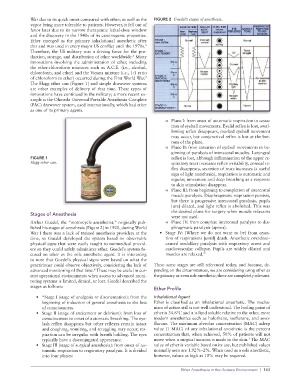
War due to its quick onset compared with ether; as well as the   FIGURE 2  Guedel’s stages of anesthesia.
              vapor being more tolerable to patients. However, it fell out of
              favor later due to its narrow therapeutic lethal-dose window
              and the discovery in the 1940s of its carcinogenic properties.
              Ether emerged as the primary inhalational anesthetic after
              this and was used in every major US conflict until the 1970s.
                                                             5
              Therefore, the US military was a driving force for the pro-
              duction, storage, and distribution of ether worldwide.  Many
                                                        6
              innovations involving the administration  of ether, including
              the ether-chloroform mixtures such as A.C.E. (i.e., alcohol,
              chloroform, and ether) and the Vienna mixture (i.e., 1:3 ratio
              of chloroform to ether) occurred during the First World War.
                                                             7
              The Flagg ether can (Figure 1) and simple drawover systems
              are other examples of delivery of that time. These types of
              innovations have continued in the military; a more recent ex-
              ample is the Ohmeda Universal Portable Anesthesia Complete
              (PAC) drawover system, used internationally, which had ether
              as one of its primary agents.
                                                                        o Plane I: from onset of automatic respiration to cessa-
                                                                        tion of eyeball movements. Eyelid reflex is lost, swal-
                                                                        lowing reflex disappears, marked eyeball movement
                                                                        may occur, but conjunctival reflex is lost at the bot-
                                                                        tom of the plane.
                                                                        o Plane II: from cessation of eyeball movements to be-
                                                                        ginning of paralysis of intercostal muscles. Laryngeal
              FIGURE 1                                                  reflex is lost, although inflammation of the upper re-
              Flagg ether can.                                          spiratory tract increases reflex irritability, corneal re-
                                                                        flex disappears, secretion of tears increases (a useful
                                                                        sign of light anesthesia), respiration is automatic and
                                                                        regular, movement and deep breathing as a response
                                                                        to skin stimulation disappear.
                                                                        o Plane III: from beginning to completion of intercostal
                                                                        muscle paralysis. Diaphragmatic respiration persists,
                                                                        but there is progressive intercostal paralysis, pupils
                                                                        [are] dilated, and light reflex is abolished. This was
                                                                        the desired plane for surgery when muscle relaxants
              Stages of Anesthesia
                                                                        were not used.
              Arthur Guedel, the “motorcycle anesthetist,” originally pub-    o Plane IV: from complete intercostal paralysis to dia-
              lished his stages of anesthesia (Figure 2) in 1920, during World   phragmatic paralysis (apnea).
              War I there was a lack of trained anesthesia providers at the   •  Stage IV: (Where we do not want to be) from cessa-
              time, so Guedel developed the system based on observable   tion of respirations [until] death. Anesthetic overdose–
              physical signs that were easily taught to nonmedical provid-  caused medullary paralysis with respiratory arrest and
              ers so they could safely administer ether. Guedel’s system fo-  cardiovascular  collapse.  Pupils  are  widely  dilated  and
              cused on ether as the sole anesthetic agent. It is interesting   muscles are relaxed.”
              to note that Guedel’s physical signs were based on what the
              practitioner could observe objectively, considering the lack of   These same stages are still referenced today, and because, de-
              advanced monitoring of that time.  These may be useful in cur-  pending on the circumstances, we are considering using ether as
                                        8
              rent operational environments when access to advanced moni-  the primary or even sole anesthetic, these are completely relevant.
              toring systems is limited, denied, or lost. Guedel described the
              stages as follows:
                                                                 Ether Profile
                •  “Stage I (stage of analgesia or disorientation): from the   Inhalational Agent
                  beginning of induction of general anesthesia to the loss   Ether is classified as an inhalational anesthetic. The mecha-
                  of consciousness.                              nism of action still is not well understood. The boiling point of
                •  Stage II (stage of excitement or delirium): from loss of   ether is 34.6°C and it is lipid soluble relative to the other, more
                  consciousness to onset of automatic breathing. The eye-  modern anesthetics such as halothane, isoflurane, and sevo-
                  lash reflex disappears but other reflexes remain intact   flurane. The minimum alveolar concentration (MAC) asleep
                  and coughing, vomiting, and struggling may occur; res-  value (1 MAC) of any inhalational anesthetic is the percent
                  piration can be irregular with breath holding. The eyes   concentration that, when achieved, 50% of patients will not
                                                                                                        1
                  typically have a disconjugated appearance.     move when a surgical incision is made in the skin.  The MAC
                •  Stage III (stage of surgical anesthesia): from onset of au-  value of ether is variable based on its use, but published values
                  tomatic respiration to respiratory paralysis. It is divided   normally seen are 1.92%–2%. When used as a sole anesthetic,
                  into four planes:                              however, values as high as 10% may be required.

                                                                            Ether Anesthesia in the Austere Environment  |  143

