


Page 147 - JSOM Summer 2018
P. 147
nose. A jar of ether and a Bellamy dropper (Figure 4) in the
              jar are required, or the provider may create one by cutting two
              opposing vents in a cork and placing a rolled piece of gauze
              to drop ether from the jar onto the gauze of the mask. This
              is the most primitive and the least resource-intensive method
              of ether administration.  The method requires moistening the
                                11
              mask but not to the point of complete saturation. This method
              is referenced  in the first Special  Forces medical handbook
              printed in 1981 and is well demonstrated in a 1944 British
              training video “Open Drop Ether, Part 1”  and Part 2.  Ether,   FIGURE 5
                                                        13
                                              12
              due to its high lipid solubility relative to the newer anesthet-  Homemade
              ics, has a long uptake time for induction to a stage III level   ether jar.
              and may take 10–15 minutes to achieve. Patient monitoring
              focuses on Guedel’s physical signs to maintain the patient in
              a stage III, plane III level until the procedure is complete. No
              matter what method is used, the stage II level, during induc-                                       Courtesy of Christie Morgans Photography.
              tion  and  emergence,  will  be  the  most  difficult  and  also  the
              most dangerous. Vigilance is key here. The dangers of stage II
              reside in the hyperactive response of the patient, especially the
              airway (e.g., laryngospasm). Of the five senses, the last to go
              to sleep and first to wake up is hearing. If possible, avoiding
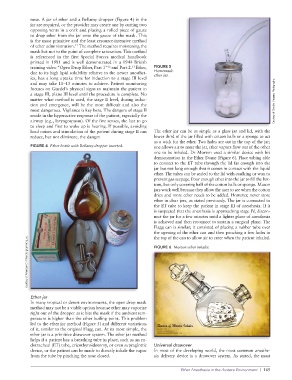
              loud noises and stimulation of the patient during stage II can   The ether jar can be as simple as a glass jar and lid, with the
              reduce, but not eliminate, the danger.             lower third of the jar filled with cotton balls or a sponge to act
                                                                 as a wick for the ether. Two holes are cut in the top of the jar;
              FIGURE 4  Ether bottle with Bellamy dropper inserted.  one allows air to enter the jar, ether vapors flow out of the other
                                                                 one to be inhaled. Dr Morton used a similar device with his
                                                                 demonstration in the Ether Dome (Figure 6). Place tubing able
                                                                 to connect to the ET tube through the lid far enough into the
                                                                 jar but not long enough that it comes in contact with the liquid
                                                                 ether. The tubes can be sealed to the lid with caulking or wax to
                                                                 prevent gas seepage. Pour enough ether into the jar to fill the bot-
                                                                 tom, but only covering half of the cotton balls or sponge. Mason
                                                                 jars work well because they allow the user to see when the cotton
                                                                 dries and more ether needs to be added. However, never store
                                                                 ether in clear jars, as stated previously. The jar is connected to
                                                                 the ET tube to keep the patient in stage III of anesthesia. If it
                                                                 is suspected that the anesthesia is approaching stage IV, discon-
                                                                 nect the jar for a few minutes until a lighter plane of anesthesia
                                                                 is achieved and then reconnect to sustain a surgical plane. The
                                                                 Flagg can is similar; it consisted of placing a rubber tube over
                                                                 the opening of the ether can and then punching a few holes in
                                                                 the top of the can to allow air to enter when the patient inhaled.
            Courtesy of American Civil War Surgical Antiques.
                                                                 FIGURE 6  Morton ether inhaler.


              Ether jar
              In many tropical or desert environments, the open drop mask
              method may not be a viable option because ether may vaporize
              right out of the dropper as it hits the mask if the ambient tem-
              perature is higher than the ether boiling point. This problem
              led to the ether jar method (Figure 5) and different variations
              of it, similar to the original Flagg can. At its most simple, the
              ether jar is a primitive drawover system. The ether jar method
              helps if a patient has a breathing tube in place, such as an en-
              dotracheal (ET) tube, cricothyroidotomy, or even supraglottic   Universal drawover
              device, or the patient can be made to directly inhale the vapor   In  most of the  developing  world, the most common anesthe-
              from the tube by pinching the nose closed.         sia  delivery  device  is  a  drawover  system.  As  stated,  the  most

                                                                            Ether Anesthesia in the Austere Environment  |  145

