


Page 146 - JSOM Summer 2018
P. 146
Ether, like any drug, has both pros and cons associated with its   support a population of 60 million people, whereas Uganda
          use. The major drawback with ether has always been its high   had 13 anesthesiologists and 330 other anesthesia providers
          flammability, which led to the preferred use of the newer inha-  supporting a population of 27 million. 10
          lational anesthetics (e.g., halothane, isoflurane, sevoflurane).
                                                         5
          Ether burns clear; if ignited, it produces invisible flames.    Cost and Training
                                                         9
          Hence, ether’s production and storage remain major concerns.   The lack of funding available in developing countries often rules
          It is not recommended in any situation that you try to create   out the availability of advanced inhalational anesthetics, com-
          your own ether: Just say no to such YouTube videos. Ether is   plicated vaporizer machines that require supplemental air flow,
          heavier than air and will settle on and travel across the ground,   and expensive monitoring modalities common in the developed
          possibly finding an ignition source, such as open flame or elec-  world. This leads to less complicated and less expensive dra-
          tric cautery.  Ether reacts to light, which causes the formation   wover vaporizer systems. Therefore, the less expensive inhala-
                   9
          of peroxide crystals over time that are highly volatile and ex-  tional anesthetics that are also drawover capable are ether and
          plosive. Therefore, ether originally was stored in tin cans and,   halothane. A liter of halothane costs $140, whereas the same
          later, in dark amber jars to prevent the peroxide crystal forma-  amount of ether costs $10.  Halothane and ether can be deliv-
                                                                                  2
          tion.  Ether’s high lipid solubility leads to a slow uptake; it may   ered through a simple drawover; however, halothane depresses
              6
          take 10–15 minutes to induce anesthesia in a patient using an   cardiac output and respiratory drive, and so requires supple-
          open drop mask method and will take longer to wear off, espe-  mental oxygen and advanced cardiac monitoring to be delivered
          cially the longer the patient is under ether anesthesia. Ether has   safely. In most developing areas, these tools will not be present.
          a high incidence of nausea and vomiting, even during Guedel’s   New recommendations for the widespread distribution and use
          stage II. Ether is pungent and irritates the airway, which may   of ether in the developing world to decrease cost and increase
          cause excessive secretions requiring pretreatment with atropine   safety improve the probability of finding ether in these areas.
          or glycopyrrolate, when possible.
                                                             Practice
          The advantages of ether include its safe delivery in less-experi-
          enced hands; measurable anesthesia levels (i.e., Guedel’s stages   Before  performing anesthesia  or  sedation  with ether, good
          of anesthesia); ease of delivery (e.g., open drop mask method,   preparation is required. Patient monitoring concerns are al-
          ether jar); bronchodilation; stimulation of respirations, sym-  ways present. The MSMAID mnemonic—machine, suction,
          pathomimetic, and analgesic; and the fact that it is a complete   monitors, airway, intravenous, drugs—should be followed as
          anesthetic.  Ether stimulates the sympathetic nervous system   much as possible, even in austere environments. Machine, in
                  2
          much like ketamine, which maintains blood pressure and heart   this case, is the mask or, hopefully, a way to give a positive
          rate even at much deeper stages of anesthesia. Thus, ether has a   pressure breath. Suction may be as simple as a turkey baster
          safe profile: Apnea occurs long before cardiovascular collapse.   to remove secretions from the airway, which are associated
          Chloroform, on the other hand, is characterized by apnea and   with the adverse effects of nausea and vomiting associated
          cardiovascular collapse occurring in rapid succession; this led   with ether use. Monitors are important as well. A pulse ox-
          to chloroform falling out of favor due to many reported anes-  imeter, if available, is vital; however, never forget that the
          thetic deaths. The fact that ether causes respiratory stimulation   most important monitor is you, the provider, and your ob-
          and bronchodilation, while not optimal, allows for the safe ad-  servation of the physical signs described by Guedel. Airway
          ministration of ether without supplemental oxygen. 2  supplies range from the simplest to more advanced, and
                                                             intravenous or interosseous access is suggested, if possible.
          Ether by itself provides analgesia, during and, for a time, after   Useful drugs, in addition to ether, include antinausea drugs
          the ether delivery has been completed. Finally, ether provides   such as ondansetron, and antisialagogues such as atropine or
          muscle relaxation for surgical procedures, especially at the   glycopyrolate.
          stage III, plane III level. The amnesia, analgesia, and muscle re-
          laxation that ether provides while maintaining cardiovascular   Methods of Delivery
          stability led to ether being referred to as a complete anesthetic.
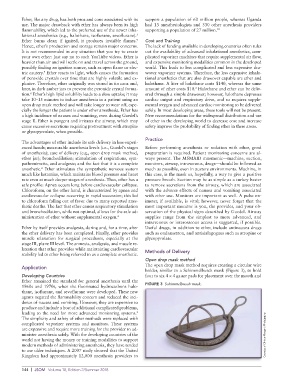
                                                             Open drop mask method
                                                             The open drop mask method requires creating a circular wire
          Application
                                                             holder, similar to a Schimmelbusch mask (Figure 3), to hold
          Developing Countries                               four to six 4 × 4 gauze pads for placement over the mouth and
          Ether remained the standard for general anesthesia until the
          1960s and  1970s, when  the fluorinated hydrocarbons  halo-  FIGURE 3  Schimmelbusch mask.
          thane, isoflurane, and sevoflurane were developed. These new
          agents negated the flammability concern and reduced the inci-
          dence of nausea and vomiting. However, they are expensive to
          produce and include a host of additional complicated problems,
          leading to the need for more advanced monitoring systems.
                                                         2
          The simplicity and safety of ether methods were replaced with
          complicated vaporizer systems and monitors. These systems
          are expensive and require more training for the provider to ad-
          minister anesthesia safely. With the developing countries of the                                     Courtesy of Christie Morgans Photography.
          world not having the money or training modalities to support
          modern methods of administering anesthesia, they have tended
          to use older techniques. A 2007 study showed that the United
          Kingdom had approximately 12,000 anesthesia providers to


          144  |  JSOM   Volume 18, Edition 2/Summer 2018

