


Page 139 - JSOM Summer 2018
P. 139
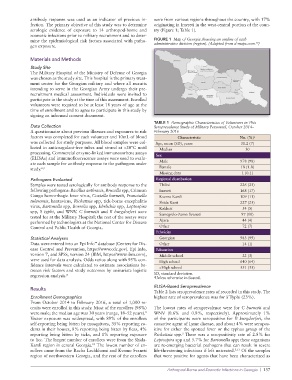
antibody  response  was  used  as an  indicator  of  previous  in-  were from various regions throughout the country, with 17%
              fection. The primary objective of this study was to determine   originating in Imereti in the west-central portion of the coun-
              serologic evidence of exposure to 14 arthropod-borne and   try (Figure 1; Table 1).
              zoonotic infections prior to military recruitment and to deter-
              mine the epidemiological risk factors associated with patho-  FIGURE 1  Map of Georgia showing an outline of each   10
              gen exposure.                                      administrative division (region). (Adapted from d-maps.com. )

              Materials and Methods

              Study Site
              The Military Hospital of the Ministry of Defense of Georgia
              was chosen as the study site. This hospital is the primary treat-
              ment center for the Georgian military and where all recruits
              intending to serve in the Georgian Army undergo their pre-
              recruitment medical assessment. Individuals were invited to
              participate in the study at the time of this assessment. Enrolled
              volunteers were required to be at least 18 years of age at the
              time of enrollment and to agree to participate in this study by
              signing an informed consent document.
                                                                 TABLE 1  Demographic Characteristics of Volunteers in This
              Data Collection                                    Seroprevalence Study of Military Personnel, October 2014–
              A questionnaire about previous illnesses and exposures to risk   February 2016
              factors was completed for each volunteer and 10mL of blood   Characteristic           No. (%) a
              was collected for study purposes. All blood samples were col-  Age, mean (SD), years  31.2 (7)
              lected in anticoagulant-free tubes and stored at −20°C until     Median                 30
              processing. Commercial enzyme-linked immunosorbent assays
              (ELISAs) and immunofluorescence assays were used to evalu-  Sex
              ate each sample for antibody response to the pathogens under     Male                 978 (98)
              study. 6,7                                           Female                           18 (1.8)
                                                                   Missing data                      1 (0.1)
              Pathogens Evaluated                                 Regional distribution
              Samples were tested serologically for antibody response to the     Tbilisi            226 (23)
              following pathogens: Bacillus anthracis, Brucella spp, Crimean     Imereti            168 (17)
              Congo hemorrhagic fever virus, Coxiella burnetii, Francisella     Kvemo Kartli        109 (11)
              tularensis, hantavirus, Rickettsia spp, tick-borne encephalitis     Shida Karti       227 (23)
              virus, Bartonella spp, Borrelia spp, Ehrlichia spp, Leptospira     Kakheti             54 (5)
              spp, S typhi, and WNV. C burnetii and B burgdorferi were
              tested for at the Military Hospital; the rest of the assays were     Samegrelo-Zemo Svaneti  97 (10)
              performed by technologists at the National Center for Disease     Ajara                44 (4)
              Control and Public Health of Georgia.                Other                             72 (7)
                                                                 Ethnicity
              Statistical Analyses                                 Georgian                         983 (99)
              Data were entered into an Epi Info  database (Centers for Dis-    Other                14 (1)
                                        ™
              ease Control and Prevention, https://www.cdc.gov). Epi Info,   Education
              version 7, and SPSS, version 24 (IBM, https://www.ibm.com),     Middle school          22 (3)
              were used for data analysis. Odds ratios along with 95% con-    High school           640 (64)
              fidence intervals were calculated to estimate associations be-
              tween risk factors and study outcomes by univariate logistic     >High school         331 (33)
              regression analysis. 8                             SD, standard deviation.
                                                                 Unless otherwise indicated.
                                                                 a
              Results                                            ELISA-Based Seroprevalence
                                                                 Table 2 lists seroprevalence rates of recorded in this study. The
              Enrollment Demographics                            highest rate of seroprevalence was for S Typhi (23%).
              From October 2014 to February 2016, a total of 1,000 re-
              cruits were enrolled in this study. Most of the enrollees (98%)   The lowest rates of seroprevalence were for  C burnetii and
              were male; the median age was 30 years (range, 18–52 years).    WNV (0.6% and 0.8%, respectively). Approximately 1%
                                                             9
              Vector exposure was widespread, with 89% of the enrollees   of the participants were seropositive for  B burgdorferi, the
              self-reporting being bitten by mosquitoes, 35% reporting ro-  causative agent of Lyme disease, and about 4% were seropos-
              dents in their houses, 8% reporting being bitten by fleas, 4%   itive for either the spotted fever or the typhus group of the
              reporting being bitten by ticks, and 1% reporting exposure   Rickettsia spp.  There was a seropositivity rate of 2.8% for
                                                                            3
              to lice. The largest number of enrollees were from the Shida-   Leptospira spp and 5.7% for Bartonella spp; these organisms
              Kartli region in central Georgia.  The lowest number of en-  are re-emerging bacterial pathogens that can result in severe
                                       10
              rollees came from the Racha Lechkhumi and Kvemo Svaneti   life-threatening infections if left untreated. 3,11  Of the samples
              region of northwestern Georgia, and the rest of the enrollees   that were positive for agents that have been characterized as

                                                                      Arthropod-Borne and Zoonotic Infections in Georgia  |  137

