


Page 135 - JSOM Summer 2018
P. 135
What’s in a Rash? Viral Exanthem Versus CBRNE Exposure

                              Teleconsultation Support for Two Special Forces Soldiers
                                     With Diffuse Rash in an Austere Environment


                      Howard D. Lee, MD *; Samuel Butterfield ; Joseph Maddry, MD ; Doug Powell, MD ;
                                                                                    3
                                                              2
                                                                                                       4
                                         1
                                                              6
                                           5
                     William Vasios, APA-C ; Heather Yun, MD ; David Ferraro, MD ; Jeremy Pamplin, MD   8
                                                                                  7


              Objective: Review clinical thought process and key principles   animal excrement. Neither had contact with each other before
              for diagnosing weaponized chemical and biologic injuries.   presentation and both had completed their mission within 24
                                                                 hours before presenting. They both slept in the same living
              Clinical Context: Special Operation Forces (SOF) team de-  conditions while on mission, which consisted of sleeping under
              ployed in an undisclosed, austere environment.     a mosquito net in an abandoned military building, in extreme
                                                                 heat, complicated by sandy and dusty conditions, without run-
              Organic Expertise: Two SOF Soldiers with civilian EMT-Basic   ning water. Both patients had consumed local food and had
              certification.                                     occasional contact with the local population.

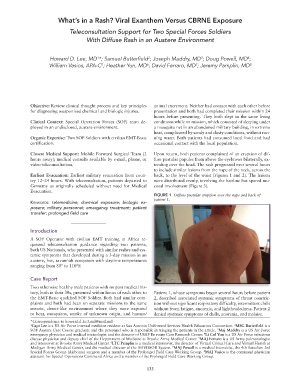
              Closest Medical Support: Mobile Forward Surgical Team (2   Upon return, both patients complained of an eruption of dif-
              hours away); medical consults available by e-mail, phone, or   fuse pustular papules from above the eyebrows bilaterally, ex-
              video-teleconsultation.                            tending over the head. The rash progressed over several hours
                                                                 to include similar lesions from the nape of the neck, across the
              Earliest Evacuation: Earliest military evacuation from coun-  back, to the level of the waist (Figures 1 and 2). The lesions
              try 12–24 hours. With teleconsultation, patients departed to   were distributed evenly, involving the hairline but spared mu-
              Germany as originally scheduled without need for Medical   cosal involvement (Figure 3).
              Evacuation.
                                                                 FIGURE 1  Diffuse pustular eruption over the nape and back of
                                                                 patient 1.
              Keywords: telemedicine; chemical exposure; biologic ex-
              posure; military personnel; emergency treatment; patient
              transfer; prolonged field care


              Introduction
              A  SOF Operator with  civilian  EMT  training in  Africa  re-
              quested teleconsultation guidance regarding two patients,
              both US Nationals, who presented with similar rashes and sys-
              temic symptoms that developed during a 3-day mission in an
              austere, hot, savannah ecosystem with daytime temperatures
              ranging from 80° to 110°F.

              Case Report
              Two otherwise healthy male patients with no past medical his-
              tory, both in their 30s, presented within hours of each other to   Patient 1, whose symptoms began several hours before patient
              the EMT-Basic qualified SOF Soldier. Both had similar com-  2, described associated systemic symptoms of throat constric-
              plaints and both had been on separate missions to the same   tion without significant respiratory difficulty, intermittent chills
              remote, desert-like environment where they were exposed   without fever, fatigue, anorexia, and lightheadedness. Patient 2
              to heat, mosquitos, smoke of unknown origin, and human/  denied systemic symptoms of chills, anorexia, and malaise.
              *Correspondence to howard.d.lee3.mil@mail.mil
                                                                                                  2
              1 Capt Lee is a US Air Force internal medicine resident at San Antonio Uniformed Services Health Education Consortium.  MSG Butterfield is a
                                                                                           3
              SOF Austere Care Course graduate and the personnel who is responsible in triaging the patients in the article.  Maj Maddry is a US Air Force
              emergency physician and medical toxicologist and the director of USAF En route Care Research Center.  Lt Col Yun is a US Air Force infectious
                                                                                     4
              disease physician and deputy chief of the Department of Medicine at Brooke Army Medical Center.  MAJ Ferraro is a US Army pulmonologist
                                                                                   5
                                               6
              and intensivist at Brooke Army Medical Center.  LTC Pamplin is a medical intensivist, the director of Virtual Critical Care and Virtual Health at
                                                                        7
              Madigan Army Medical Center, and the medical director of the ADVISSOR System.  MAJ Powell is a medical intensivist, the 4th Battalion 3rd
                                                                                     8
              Special Forces Group (Airborne) surgeon and a member of the Prolonged Field Care Working Group.  MAJ Vasios is the command physician
              assistant for Special Operations Command Africa and a member of the Prolonged Field Care Working Group.
                                                              133

