


Page 78 - Journal of Special Operations Medicine - Fall 2017
P. 78
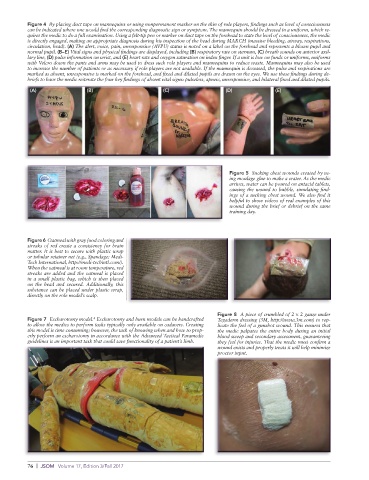
Figure 4  By placing duct tape on mannequins or using nonpermanent marker on the skin of role players, findings such as level of consciousness
          can be indicated where one would find the corresponding diagnostic sign or symptom. The mannequin should be dressed in a uniform, which re-
          quires the medic to do a full examination. Using a felt-tip pen or marker on duct tape on the forehead to state the level of consciousness, the medic
          is directly engaged, making an appropriate diagnosis during his inspection of the head during MARCH (massive bleeding, airway, respirations,
          circulation, head). (A) The alert, voice, pain, unresponsive (AVPU) status is noted on a label on the forehead and represents a blown pupil and
          normal pupil. (B–E) Vital signs and physical findings are displayed, including (B) respiratory rate on sternum, (C) breath sounds on anterior axil-
          lary line, (D) pulse information on wrist, and (E) heart rate and oxygen saturation on index finger. If a unit is low on funds or uniforms, uniforms
          with Velcro down the pants and arms may be used to dress such role players and mannequins to reduce waste. Mannequins may also be used
          to increase the number of patients or as necessary if role players are not available. If the mannequin is deceased, the pulse and respirations are
          marked as absent, unresponsive is marked on the forehead, and fixed and dilated pupils are drawn on the eyes. We use these findings during de-
          briefs to have the medic reiterate the four key findings of absent vital signs: pulseless, apneic, unresponsive, and bilateral fixed and dilated pupils.
           (A)               (B)                      (C)                  (D)             (E)


                                                                            Figure 5  Sucking chest wounds created by us-
                                                                            ing moulage glue to make a crater. As the medic
                                                                            arrives, water can be poured on antacid tablets,
                                                                            causing the wound to bubble, simulating find-
                                                                            ings of a sucking chest wound. We also find it
                                                                            helpful to show videos of real examples of this
                                                                            wound during the brief or debrief on the same
                                                                            training day.


          Figure 6  Oatmeal with gray food coloring and
          streaks of red create a consistency for brain
          matter. It is best to secure with plastic wrap
          or  tubular retainer net (e.g., Spandage; Medi-
          Tech International, http://medi-techintl.com/).
          When the oatmeal is at room temperature, red
          streaks are added and the oatmeal is placed
          in a small plastic bag, which is then placed
          on the head and secured. Additionally, this
          substance can be placed under plastic wrap,
          directly on the role model’s scalp.


                                                                        Figure 8  A piece of crumbled of 2 × 2 gauze under
          Figure 7  Escharotomy model.  Escharotomy and burn models can be handcrafted   Tegaderm dressing (3M, http://www.3m.com) to rep-
                                4
          to allow the medics to perform tasks typically only available on cadavers. Creating   licate the feel of a gunshot wound. This ensures that
          this model is time consuming; however, the task of knowing when and how to prop-  the medic palpates the entire body during an initial
          erly perform an escharotomy in accordance with the Advanced Tactical Paramedic   blood sweep and secondary assessment, guaranteeing
          guidelines is an important task that could save functionality of a patient’s limb.  they feel for injuries. That the medic must confirm a
                                                                        wound exists and properly treats it will help minimize
                                                                        proctor input.


          76  |  JSOM   Volume 17, Edition 3/Fall 2017

