


Page 79 - Journal of Special Operations Medicine - Fall 2017
P. 79
SKILLS
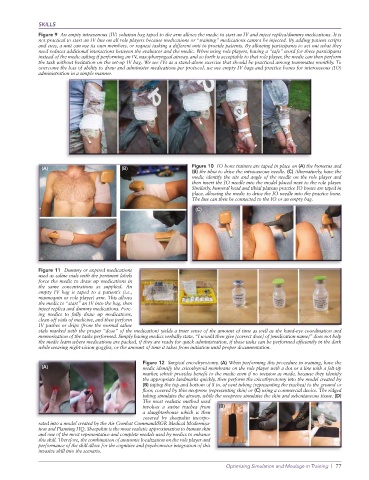
              Figure 9  An empty intravenous (IV) solution bag taped to the arm allows the medic to start an IV and inject replica/dummy medications. It is
              not practical to start an IV line on all role players because medications or “training” medications cannot be injected. By adding patient scripts
              and cues, a unit can use its own members, or request tasking a different unit to provide patients. By allowing participants to act out what they
              need reduces additional interactions between the evaluator and the medic. When using role players, having a “safe” word for these participants
              instead of the medic asking if performing an IV, nasopharyngeal airway, and so forth is acceptable to that role player, the medic can then perform
              the task without hesitation on the set-up IV bag. We see IVs as a stand-alone exercise that should be practiced among teammates monthly. To
              overcome the loss of ability to draw and administer medications per protocol, we use empty IV bags and practice bones for interosseous (IO)
              administration in a simple manner.


                                                                Figure 10  IO bone trainers are taped in place on (A) the humerus and
               (A)                       (B)
                                                                (B) the tibia to drive the intraosseous needle. (C) Alternatively, have the
                                                                medic identify the site and angle of the needle on the role player and
                                                                then insert the IO needle into the model placed next to the role player.
                                                                Similarly, humeral head and tibial plateau practice IO bones are taped in
                                                                place, allowing the medic to drive the IO needle into the practice bone.
                                                                The line can then be connected to the IO or an empty bag.
                                                                 (C)


              Figure 11  Dummy or expired medications
              used as saline vials with the pertinent labels
              force the medic to draw up medications in
              the same concentrations as supplied. An
              empty IV bag is taped to a patient’s (i.e.,
              mannequin or role player) arm. This allows
              the medic to “start” an IV into the bag, then
              inject replica and dummy medications. Forc-
              ing medics to fully draw up medications,
              clean off vials of medicine, and then perform
              IV pushes or drips (from the normal saline
              vials marked with the proper “dose” of the medication) yields a truer sense of the amount of time as well as the hand-eye coordination and
              memorization of the tasks performed. Simply having medics verbally state, “I would then give [correct dose] of [medication name]” does not help
              the medic learn where medications are packed, if they are ready for quick administration, if these tasks can be performed efficiently in the dark
              while wearing night-vision goggles, or the amount of time it takes from initiation until proper documentation.

                                                Figure 12  Surgical cricothyrotomy. (A) When performing this procedure in training, have the
               (A)                              medic identify the cricothyroid membrane on the role player with a dot or a line with a felt-tip
                                                marker, which provides benefit to the medic even if no incision as made, because they identify
                                                the appropriate landmarks quickly, then perform the cricothyrotomy into the model created by
                                                (B) taping the top and bottom of 8 in. of vent tubing (representing the trachea) to the ground or
                                                floor, covered by thin neoprene (representing skin) or (C) using a commercial device. The ridged
                                                tubing simulates the airway, while the neoprene simulates the skin and subcutaneous tissue. (D)
                                                The most realistic method used
                                                involves a swine trachea from   (B)
                                                a slaughterhouse which is then
                                                covered by sheepskin incorpo-
              rated into a model created by the Air Combat Command/SGR Medical Moderniza-
              tion and Planning HQ. Sheepskin is the most realistic approximation to human skin
              and one of the most representative and complete models used by medics to enhance
              this skill. Therefore, the combination of anatomic localization on the role player and
              performance of the skill allow for the cognitive and psychomotor integration of this
              invasive skill into the scenario.

                                                                           Optimizing Simulation and Moulage in Training  |  77

