


Page 81 - Journal of Special Operations Medicine - Fall 2017
P. 81
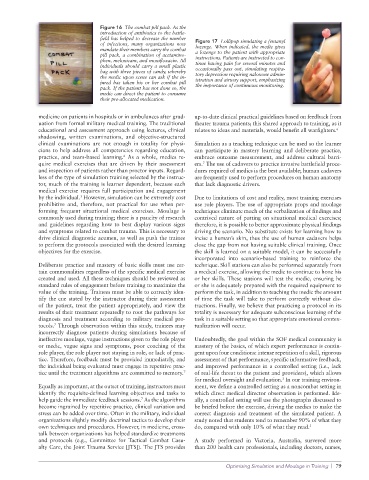
Figure 16  The combat pill pack. As the
                                  introduction of antibiotics to the battle-
                                  field has helped to decrease the number   Figure 17  Lollipop simulating a fent anyl
                                  of infections, many organizations now   lozenge. When indicated, the medic gives
                                  mandate their members carry the combat   a lozenge to the patient with appropriate
                                  pill pack, a combination of acetamino-  instructions. Patients are instructed to con-
                                  phen, meloxicam, and moxifloxacin. All   tinue having pain for several minutes and
                                  individuals should carry a small plastic   occasionally pass out, simulating respira-
                                  bag with three pieces of candy, whereby   tory depression requiring naloxone admin-
                                  the medic upon scene can ask if the in-  istration and airway support, emphasizing
                                  jured has taken his or her combat pill   the importance of continuous monitoring.
                                  pack. If the patient has not done so, the
                                  medic can direct the patient to consume
                                  their pre-allocated medication.

                medicine on patients in hospitals or in ambulances after grad-  up-to-date clinical practical guidelines based on feedback from
              uation from formal military medical training. The traditional   theater trauma patients; this shared approach to training, as it
              educational and assessment approach using lectures, clinical   relates to ideas and materials, would benefit all warfighters. 6
              shadowing,  written  examinations,  and  objective-structured
              clinical examinations are not enough in totality for physi-  Simulation as a teaching technique can be used so the learner
              cians to help address all competencies regarding education,   can participate in mastery learning and deliberate practice,
                                         6
              practice, and team-based learning.  As a whole, medics re-  embrace outcome measurement, and address cultural barri-
              quire medical exercises that are driven by their assessment   ers.  The use of cadavers to practice invasive battlefield proce-
                                                                   7
              and inspection of patients rather than proctor inputs. Regard-  dures required of medics is the best available; human cadavers
              less of the type of simulation training selected by the instruc-  are frequently used to perform procedures on human anatomy
              tor, much of the training is learner dependent, because each   that lack diagnostic drivers.
              medical exercise requires full participation and engagement
                           3
              by the individual.  However, simulation can be extremely cost   Due to limitations of cost and reality, most training exercises
              prohibitive and, therefore, not practical for use when per-  use role players. The use of appropriate props and moulage
              forming frequent situational medical exercises. Moulage is   techniques eliminate much of the verbalization of findings and
              commonly used during training; there is a paucity of research   contrived nature of putting on situational medical exercises;
              and guidelines regarding how to best display various signs   therefore, it is possible to better approximate physical findings
              and symptoms related to combat trauma. This is necessary to   driving the scenario. No substitute exists for learning how to
              drive clinical diagnostic acumen, as well as push the trainee   incise a human’s skin, thus the use of human cadavers helps
              to perform the protocols associated with the desired learning   close the gap from not having suitable clinical training. Once
              objectives for the exercise.                       the skill is learned on a suitable model, it can be successfully
                                                                 incorporated into scenario-based training to reinforce the
              Deliberate practice and mastery of basic skills must use cer-  technique. Skill stations can also be performed separately from
              tain commonalities regardless of the specific medical exercise   a medical exercise, allowing the medic to continue to hone his
              created and used. All these techniques should be reviewed as   or her skills. These stations will test the medic, ensuring he
              standard rules of engagement before training to maximize the   or she is adequately prepared with the required equipment to
              value of the training. Trainees must be able to correctly iden-  perform the task, in addition to teaching the medic the amount
              tify the cue stated by the instructor during their assessment   of time the task will take to perform correctly without dis-
              of the patient, treat the patient appropriately, and view the   tractions. Finally, we believe that practicing a protocol in its
              results of their treatment repeatedly to root the pathways for   totality is necessary for adequate subconscious learning of the
              diagnosis and treatment according to military medical pro-  task in a suitable setting so that appropriate emotional contex-
              tocols.  Through observation within this study, trainees may   tualization will occur.
                   7
              incorrectly diagnose patients during simulations because of
              ineffective moulage, vague instructions given to the role player   Undoubtedly, the goal within the SOF medical community is
              or medic, vague signs and symptoms, poor coaching of the   mastery of the basics, of which expert performance is contin-
              role player, the role player not staying in role, or lack of prac-  gent upon four conditions: intense repetition of a skill, rigorous
              tice. Therefore, feedback must be provided immediately, and   assessment of that performance, specific informative feedback,
              the individual being evaluated must engage in repetitive prac-  and improved performance in a controlled setting (i.e., lack
              tice until the treatment algorithms are committed to memory. 7  of real-life threat to the patient and providers), which allows
                                                                 for medical oversight and evaluation.  In our training environ-
                                                                                             3
              Equally as important, at the outset of training, instructors must   ment, we define a controlled setting as a noncombat setting in
              identify the requisite-defined learning objectives and tasks to   which direct medical director observation is performed. Ide-
                                               7
              help guide the immediate feedback sessions.  As the algorithms   ally, a controlled setting will use the photographs discussed to
              become ingrained by repetitive practice, clinical variation and   be briefed before the exercise, driving the medics to make the
              stress can be added over time. Often in the military, individual   correct diagnosis and treatment of the simulated patient. A
              organizations slightly modify doctrinal tactics to develop their   study noted that students tend to remember 90% of what they
              own techniques and procedures. However, in medicine, cross-  do, compared with only 10% of what they read. 3
              talk between organizations has helped standardize treatments
              and protocols (e.g., Committee for Tactical Combat Casu-  A  study performed  in  Victoria,  Australia,  surveyed  more
              alty Care, the Joint Trauma Service [JTS]). The JTS provides     than 200 health care professionals, including doctors, nurses,


                                                                           Optimizing Simulation and Moulage in Training  |  79

