


Page 73 - Journal of Special Operations Medicine - Fall 2017
P. 73
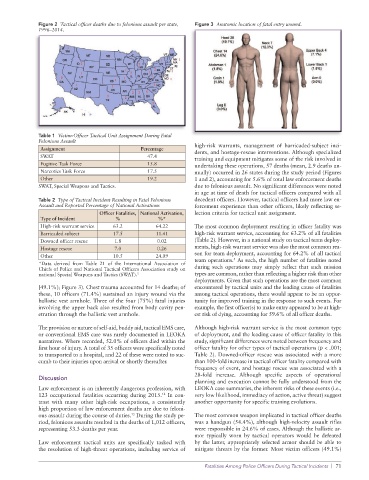
Figure 2  Tactical officer deaths due to felonious assault per state,   Figure 3  Anatomic location of fatal entry wound.
              1996–2014.


              Table 1  Victim-Officer Tactical Unit Assignment During Fatal
              Felonious Assault
              Assignment                       Percentage        high-risk warrants, management of barricaded-subject inci-
                                                                 dents, and hostage-rescue interventions. Although specialized
              SWAT                               47.4            training and equipment mitigates some of the risk involved in
              Fugitive Task Force                15.8            undertaking these operations, 57 deaths (mean, 2.9 deaths an-
              Narcotics Task Force               17.5            nually) occurred in 26 states during the study period (Figures
              Other                              19.2            1 and 2), accounting for 5.6% of total law enforcement deaths
              SWAT, Special Weapons and Tactics.                 due to felonious assault. No significant differences were noted
                                                                 in age at time of death for tactical officers compared with all
              Table 2  Type of Tactical Incident Resulting in Fatal Felonious   decedent officers. However, tactical officers had more law en-
              Assault and Reported Percentage of National Activations  forcement experience than other officers, likely reflecting se-
                                  Officer Fatalities,  National Activation,     lection criteria for tactical unit assignment.
              Type of Incident         %             %*
              High-risk warrant service  63.2       64.22        The most common deployment resulting in officer fatality was
              Barricaded subject      17.5          11.41        high-risk warrant service, accounting for 63.2% of all fatalities
              Downed officer rescue   1.8           0.02         (Table 2). However, in a national study on tactical team deploy-
              Hostage rescue          7.0           0.26         ments, high-risk warrant service was also the most common rea-
              Other                   10.5          24.09        son for team deployment, accounting for 64.2% of all tactical
                                                                             5
              *Data  derived  from  Table  21  of  the  International  Association  of   team operations.  As such, the high number of fatalities noted
              Chiefs of Police and National Tactical Officers Association study on   during such operations may simply reflect that such mission
              national Special Weapons and Tactics (SWAT). 5     types are common, rather than reflecting a higher risk than other
                                                                 deployments. Given that such operations are the most common
              [49.1%]; Figure 3). Chest trauma accounted for 14 deaths; of   encountered by tactical units and the leading cause of fatalities
              these, 10 officers (71.4%) sustained an injury wound via the   among tactical operations, there would appear to be an oppor-
              ballistic vest armhole. Three of the four (75%) fatal injuries   tunity for improved training in the response to such events. For
              involving the upper back also resulted from body cavity pen-  example, the first officer(s) to make entry appeared to be at high-
              etration through the ballistic vest armhole.       est risk of dying, accounting for 59.6% of all officer deaths.

              The provision or nature of self-aid, buddy aid, tactical EMS care,   Although high-risk warrant service is the most common type
              or conventional EMS care was rarely documented in LEOKA   of deployment, and the leading cause of officer fatality in this
              narratives. Where recorded, 52.0% of officers died within the   study, significant differences were noted between frequency and
              first hour of injury. A total of 35 officers were specifically noted   officer fatality for other types of tactical operations (p < .001;
              to transported to a hospital, and 22 of these were noted to suc-  Table 2). Downed-officer rescue was associated with a more
              cumb to their injuries upon arrival or shortly thereafter.  than 100-fold increase in tactical officer fatality compared with
                                                                 frequency of event, and hostage rescue was associated with a
                                                                 28-fold increase. Although specific aspects of operational
              Discussion
                                                                 planning and execution cannot be fully understood from the
              Law enforcement is an inherently dangerous profession, with   LEOKA case summaries, the inherent risks of these events (i.e.,
                                                      14
              123 occupational fatalities occurring during 2015.  In con-  very low likelihood, immediacy of action, active threat) suggest
              trast with many other high-risk occupations, a consistently   another opportunity for specific training evolutions.
              high proportion of law enforcement deaths are due to feloni-
              ous assault during the course of duties.  During the study pe-  The most common weapon implicated in tactical officer deaths
                                            15
              riod, felonious assaults resulted in the deaths of 1,012 officers,   was a handgun (54.4%), although high-velocity assault rifles
              representing 53.3 deaths per year.                 were responsible in 24.6% of cases. Although the ballistic ar-
                                                                 mor typically worn by tactical operators would be defeated
              Law enforcement tactical units are specifically tasked with   by the latter, appropriately selected armor should be able to
              the resolution of high-threat operations, including service of   mitigate threats by the former. Most victim officers (49.1%)

                                                                    Fatalities Among Police Officers During Tactical Incidents  |  71

