


Page 72 - Journal of Special Operations Medicine - Fall 2017
P. 72
Mayo Foundation Institutional Review Board and determined   situation”; these assignments were classified as “other.” Of-
          to be exempt.                                      ficers who were unlawfully killed before or separate from a
                                                             tactical incident were excluded from this study.
          Under the Uniform Crime Reporting (UCR) program, the FBI
          obtains data from nearly 17,000 law enforcement agencies   Data collection and entry
          across the United States and its protectorates and territories.   A standardized data collection form with predefined entry
          The FBI receives information on LODDs via multiple sources,   fields was developed to guide data collection. After initial
          including direct agency participation in the UCR program, FBI   training and review of 10 cases, data for each officer meeting
          field division reports, and data provided through the Bureau of   inclusion criteria were abstracted into a secured Microsoft Ex-
          Justice Assistance, the Public Safety Officers’ Benefits Program,   cel database (Microsoft Excel for Mac 2011, version 14.6.3.;
          and nonprofit organizations. Upon notification of a LODD,   Microsoft Corp.;  https://www.microsoft.com) by two sepa-
          Law Enforcement Officers Killed and Assaulted (LEOKA) staff   rate, blinded physician abstractors (M.S.T., T.M.H.). Discrep-
          contact the fallen officer’s employing agency and request ad-  ancies in data were identified and resolved by a third physician
          ditional details about the incident. Data are compiled and pre-  reviewer (M.D.S.). Where mean values are reported, they are
          sented in an annual LEOKA report; most LODDs in the report   given with the standard deviation.
          also include a brief de-identified narrative summary of events,
          including nature of injury. Open-source LEOKA reports were   Results
          accessed online at https://ucr.fbi.gov/leoka.
                                                             Of the 1,012 officer deaths that occurred during the study pe-
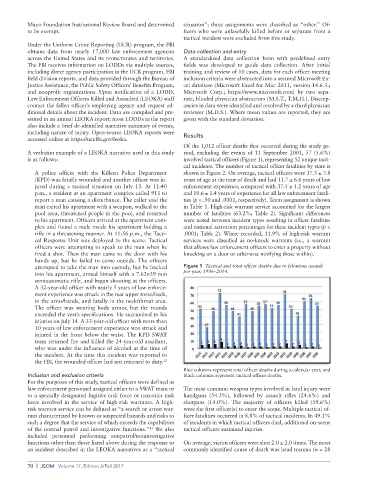
          A verbatim example of a LEOKA narrative used in this study   riod, excluding the events of 11 September 2001, 57 (5.6%)
          is as follows:                                     involved tactical officers (Figure 1), representing 52 unique tacti-
                                                             cal incidents. The number of tactical officer fatalities by state is
            A police officer with the Killeen Police Department   shown in Figure 2. On average, tactical officers were 37.3 ± 7.8
            (KPD) was fatally wounded and another officer was in-  years of age at the time of death and had 11.7 ± 6.6 years of law
            jured during a tactical situation on July 13. At 11:40   enforcement experience, compared with 37.5 ± 1.2 years of age
            p.m., a resident at an apartment complex called 911 to   and 10.6 ± 1.4 years of experience for all law enforcement fatali-
            report a man causing a disturbance. The caller said the   ties (p = .50 and .0001, respectively). Team assignment is shown
            man exited his apartment with a weapon, walked to the   in Table 1. High-risk warrant service accounted for the largest
            pool area, threatened people in the pool, and returned   number of fatalities (63.2%; Table 2). Significant differences
            to his apartment. Officers arrived at the apartment com-  were noted between incident types resulting in officer fatalities
            plex and found a male inside his apartment holding a   and national activation percentages for these incident types (p <
            rifle in a threatening manner. At 11:56 p.m., the Tacti-  .0001; Table 2). Where recorded, 11.9% of high-risk warrant
            cal Response Unit was deployed to the scene. Tactical   services were classified as no-knock warrants (i.e., a warrant
            officers were attempting to speak to the man when he   that allows law enforcement officers to enter a property without
            fired a shot. Then the man came to the door with his   knocking on a door or otherwise notifying those within).
            hands up, but he failed to come outside. The officers
            attempted to take the man into custody, but he backed   Figure 1  Tactical and total officer deaths due to felonious assault
            into his apartment, armed himself with a 7.62×39 mm   per year, 1996–2014.
            semiautomatic rifle, and began shooting at the officers.
            A 32-year-old officer with nearly 5 years of law enforce-
            ment experience was struck in the rear upper torso/back,
            in the arms/hands, and fatally in the neck/throat area.
            The officer was wearing body armor, but the rounds
            exceeded the vest’s specifications. He succumbed to his
            injuries on July 14. A 33-year-old officer with more than
            10 years of law enforcement experience was struck and
            injured in the front below the waist. The KPD SWAT
            team returned fire and killed the 24-year-old assailant,
            who was under the influence of alcohol at the time of
            the incident. At the time this incident was reported to
            the FBI, the wounded officer had not returned to duty. 12
                                                             Blue columns represent total officer deaths during a calendar year, and
          Inclusion and exclusion criteria                   black columns represent tactical officer deaths.
          For the purposes of this study, tactical officers were defined as
          law enforcement personnel assigned either to a SWAT team or   The most common weapon types involved in fatal injury were
          to a specially designated fugitive task force or narcotics task   handguns (54.3%), followed by assault rifles (24.6%) and
          force involved in the service of high-risk warrants. A high-  shotguns  (14.0%). The  majority  of officers  killed  (59.6%)
          risk warrant service can be defined as “a search or arrest war-  were the first officer(s) to enter the scene. Multiple tactical of-
          rant characterized by known or suspected hazards and risks to   ficer fatalities occurred in 8.8% of tactical incidents. In 49.1%
          such a degree that the service of which exceeds the capabilities   of incidents in which tactical officers died, additional on-scene
          of the normal patrol and investigative functions.”  We also   tactical officers sustained injuries.
                                                  13
          included personnel performing nonpatrol/noninvestigative
            functions other than those listed above during the response to   On average, victim officers were shot 2.0 ± 2.0 times. The most
          an incident described in the LEOKA narratives as a “tactical   commonly identified cause of death was head trauma (n = 28

          70  |  JSOM   Volume 17, Edition 3/Fall 2017

