


Page 63 - Journal of Special Operations Medicine - Fall 2017
P. 63
effect size. With 64 subjects per device, the investigators would
                                                                 be able to detect an effect size of 0.5 SD; with 26 subjects per
                                                                 device, an effect size of 0.8 SD would be detectable.

                                                                 Results
                                                                 A total of 89 Medics were enrolled in the study and completed
                                       Figure 2  Assisted Ventilation
                                       With the Study Device in a   the classroom portion. A subset of 36 Medics were evaluated
                                       Simulated Casualty.       in the field. Descriptive statistics are listed in Table 1.

                                                                 Table 1  Descriptive Statistics of Ventilation Rates (BPM) for the
                                                                 Classroom and the Field by Device
                                                                 Column1       N    Minimum  Maximum  Mean   SD
                                                                 Classroom
                                                                 standard BVM  89.00  6.45    17.01   10.10  2.00
                                                                 Classroom test   89.00  6.15  12.54   8.80  1.30
                                                                 BVM
                                                                 Field standard   36.00  6.40  23.23  11.20  3.30
                                                                 BVM
                                                                 Field test BVM  36.00  6.59  14.48   10.22  1.75

                                                                 Mean ventilation rates were analyzed with a two-factor
                                                                 ANOVA on BPM by device and order, with repeated measures
              Figure 3  Assisted Ventilation                     on device in the classroom and in the field. There was a small
              With the Study Device During a
              Simulated Evacuation.                              but statistically significant difference (p < .001) in overall ven-
                                                                 tilation rate between devices in the classroom, representing
                                                                 a difference of 1.3 BPM. There was no difference in overall
                                                                 ventilation rate in the field between devices (p > .05). Order
                                                                 of devices had no effect on the results in the classroom or the
                                                                 field (p > .05). There was also no difference in the total dura-
                                                                 tion of assisted ventilation between devices in the classroom or
                                                                 in the field (p > .05).
              of the study. For these scenarios each Medic carried a standard
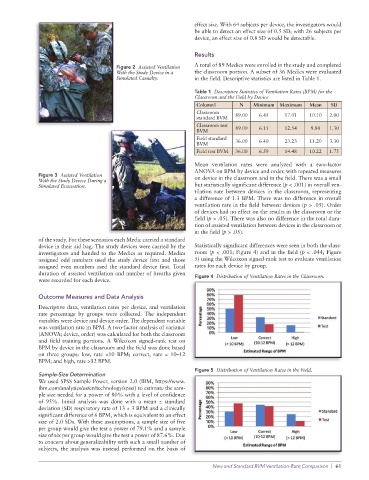
              device in their aid bag. The study devices were carried by the   Statistically significant differences were seen in both the class-
              investigators and handed to the Medics as required. Medics   room (p < .001; Figure 4) and in the field (p < .044; Figure
              assigned odd numbers used the study device first and those   5) using the Wilcoxon signed-rank test to evaluate ventilation
              assigned even numbers used the standard device first. Total   rates for each device by group.
              duration of assisted ventilation and number of breaths given
              were recorded for each device.                     Figure 4  Distribution of Ventilation Rates in the Classroom.


              Outcome Measures and Data Analysis
              Descriptive data, ventilation rates per device, and ventilation
              rate percentage by groups were collected. The independent
              variables were device and device order. The dependent variable
              was ventilation rate in BPM. A two-factor analysis of variance
              (ANOVA; device, order) was calculated for both the classroom
              and  field  training  portions.  A  Wilcoxon  signed-rank  test  on
              BPM by device in the classroom and the field was done based
              on  three  groups:  low,  rate  <10  BPM;  correct,  rate  =  10–12
              BPM; and high, rate >12 BPM.
                                                                 Figure 5  Distribution of Ventilation Rates in the Field.
              Sample-Size Determination
              We used SPSS Sample Power, version 2.0 (IBM, https://www.
              ibm.com/analytics/us/en/technology/spss/) to estimate the sam-
              ple size needed for a power of 80% with a level of confidence
              of 95%. Initial analysis was done with a mean  ± standard
              deviation (SD) respiratory rate of 13 ± 3 BPM and a clinically
              significant difference of 6 BPM, which is equivalent to an effect
              size of 2.0 SDs. With these assumptions, a sample size of five
              per group would give the test a power of 79.1% and a sample
              size of six per group would give the test a power of 87.6%. Due
              to concern about generalizability with such a small number of
              subjects, the analysis was instead performed on the basis of

                                                                      New and Standard BVM Ventilation-Rate Comparison  |  61

