


Page 62 - Journal of Special Operations Medicine - Fall 2017
P. 62
blast injuries and penetrating trauma. In austere environments   6910-01-445-4093; Armstrong Medical Industries,  https://
          commonly encountered by Medics, it is even more difficult to   www.armstrongmedical.com/) consisting of a head, neck, and
          monitor for hyperventilation because they likely will not have   lungs was used in the classroom portion of BCT3 for airway
          the monitoring equipment to do so. 5               training. A Rescue Randy  training manikin (NSN 6910-01-
                                                                                 ®
                                                             605-207; CMC Rescue, http://www.cmcrescue.com/) was used
          If effective, the new device could result in changes to the es-  during the combat casualty simulations in the field.
          tablished medical equipment sets of military units and integra-
          tion of the device into standard medical training. Ultimately,   Methods
          this type of device could lead to reductions of iatrogenically   The first portion of the study was integrated into the surgi-
          induced morbidity and mortality by decreasing or eliminat-  cal airway skill station, during which one Medic secured the
          ing the incidence of hyperventilation in the early treatment of   airway in the manikin and a second Medic delivered breaths
          combat casualties.                                 with a BVM device. This station consisted of five manikins,
                                                             each with the standard and study devices located next to it.
          Our hypothesis was that the new device would decrease exces-  Two to three Medics were assigned to each manikin at a time.
          sive rates of ventilation compared with a traditional device   Each group received a review of the procedure before per-
          when used by Army Medics in a classroom and a prehospital/  forming the skill. After this, the principal investigator gave a
          field environment.                                 demonstration of the study device. Ventilation rates were not
                                                             addressed in this training. Volunteers participating in the study
                                                             were then identified. Participants were assigned a letter-num-
          Study Design and Methods
                                                             ber designator (e.g., A1), with the letter indicating which class
          Setting and Subjects                               the participant was in (A = first class, B = second class, and
          This study was conducted at the Brigade Combat Team Trauma   so on) and the numbers assigned consecutively. Participants
          Training (BCT3) course located at Camp Bullis, Texas. BCT3   then each took turns practicing with the study device and then
          is a 5-day course required for Army Medics within 180 days   continued with the training scenario.
          of deployment to a combat theater of operations. This course
          was chosen because Medics come from around the country,   The assigned numbers were used to randomly assign the partic-
          providing a more diverse sample population, and it includes   ipants to device order, with odd numbers using the study device
          simulated combat training scenarios in field conditions to   first and even numbers using the standard device first. The first
          more closely simulate real-world performance.      Medic in each group performed the surgical airway and the
                                                             second Medic delivered breaths with either the standard BVM
          Subjects were U.S. Army Medics attending BCT3 who volun-  or study device. The investigators timed each iteration with
          teered to participate in the study. There were no additional   an iPhone stopwatch (Apple; https://www.apple.com/) begin-
          exclusion criteria.                                ning with the first breath given. The number of breaths given
                                                             and the total duration of assisted ventilation were recorded.
          Study Design                                       The Medic delivered breaths with the first device until the air-
          Our study used a prospective, observational, semirandomized,   way was secured or a minimum of 1 minute had elapsed. The
          cross-over design that was integrated into the 5-day structure   Medic was then asked to switch devices and again time was
          of the BCT3 course.                                measured starting with the first breath delivered. Total dura-
                                                             tion of assisted ventilation and number of breaths given were
          Materials                                          then recorded for the second device. All data were collected on
          The standard BVM device used in this study was a Cyclone    standardized forms.
                                                         ®
          Pocket BVM distributed by North American Rescue (http://

          www.narescue.com). This device was being used at BCT3 at   The second portion of the study was integrated into the simu-
          the time of this study and was not chosen by the investigators.   lated combat training. During this portion of the course, small
          The Cyclone Pocket BVM is typical of traditional BVMs.  groups of Medics carrying all their equipment were given a
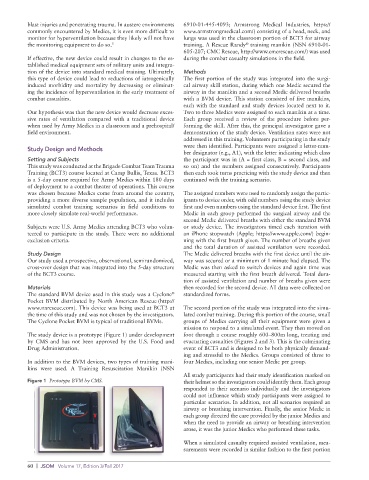
                                                             mission to respond to a simulated event. They then moved on
          The study device is a prototype (Figure 1) under development   foot through a course roughly 600–800m long, treating and
          by CMS and has not been approved by the U.S. Food and   evacuating casualties (Figures 2 and 3). This is the culminating
          Drug Administration.                               event of BCT3 and is designed to be both physically demand-
                                                             ing and stressful to the Medics. Groups consisted of three to
          In addition to the BVM devices, two types of training mani-  four Medics, including one senior Medic per group.
          kins  were  used. A  Training  Resuscitation  Manikin  (NSN
                                                             All study participants had their study identification marked on
          Figure 1  Prototype BVM by CMS.                    their helmet so the investigators could identify them. Each group
                                                             responded to their scenario individually and the investigators
                                                             could not influence which study participants were assigned to
                                                             particular scenarios. In addition, not all scenarios required an
                                                             airway or breathing intervention. Finally, the senior Medic in
                                                             each group directed the care provided by the junior Medics and
                                                             when the need to provide an airway or breathing intervention
                                                             arose, it was the junior Medics who performed these tasks.

                                                             When a simulated casualty required assisted ventilation, mea-
                                                             surements were recorded in similar fashion to the first portion

          60  |  JSOM   Volume 17, Edition 3/Fall 2017

