


Page 34 - Journal of Special Operations Medicine - Fall 2017
P. 34
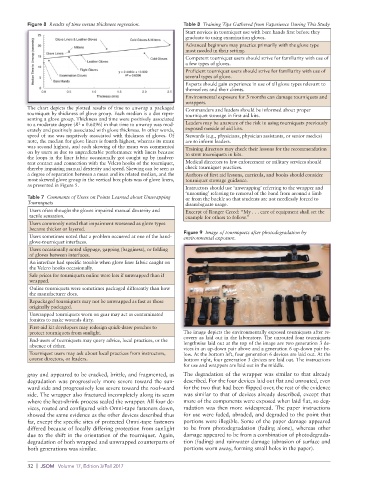
Figure 8  Results of time versus thickness regression.  Table 8  Training Tips Gathered from Experience During This Study
                                                              Start novices in tourniquet use with bare hands first before they
                                                              graduate to using examination gloves.
                                                              Advanced beginners may practice primarily with the glove type
                                                              most needed in their setting.
                                                              Competent tourniquet users should strive for familiarity with use of
                                                              a few types of gloves.
                                                              Proficient tourniquet users should strive for familiarity with use of
                                                              several types of glove.
                                                              Experts should gain experience in use of all glove types relevant to
                                                              themselves and their clients.
                                                              Environmental exposure for 3 months can damage tourniquets and
                                                              wrappers.
          The chart depicts the plotted results of time to unwrap a packaged   Commanders and leaders should be informed about proper
          tourniquet by thickness of glove group. Each median is a dot repre-  tourniquet stowage in first aid kits.
          senting a glove group. Thickness and time were positively associated
          to a moderate degree (R  = 0.6096) in that time to unwrap was mod-  Leaders may be unaware of the risk in using tourniquets previously
                           2
          erately and positively associated with glove thickness. In other words,   exposed outside of aid kits.
          speed of use was negatively associated with thickness of gloves. Of   Stewards (e.g., physicians, physician assistants, or senior medics)
          note, the median for glove liners is fourth highest, whereas its mean   are to inform leaders.
          was second highest, and such skewing of the mean was commented   Training directors may check their lessons for the recommendation
          on by users as due to unpredictable performance with liners because   to stow tourniquets in kits.
          the loops in the liner fabric occasionally got caught up by inadver-
          tent contact and connection with the Velcro hooks of the tourniquet,   Medical directors to law enforcement or military services should

          thereby impairing manual dexterity and speed. Skewing can be seen as   check tourniquet practices.
          a degree of separation between a mean and its related median, and the   Authors of first aid lessons, curricula, and books should consider
          most skewed glove group in the vertical box plots was of glove liners,   tourniquet stowage guidance.
          as presented in Figure 5.                           Instructors should use ‘unwrapping’ referring to the wrapper and
                                                              ‘unrouting’ referring to removal of the band from around a limb
          Table 7  Comments of Users on Points Learned about Unwrapping   or from the buckle so that students are not needlessly forced to
          Tourniquets                                         disambiguate usage.
           Users often thought the gloves impaired manual dexterity and   Excerpt of Ranger Creed: “My . . . care of equipment shall set the
           tactile sensation.                                 example for others to follow.”
           Users commonly noted that impairment worsened as glove types
           became thicker or layered.                        Figure 9  Image of tourniquets after photodegradation by
           Users sometimes noted that a problem occurred at one of the hand-  environmental exposure.
           glove-tourniquet interfaces.
           Users occasionally noted slippage, gapping (bagginess), or folding
           of gloves between interfaces.
           An interface had specific trouble when glove liner fabric caught on
           the Velcro hooks occasionally.
           Sale prices for tourniquets online were less if unwrapped than if
           wrapped.
           Online tourniquets were sometimes packaged differently than how
           the manufacturer does.
           Repackaged tourniquets may not be unwrapped as fast as those
           originally packaged.
           Unwrapped tourniquets worn on gear may act as contaminated
           fomites to make wounds dirty.
           First-aid kit developers may redesign quick-draw pouches to
           protect tourniquets from sunlight.                The image depicts the environmentally exposed tourniquets after re-
                                                             covery as laid out in the laboratory. The unrouted four tourniquets
           End-users of tourniquets may query advice, local practices, or the
           absence of either.                                lengthwise laid out at the top of the image are two generation 3 de-
                                                             vices in an up-down pair above and a generation 6 up-down pair be-
           Tourniquet users may ask about local practices from instructors,   low. At the bottom left, four generation 6 devices are laid out. At the
           course directors, or leaders.                     bottom right, four generation 3 devices are laid out. The instructions
                                                             for use and wrappers are laid out in the middle.
          gray and appeared to be cracked, brittle, and fragmented, as   The degradation of the wrapper was similar to that already
          degradation was progressively more severe toward the sun-  described. For the four devices laid out flat and unrouted, even
          ward side and progressively less severe toward the roof-ward   for the two that had been flipped over, the rest of the evidence
          side. The wrapper also fractured incompletely along its seam   was similar to that of devices already described, except that
          where the heat-shrink process sealed the wrapper. All four de-  more of the components were exposed when laid flat, so deg-
          vices, routed and configured with Omni-tape fasteners down,   radation was then more widespread. The paper instructions
          showed the same evidence as the other devices described thus   for use were faded, abraded, and degraded to the point that
          far, except the specific sites of protected Omni-tape fasteners   portions were illegible. Some of the paper damage appeared
          differed because of locally differing protection from sunlight   to be from photodegradation (fading alone), whereas other
          due to the shift in the orientation of the tourniquet. Again,     damage appeared to be from a combination of photodegrada-
          degradation of both wrapped and unwrapped counterparts of   tion (fading) and rainwater damage (abrasion of surface and
          both generations was similar.                      portions worn away, forming small holes in the paper).

          32  |  JSOM   Volume 17, Edition 3/Fall 2017

