


Page 32 - Journal of Special Operations Medicine - Fall 2017
P. 32
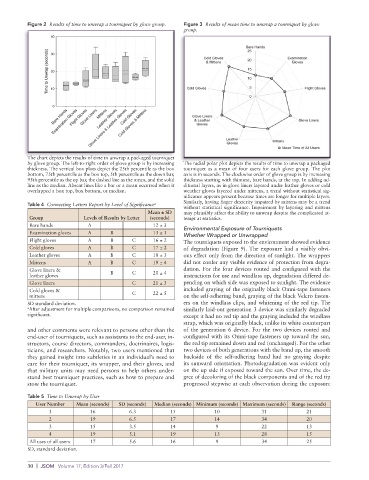
Figure 2  Results of time to unwrap a tourniquet by glove group.  Figure 3  Results of mean time to unwrap a tourniquet by glove
                                                             group.


          The chart depicts the results of time to unwrap a packaged tourniquet
          by glove group. The left-to-right order of glove group is by increasing   The radial polar plot depicts the results of time to unwrap a packaged
          thickness. The vertical box plots depict the 25th percentile as the box   tourniquet as a mean of four users for each glove group. The plot
          bottom, 75th percentile as the box top, 5th percentile as the down bar,   axis is in seconds. The clockwise order of glove group is by increasing
          95th percentile as the up bar, the dashed line as the mean, and the solid   thickness starting with thinnest, bare hands, at the top. In adding ad-
          line as the median. Absent lines like a bar or a mean occurred when it   ditional layers, as in glove liners layered under leather gloves or cold
          overlapped a box top, box bottom, or median.       weather gloves layered under mittens, a trend without statistical sig-
                                                             nificance appears present because times are longer for multiple layers.
                                                             Similarly, having finger dexterity impaired by mittens may be a trend
          Table 4  Connecting Letters Report by Level of Significance a  without statistical significance. Impairment by layering and mittens
                                                 Mean ± SD   may plausibly affect the ability to unwrap despite the complicated at-
           Group            Levels of Results by Letter  (seconds)  tempt at statistics.
           Bare hands         A                    12 ± 3    Environmental Exposure of Tourniquets
           Examination gloves  A     B             13 ± 1    Whether Wrapped or Unwrapped
           Flight gloves      A      B      C      16 ± 2    The tourniquets exposed to the environment showed evidence
           Cold gloves        A      B      C      17 ± 2    of degradation (Figure 9). The exposure had a visibly obvi-
           Leather gloves     A      B      C      18 ± 3    ous effect only from the direction of sunlight. The wrappers
           Mittens            A      B      C      19 ± 4    did not confer any visible evidence of protection from degra-
           Glove liners &            B      C      20 ± 4    dation. For the four devices routed and configured with the
           leather gloves                                    instructions for use and windlass up, degradation differed de-
           Glove liners                     C      21 ± 3    pending on which side was exposed to sunlight. The evidence
           Cold gloves &                    C      22 ± 5    included graying of the originally black Omni-tape fasteners
           mittens                                           on the self-adhering band, graying of the black Velcro fasten-
          SD standard deviation.                             ers on the windlass clips, and whitening of the red tip. The
          a After adjustment for multiple comparisons, no comparison remained   similarly laid-out generation 3 device was similarly degraded
          significant.                                       except it had no red tip and the graying included the windlass
                                                             strap, which was originally black, unlike its white counterpart
          and other  comments were relevant to persons other than the   of the generation 6 device. For  the two devices  routed and
          end-user of tourniquets, such as assistants to the end-user, in-  configured with its Omni-tape fasteners up toward the sun,
          structors, course directors, commanders, doctrinaires, logis-  the red tip remained down and red (unchanged). For the other
          ticians, and researchers. Notably, two users mentioned that   two devices of both generations with the band up, the smooth
          they gained insight into subtleties in an individual’s need to   backside of the self-adhering band had no graying despite
          care for their tourniquet, its wrapper, and their gloves, and   its sunward orientation. Photodegradation was evident only
          that military units may need persons to help others under-  on the up side if exposed toward the sun. Over time, the de-
          stand best tourniquet practices, such as how to prepare and   gree of decoloring of the black components and of the red tip
          stow the tourniquet.                               progressed stepwise at each observation during the  exposure
          Table 5  Time to Unwrap by User
             User Number  Mean (seconds)  SD (seconds)  Median (seconds) Minimum (seconds) Maximum (seconds)  Range (seconds)
                 1            16           6.3           15            10             31             21
                 2            19           6.5           17            14             34             20
                 3            15           3.5           14             9             22             13
                 4            19           5.1           19            13             28             15
           All uses of all users  17       5.6           16             9             34             25
          SD, standard deviation.

          30  |  JSOM   Volume 17, Edition 3/Fall 2017

