


Page 28 - Journal of Special Operations Medicine - Fall 2017
P. 28
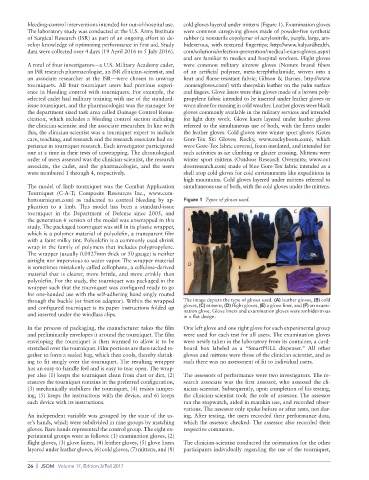
bleeding-control interventions intended for out-of-hospital use.   cold gloves  layered under mittens (Figure 1). Examination gloves
          The laboratory study was conducted at the U.S. Army Institute   were common caregiving gloves made of powder-free synthetic
          of Surgical Research (ISR) as part of an ongoing effort to de-  rubber (a nonsterile copolymer of acrylonitrile, purple, large, am-
          velop knowledge of optimizing performance in first aid. Study   bidextrous, with textured fingertips; http://www.halyardhealth.
          data were collected over 4 days (19 April 2016 to 5 July 2016).  com/solutions/infection-prevention/medical-exam-gloves.aspx)
                                                             and are familiar to medics and hospital workers. Flight gloves
          A total of four investigators—a U.S. Military Academy cadet,   were common military aircrew gloves (Nomex brand fibers
          an ISR research pharmacologist, an ISR clinician-scientist, and   of an artificial polymer, meta-terephthalamide, woven into a
          an associate researcher at the ISR—were chosen to unwrap   heat and flame-resistant fabric; Gibson & Barnes, http://www
          tourniquets. All four tourniquet users had previous experi-  .nomexgloves.com/) with sheepskin leather on the palm surface
          ence in bleeding control with tourniquets. For example, the   and fingers. Glove liners were thin gloves made of a brown poly-
          selected cadet had military training with use of the standard-  propylene fabric intended to be inserted under leather gloves or
          issue tourniquet, and the pharmacologist was the manager for   worn alone for running in cold weather. Leather gloves were black
          the department sized task area called Damage Control Resus-  gloves commonly available in the military services and intended
          citation, which includes a bleeding control section including   for light duty work. Glove liners layered under leather gloves
          the clinician-scientist and the associate researcher. In line with   referred to the simultaneous use of both, with the liners under
          this, the clinician-scientist was a tourniquet expert to include   the leather gloves. Cold gloves were winter sport gloves (Gates
          care, teaching, and research and the research associate had ex-  Gore-Tex  Ski  Gloves;  Rocky,  www.rockyboots.com),  which
          perience in tourniquet research. Each investigator participated   were Gore-Tex fabric covered, foam insulated, and intended for
          one at a time in their tests of unwrapping. The chronological   such activities as ice climbing or glacier crossing. Mittens were
          order of users assessed was the clinician-scientist, the research   winter sport mittens (Outdoor Research Overmitts;  www.out
          associate, the cadet, and the pharmacologist, and the users   doorresearch.com) made of blue Gore-Tex fabric intended as a
          were numbered 1 through 4, respectively.           shell atop cold gloves for cold environments like expeditions in
                                                             high mountains. Cold gloves layered under mittens referred to
          The model of limb tourniquet was the Combat Application   simultaneous use of both, with the cold gloves under the mittens.
          Tourniquet (C-A-T; Composite Resources Inc.,  www.com-
          battourniquet.com) as indicated to control bleeding by ap-  Figure 1  Types of gloves used.
          plication to a limb. This model has been a standard-issue
          tourniquet  in  the  Department  of  Defense  since  2005,  and
          the generation 6 version of the model was unwrapped in this
          study. The packaged tourniquet was still in its plastic wrapper,
          which is a polymer material of polyolefin, a transparent film
          with a faint milky tint. Polyolefin is a commonly used shrink
          wrap in the family of polymers that includes polypropylene.
          The wrapper (usually 0.0127mm thick or 50 gauge) is neither
          airtight nor impervious to water vapor. The wrapper material
          is sometimes mistakenly called cellophane, a cellulose-derived
          material that is clearer, more brittle, and more crinkly than
          polyolefin. For the study, the tourniquet was packaged in the
          wrapper such that the tourniquet was configured ready to go
          for one-handed use with the self-adhering band singly routed
          through the buckle (or friction adaptor). Within the wrapped   The image depicts the type of gloves used. (A) leather gloves, (B) cold
          and configured tourniquet is its paper instructions folded up   gloves, (C) mittens, (D) flight gloves, (E) a glove liner, and (F) an exami-
          and inserted under the windlass clips.             nation glove. Glove liners and examination gloves were ambidextrous
                                                             in a flat design.
          In the process of packaging, the manufacturer takes the film   One left glove and one right glove for each experimental group
          and preliminarily envelopes it around the tourniquet. The film   were used for each test for all users. The examination gloves
          enveloping the tourniquet is then warmed to allow it to be   were newly taken in the laboratory from its container, a card-
          stretched over the tourniquet. Film portions are then tacked to-  board  box  labeled  as  a  “SmartPULL  dispenser.”  All  other
          gether to form a sealed bag, which then cools, thereby shrink-  gloves and mittens were those of the clinician-scientist, and as
          ing to fit snugly over the tourniquet. The resulting wrapper   such there was no assessment of fit to individual users.
          has an easy-to-handle feel and is easy to tear open. The wrap-
          per also (1) keeps the tourniquet clean from dust or dirt, (2)   The assessors of performance were two investigators. The re-
          ensures the tourniquet remains in the preferred configuration,   search associate was the first assessor, who assessed the cli-
          (3) mechanically stabilizes the tourniquet, (4) resists tamper-  nician-scientist. Subsequently, upon completion of his testing,
          ing, (5) keeps the instructions with the device, and 6) keeps   the clinician-scientist took the role of assessor. The assessor
          each device with its instructions.                 ran the stopwatch, aided in manikin use, and recorded obser-
                                                             vations. The assessor only spoke before or after tests, not dur-
          An independent variable was grouped by the state of the us-  ing. After testing, the users recorded their performance data,
          er’s hands, which were subdivided in nine groups by matching   which the assessor checked. The assessor also recorded their
          gloves. Bare hands represented the control group. The eight ex-  respective comments.
          perimental groups were as follows: (1) examination gloves, (2)
          flight gloves, (3) glove liners, (4) leather gloves, (5) glove liners   The clinician-scientist conducted the orientation for the other
          layered under leather gloves, (6) cold gloves, (7) mittens, and (8)   participants individually regarding the use of the tourniquet,

          26  |  JSOM   Volume 17, Edition 3/Fall 2017

