


Page 33 - Journal of Special Operations Medicine - Fall 2017
P. 33
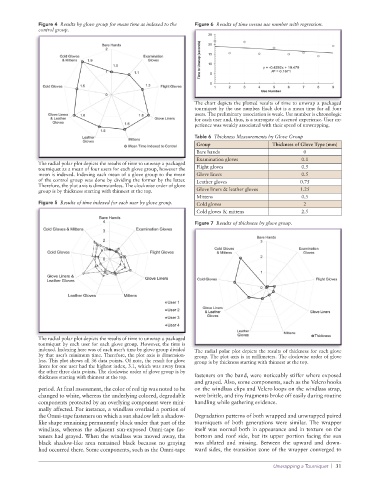
Figure 4  Results by glove group for mean time as indexed to the   Figure 6  Results of time versus use number with regression.
              control group.


                                                                 The chart depicts the plotted results of time to unwrap a packaged
                                                                 tourniquet by the use number. Each dot is a mean time for all four
                                                                 users. The preliminary association is weak. Use number is chronologic
                                                                 for each user and, thus, is a surrogate of accrued experience. User ex-
                                                                 perience was weakly associated with their speed of unwrapping.
                                                                 Table 6  Thickness Measurements by Glove Group
                                                                 Group                    Thickness of Glove Type (mm)
                                                                 Bare hands                         0
                                                                 Examination gloves                 0.1
              The radial polar plot depicts the results of time to unwrap a packaged
              tourniquet as a mean of four users for each glove group, however the   Flight gloves  0.5
              mean is indexed. Indexing each mean of a glove group to the mean   Glove liners       0.5
              of the control group was done by dividing the former by the latter.   Leather gloves  0.75
              Therefore, the plot axis is dimensionless. The clockwise order of glove
              group is by thickness starting with thinnest at the top.  Glove liners & leather gloves  1.25
                                                                 Mittens                            0.5
              Figure 5  Results of time indexed for each user by glove group.  Cold gloves          2
                                                                 Cold gloves & mittens              2.5

                                                                 Figure 7  Results of thickness by glove group.


              The radial polar plot depicts the results of time to unwrap a packaged
              tourniquet by each user for each glove group. However, the time is
              indexed. Indexing here was of each user’s time by glove group divided   The radial polar plot depicts the results of thickness for each glove
              by that user’s minimum time. Therefore, the plot axis is dimension-  group. The plot axis is in millimeters. The clockwise order of glove
              less. This plot shows all 36 data points. Of note, the result for glove   group is by thickness starting with thinnest at the top.
              liners for one user had the highest index, 3.1, which was away from
              the other three data points. The clockwise order of glove group is by
              thickness starting with thinnest at the top.       fasteners on the band, were noticeably stiffer where exposed

                                                                 and grayed. Also, some components, such as the Velcro hooks
                period. At final assessment, the color of red tip was noted to be   on the windlass clips and Velcro loops on the windlass strap,

              changed to white, whereas the underlying colored, degradable   were brittle, and tiny fragments broke off easily during routine
              components protected by an overlying component were mini-  handling while gathering evidence.
              mally affected. For instance, a windlass overlaid a portion of
              the Omni-tape fasteners on which a sun shadow left a shadow-  Degradation patterns of both wrapped and unwrapped paired
              like shape remaining permanently black under that part of the   tourniquets of both generations were similar. The wrapper
              windlass, whereas the adjacent sun-exposed Omni-tape fas-  itself was normal both in appearance and in texture on the
              teners had grayed. When the windlass was moved away, the   bottom  and roof  side,  but  its  upper  portion  facing  the  sun
              black shadow-like area remained black because no graying   was   ablated and  missing.  Between  the  upward  and  down-
              had occurred there. Some components, such as the Omni-tape   ward sides, the transition zone of the wrapper converged to

                                                                                          Unwrapping a Tourniquet  |  31

