


Page 96 - Journal of Special Operations Medicine - Spring 2017
P. 96
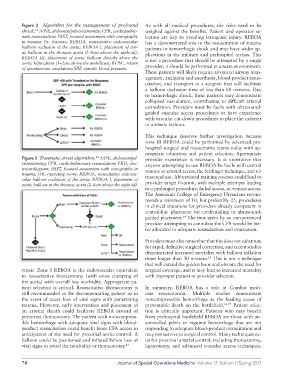
Figure 2   Algorithm for the  management of profound   As  with  all  medical  procedures,  the  risks  need  to  be
                12
          shock.  A/P/E, abdomen/pelvis/extremity; CPR, cardiopulmo-  weighed against the benefits. Patient and operator se-
          nary resuscitation; FAST, focused assessment with sono graphy   lection are key to avoiding iatrogenic injury. REBOA
          in trauma; Fx, fracture; REBOA, resuscitative endovascular   has a demonstrated role in the resuscitation of trauma
          balloon occlusion of the aorta; REBOA I, placement of aor-  patients in hemorrhagic shock and may have wider ap-
          tic balloon in the thoracic aorta (2–8cm above the xiphoid);   plications in the military and prehospital arenas. This
          REBOA III, placement of  aortic  balloon directly above the   is not a procedure that should be attempted by a single
          aortic bifurcation (1–2cm above the umbilicus); ROSC, return
          of spontaneous circulation; SBP, systolic blood pressure.  provider; it should be performed in a team environment.
                                                             These patients will likely require advanced airway man-
                                                             agement, analgesia and anesthesia, blood-product resus-
                                                             citation, and transport to a surgeon that will facilitate
                                                             a balloon occlusion time of less than 60 minutes. Due
                                                             to hemorrhagic shock, these patients may demonstrate
                                                             collapsed vasculature, contributing to difficult arterial
                                                             cannulation. Providers must be facile with ultrasound-
                                                             guided  vascular access  procedures  or have  experience
                                                             with vascular cut-down procedures to place the catheter
                                                             in a timely fashion.

                                                             This technique deserves further investigation because
                                                             zone III REBOA could be performed by advanced pre-
                                                             hospital surgical and resuscitative teams today with ap-
                                                             propriate education and patient selection. Appropriate
                                        12
          Figure 3  Traumatic arrest algorithm.  A/P/E, abdomen/pel-  provider experience is necessary. It is imperative that
          vis/extremity; CPR, cardiopulmonary resuscitation; EKG, elec-  anyone attempting to use REBOA be facile with central
          trocardiogram; FAST, focused assessment with sonography in   venous or arterial access, the Seldinger technique, and ul-
          trauma; OR, operating room; REBOA, resuscitative endovas-
          cular balloon occlusion of the aorta; REBOA I, placement of   trasound use. Abbreviated training courses could lead to
          aortic balloon in the thoracic aorta (2–8cm above the xiphoid).  provider target fixation, with multiple attempts leading
                                                             to a prolonged procedure, failed access, or venous access.
                                                             The American College of Emergency Physicians recom-
                                                             mends a minimum of 10, but preferably 25, procedures
                                                             in clinical situations for providers already competent in
                                                             central-line placement for credentialing in ultrasound-
                                                             guided placement.  The time spent by an inexperienced
                                                                             14
                                                             provider attempting to cannulate the CFA would be bet-
                                                             ter allocated to adequate resuscitation and evacuation.

                                                             Providers must also remember that this does not substitute
                                                             for rapid, definitive surgical correction, and recent studies
                                                             demonstrated increased mortality with balloon inflation
                                                             times longer than 30 minutes.  This is not a technique
                                                                                       15
                                                             that will extend the golden hour and obviate the need for
          repair. Zone I  REBOA is the  endovascular equivalent   surgical coverage, and it may lead to increased mortality
          to resuscitative thoracotomy (with cross clamping of   with improper patient or provider selection.
          the aorta) with overall less morbidity. Appropriate pa-
          tient  selection  is  critical.  Resuscitative  thoracotomy  is   In summary, REBOA has a role in Combat medi-
          still recommended in the decompensating patient or in   cine resuscitation. Multiple studies demonstrate
          the event of acute loss of vital signs with   penetrating     noncompressible hemorrhage as the leading cause of
          trauma. However, early intervention and placement of   preventable death on the battlefield. 16,17  Patient selec-
          an arterial sheath could facilitate REBOA instead of   tion is critically important. Patients who may benefit
          periarrest thoracotomy. The patient with noncompress-  from prehospital battlefield REBOA are those with un-
          ible hemorrhage with adequate vital signs with blood-  controlled pelvic or inguinal hemorrhage that are not
          product resuscitation could benefit from CFA access in   responding to adequate blood-product resuscitation and
          anticipation of the need for proximal aortic control. A   may not survive to surgical control. Many techniques ex-
          balloon could be positioned and inflated before loss of   ist for proximal arterial control, including thoracotomy,
          vital signs to avoid the morbidity or thoracotomy. 13  laparotomy, and advanced vascular access techniques.


          74                                      Journal of Special Operations Medicine  Volume 17, Edition 1/Spring 2017

