


Page 91 - Journal of Special Operations Medicine - Spring 2017
P. 91
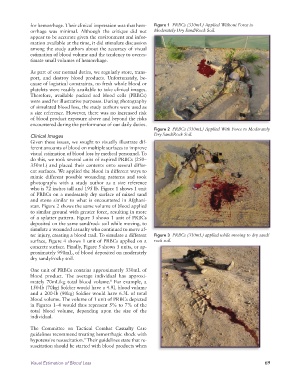
for hemorrhage. Their clinical impression was that hem-  Figure 1  PRBCs (330mL) Applied Without Force to
              orrhage was  minimal. Although the critique  did not   Moderately Dry Sand/Rock Soil.
              appear to be accurate given the environment and infor-
              mation available at the time, it did stimulate discussion
              among the study authors about the accuracy of visual
              estimation of blood volume and the tendency to overes-
              timate small volumes of hemorrhage.

              As part of our normal duties, we regularly store, trans-
              port, and destroy blood products. Unfortunately, be-
              cause of logistical constraints, no fresh whole blood or
              platelets were readily available to take clinical images.
              Therefore, available packed red blood cells (PRBCs)
              were used for illustrative purposes. During photography
              of simulated blood loss, the study authors were used as
              a size reference. However, there was no increased risk
              of blood product exposure above and beyond the risks
              encountered during the performance of our daily duties.
                                                                 Figure 2  PRBCs (330mL) Applied With Force to Moderately
              Clinical Images                                    Dry Sand/Rock Soil.
              Given these issues, we sought to visually illustrate dif-
              ferent amounts of blood on multiple surfaces to improve
              visual estimation of blood loss by medical personnel. To
              do this, we took several units of expired PRBCs (250–
              350mL) and placed their contents onto several differ-
              ent surfaces. We applied the blood in different ways to
              mimic  different  possible  wounding  patterns  and  took
              photographs with a study author as a size reference
              who is 72 inches tall and 195 lb. Figure 1 shows 1 unit
              of PRBCs on a moderately dry surface of mixed sand
              and stone similar to what is encountered in Afghani-
              stan. Figure 2 shows the same volume of blood applied
              to similar ground with greater force, resulting in more
              of a splatter pattern. Figure 3 shows 1 unit of PRBCs
              deposited on the same sand/rock soil while moving, to
              simulate a wounded casualty who continued to move af-
              ter injury, creating a blood trail. To simulate a different   Figure 3  PRBCs (330mL) applied while moving to dry sand/
              surface, Figure 4 shows 1 unit of PRBCs applied on a   rock soil.
              concrete surface. Finally, Figure 5 shows 3 units, or ap-
              proximately 990mL, of blood deposited on moderately
              dry sandy/rocky soil.

              One unit of PRBCs contains approximately 330mL of
              blood product. The average individual has approxi-
              mately 70mL/kg total blood volume.  For example, a
                                               8
              150-lb (70kg) Soldier would have a 4.9L blood volume
              and a 200-lb (90kg) Soldier would have 6.3L of total
              blood volume. The volume of 1 unit of PRBCs depicted
              in Figures 1–4 would thus represent 5% to 7% of the
              total blood volume, depending upon the size of the
              individual.

              The  Committee on  Tactical  Combat  Casualty  Care
              guidelines recommend treating hemorrhagic shock with
              hypotensive resuscitation.  Their guidelines state that re-
                                    9
              suscitation should be started with blood products when


              Visual Estimation of Blood Loss                                                                 69

