


Page 95 - Journal of Special Operations Medicine - Spring 2017
P. 95
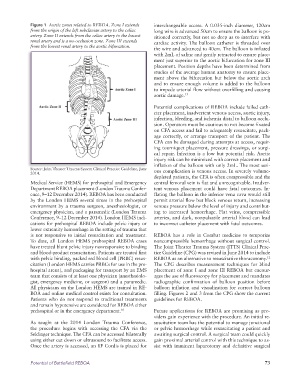
Figure 1  Aortic zones related to REBOA. Zone I extends   interchangeable access. A 0.035-inch diameter, 120cm
              from the origin of the left subclavian artery to the celiac   long wire is advanced 50cm to ensure the balloon is po-
              artery. Zone II extends from the celiac artery to the lowest   sitioned correctly, but not so deep as to interfere with
              renal artery and is a no-occlusion zone. Zone III extends   cardiac activity. The balloon catheter is threaded over
              from the lowest renal artery to the aortic bifurcation.
                                                                 the wire and advanced to 40cm. The balloon is inflated
                                                                 with 2mL of saline and gently retracted to ensure place-
                                                                 ment just superior to the aortic bifurcation for zone III
                                                                 placement. Position depths have been determined from
                                                                 studies of the average human anatomy to ensure place-
                                                                 ment above the bifurcation but below the aortic arch
                                                                 and to ensure enough volume is added to the balloon
                                                                 to impede arterial flow without overfilling and causing
                                                                 aortic damage. 13

                                                                 Potential complications of REBOA include failed cath-
                                                                 eter placement, inadvertent venous access, aortic injury,
                                                                 infection, bleeding, and ischemia distal to balloon occlu-
                                                                 sion. Operators must be cautious to not become fixated
                                                                 on CFA access and fail to adequately resuscitate, pack-
                                                                 age correctly, or arrange transport of the patient. The
                                                                 CFA can be damaged during attempts at access, requir-
                                                                 ing tourniquet placement, pressure dressings, or surgi-
                                                                 cal repair. Infection is a low but potential risk. Aortic
                                                                 injury risk can be minimized with correct placement and
                                                                 inflation of the balloon with only 2mL. The most seri-
              Source: Joint Theater Trauma System Clinical Practice Guideline, June   ous complication is venous access. In severely volume-
              2014.
                                                                 depleted patients, the CFA is often compressible and the
              Medical Service (HEMS) for prehospital and Emergency   central femoral vein is flat and unrecognizable. Inadver-
              Department REBOA placement (London Trauma Confer-  tent venous placement could have fatal outcomes. In-
              ence, 9–12 December 2014). REBOA has been conducted   flating the balloon in the inferior vena cava would still
              by the London HEMS several times in the prehospital   permit arterial flow but block venous return, increasing
              environment by a trauma surgeon, anesthesiologist, or   venous pressure below the level of injury and contribut-
              emergency physician, and a paramedic (London Trauma   ing to increased hemorrhage. Flat veins, compressible
              Conference, 9–12 December 2014). London HEMS indi-  arteries, and dark, nonpulsatile arterial blood can lead
              cations for prehospital REBOA include pelvic injury or   to incorrect catheter placement with fatal outcomes.
              lower extremity hemorrhage in the setting of trauma that
              is not responsive to initial resuscitation and treatment.   REBOA has a role in Combat medicine to temporize
              To date, all London HEMS prehospital REBOA cases   noncompressible hemorrhage without surgical control.
              have treated blunt pelvic injury nonresponsive to binding   The Joint Theater Trauma System (JTTS) Clinical Prac-
              and blood-product resuscitation. Patients are treated first   tice Guideline (CPG) was revised in June 2014 to include
              with pelvic binding, packed red blood cell (PRBC) resus-  REBOA as an alternative to resuscitative thoracotomy.
                                                                                                               12
              citation (London HEMS carries PRBCs for use in the pre-  The CPG describes measurement techniques for blind
              hospital arena), and packaging for transport by an EMS   placement of zone I and zone III REBOA but encour-
              team that consists of at least one physician (anesthesiolo-  ages the use of fluoroscopy for placement and mandates
              gist, emergency medicine, or surgeon) and a paramedic.   radiographic confirmation of balloon position before
              All physicians on the London HEMS are trained in RE-  balloon inflation and visualization for correct balloon
              BOA and online medical control exists for consultation.   filling. Figures 2 and 3 from the CPG show the current
              Patients who do not respond to traditional treatments   guidelines for REBOA.
              and remain hypotensive are considered for REBOA either
              prehospital or in the emergency department. 10     Future applications for REBOA are promising as pro-
                                                                 viders gain experience with the procedure. An initial re-
              As taught at the 2014 London Trauma Conference,    suscitation team has the potential to manage junctional
              the procedure begins with accessing the CFA via the   or pelvic hemorrhage while resuscitating a patient and
                Seldinger technique. The CFA can be accessed bilaterally   awaiting surgical control. A surgical team could quickly
              using either cut down or ultrasound to facilitate access.   gain proximal arterial control with this technique to as-
              Once the artery is accessed, an 8F Cordis is placed for   sist with imminent laparotomy and definitive surgical


              Potential of Battlefield REBOA                                                                  73

