


Page 100 - Journal of Special Operations Medicine - Spring 2017
P. 100
Disease Positive             Disease Negative
                                                                                       PPV = TP/(TP + FP)
          Test Positive           90 (TP)                      50 (FP)                        = 90/(90 + 50)
                                                                                               = 0.64 or ~64%
                                                                                      NPV = TN/(FN + TN)
          Test Negative          10 (FN)                      850 (TN)                        = 850/(10 + 850)
                                                                                              = 0.988 or ~99%
                                                          Sp = TN/(FP + TN)
                             Sn = TP/(TP + FN)                 = 850/(850 + 50)
                                 = 90/(90 + 10)
                                   = 0.90 or ~90%              = 0.944 or ~94%

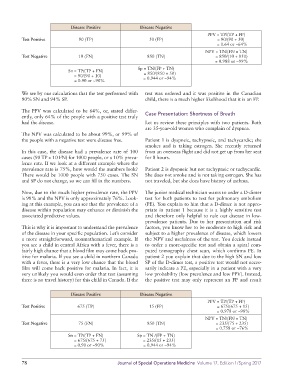
          We see by our calculations that the test performed with   test was ordered and it was positive in the Canadian
          90% SN and 94% SP.                                 child, there is a much higher likelihood that it is an FP.

          The PPV was calculated to be 64%, or, stated differ-  Case Presentation: Shortness of Breath
          ently, only 64% of the people with a positive test truly
          had the disease.                                   Let us review these principles with two patients. Both
                                                             are 35-year-old women who complain of dyspnea.
          The NPV was calculated to be about 99%, or 99% of
          the people with a negative test were disease free.  Patient 1 is dyspneic, tachypneic, and tachycardic; she
                                                             smokes and is taking estrogen. She recently returned
          In this case, the disease had a prevalence rate of 100   from an overseas flight and did not get up from her seat
          cases (90 TP + 10 FN) for 1000 people, or a 10% preva-  for 8 hours.
          lence rate. If we look at a different example where the
          prevalence rate is 75%, how would the numbers look?   Patient 2 is dyspneic but not tachypneic or tachycardic.
          There would be 1000 people with 750 cases. The SN   She does not smoke and is not taking estrogen. She has
          and SP do not change, so we can fill in the numbers.  not traveled, but she does have history of asthma.

          Now, due to the much higher prevalence rate, the PPV   The junior medical technician wants to order a D-dimer
          is 98% and the NPV is only approximately 76%. Look-  test for both patients to test for pulmonary embolism
          ing at this example, you can see that the prevalence of a   (PE). You explain to him that a D-dimer is not appro-
          disease within population may enhance or diminish the   priate in patient 1 because it is a highly sensitive test
          associated predictive values.                      and therefore only helpful to rule out disease in low-
                                                             prevalence patients. Due to her presentation and risk
          This is why it is important to understand the prevalence   factors, you know her to be moderate to high risk and
          of the disease in your specific population. Let’s consider   subject to a higher prevalence of disease, which lowers
          a more straightforward, nonmathematical example. If   the NPV and usefulness of the test. You decide instead
          you see a child in central Africa with a fever, there is a   to order a more-specific test and obtain a spiral com-
          fairly high chance that a blood film may come back pos-  puted tomography chest scan, which confirms PE. In
          itive for malaria. If you see a child in northern Canada   patient 2 you explain that due to the high SN and low
          with a fever, there is a very low chance that the blood   SP of the D-dimer test, a positive test would not neces-
          film will come back positive for malaria. In fact, it is   sarily indicate a PE, especially in a patient with a very
          very unlikely you would even order that test (assuming   low probability (low prevalence and low PPV). Instead,
          there is no travel history) for this child in Canada. If the   the positive test may only represent an FP and result


                              Disease Positive             Disease Negative
                                                                                       PPV = TP/(TP + FP)
          Test Positive          675 (TP)                      15 (FP)                          = 675/(675 + 15)
                                                                                                = 0.978 or ~98%
                                                                                      NPV = TN/(FN + TN)
          Test Negative          75 (FN)                      850 (TN)                         = 235/(75 + 235)
                                                                                              = 0.758 or ~76%
                             Sn = TP/(TP + FN)            Sp = TN /(FP + TN)
                                   = 675/(675 + 75)            = 235/(15 + 235)
                                  = 0.90 or ~90%               = 0.944 or ~94%


          78                                      Journal of Special Operations Medicine  Volume 17, Edition 1/Spring 2017

