


Page 99 - Journal of Special Operations Medicine - Spring 2017
P. 99
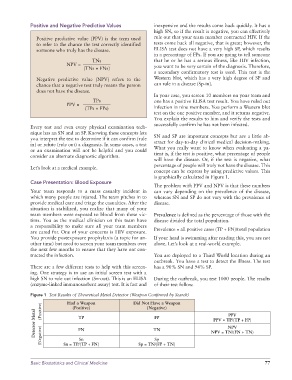
Positive and Negative Predictive Values            inexpensive and the results come back quickly. It has a
                                                                 high SN, so if the result is negative, you can effectively
                Positive predictive value (PPV) is the term used   rule out that your team member contracted HIV. If the
                to refer to the chance the test correctly identified   tests come back all negative, that is great; however, the
                someone who truly has the disease.               ELISA test does not have a very high SP, which results
                                                                 in a percentage of FPs. If you are going to tell someone
                                       TNs                       that he or he has a serious illness, like HIV infection,
                            NPV =                                you want to be very certain of the diagnosis. Therefore,
                                    (TNs + FNs)
                                                                 a secondary confirmatory test is used. This test is the
                Negative predictive value (NPV) refers to the    Western blot, which has a very high degree of SP and
                chance that a negative test truly means the person   can rule in a disease (Sp-in).
                does not have the disease.
                                                                 In your case, you screen 10 members on your team and
                                       TPs                       one has a positive ELISA test result. You have ruled out
                            PPV =
                                    (TPs + FPs)                  infection in nine members. You perform a Western blot
                                                                 test on the one positive member, and it returns negative.
                                                                 You explain the results to him and verify the tests and
                                                                 successfully confirm he has not been infected.
              Every test  and even every physical examination tech-
              nique has an SN and an SP. Knowing these concepts lets
              you interpret the test to determine if it can confirm (rule   SN and SP are important concepts but are a little ab-
              in) or refute (rule out) a diagnosis. In some cases, a test   stract for day-to-day clinical medical decision-making.
              or an  examination  will not be  helpful  and you could   What you really want to know when evaluating a pa-
              consider an alternate diagnostic algorithm.        tient is, if the test is positive, what percentage of people
                                                                 will have the disease. Or, if the test is negative, what
                                                                 percentage of people will truly not have the disease. This
              Let’s look at a medical example.
                                                                 concept can be express by using predictive values. This
                                                                 is graphically calculated in Figure 1.
              Case Presentation: Blood Exposure
                                                                 The problem with PPV and NPV is that these numbers
              Your team responds to a mass casualty incident in   can vary depending on the prevalence of the disease,
              which many people are injured. The team pitches in to   whereas SN and SP do not vary with the prevalence of
              provide medical care and triage the casualties. After the   disease.
              situation is stabilized, you realize that many of your
              team members were exposed to blood from these vic-  Prevalence is defined as the percentage of those with the
              tims. You as the medical clinician on this team have   disease divided the total population.
              a responsibility to make sure all your team members   Prevalence = all positive cases (TP + FN)/total population
              are cared for. One of your concerns is HIV exposure.
              You provide postexposure prophylaxis (a topic for an-  If your head is swimming after reading this, you are not
              other time) but need to screen your team members over   alone. Let’s look at a real-world example.
              the next few months to ensure that they have not con-
              tracted the infection.                             You are deployed to a Third World location during an
                                                                 outbreak. You have a test to detect the illness. The test
              There are a few different tests to help with this screen-  has a 90% SN and 94% SP.
              ing. One strategy is to use an initial screen test with a
              high SN to rule out infection (Sn-out). This is an ELISA   During the outbreak, you test 1000 people. The results
              (enzyme-linked immunosorbent assay) test. It is fast and   of their test follow.

              Figure 1  Test Results of Theoretical Metal Detector (Weapon Confirmed by Search)
                             Had a Weapon               Did Not Have a Weapon
                  (Positive)
                                                              (Negative)
                               (Positive)
               Detector Metal  (Negative)  TP                   TN                      NPV = TN/(FN + TN)
                                                                                               PPV
                                                                 FP
                                                                                         PPV = TP/(TP + FP)
                                                                                               NPV
                                 FN
                                                                 Sp
                                  Sn
                           Sn = TP/(TP + FN)


              Basic Biostatistics and Clinical Medicine   Sp = TN/(FP + TN)                                   77

