


Page 115 - Journal of Special Operations Medicine - Spring 2017
P. 115
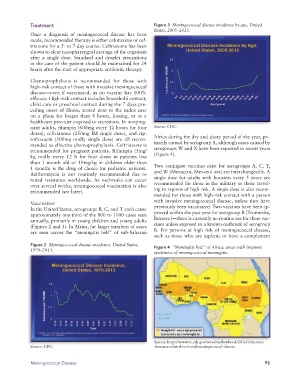
Treatment                                          Figure 3  Meningococcal disease incidence by age, United
                                                                 States, 2005–2013.
              Once a diagnosis of meningococcal disease has been
              made, recommended therapy is either cefotaxime or cef-
              triaxone for a 5- to 7-day course. Ceftriaxone has been
              shown to clear nasopharyngeal carriage of the organism
              after a single dose. Standard and droplet precautions
              in the care of the patient should be maintained for 24
              hours after the start of appropriate antibiotic therapy.

              Chemoprophylaxis is recommended for those with
              high-risk contact of those with invasive meningococcal
              disease—even if vaccinated, as no vaccine has 100%
              efficacy. High-risk contact includes household contact,
              child care or preschool contact during the 7 days pre-
              ceding onset of illness, seated next to the index case
              on a plane for longer than 8 hours, kissing, or as a
              healthcare provider exposed to secretions. In nonpreg-
              nant adults, rifampin (600mg every 12 hours for four   Source: CDC.
              doses), ceftriaxone (250mg IM single dose), and cip-
              rofloxacin (500mg orally single dose) are all recom-  Africa during the dry and dusty period of the year, pri-
              mended as effective chemoprophylaxis. Ceftriaxone is   marily caused by serogroup A, although cases caused by
              recommended for pregnant patients. Rifampin (5mg/  serogroups W and X have been reported in recent years
              kg orally every 12 h for four doses in patients less   (Figure 4).
              than 1 month old or 10mg/kg in children older than
              1 month) is the drug of choice for pediatric patients.   Two conjugate  vaccines  exist  for  serogroups  A, C,  Y,
              Azithromycin is not routinely recommended due to   and W (Menactra, Menveo) and are interchangeable. A
              noted resistance worldwide. As outbreaks can occur   single dose for adults with boosters every 5 years are
              over several weeks, meningococcal vaccination is also   recommended for those in the military or those travel-
              recommended (see later).                           ing to regions of high risk. A single dose is also recom-
                                                                 mended for those with high-risk contact with a person
                                                                 with invasive meningococcal disease, unless they have
              Vaccination
              In the United States, serogroups B, C, and Y each cause   previously been vaccinated. Two vaccines have been ap-
              approximately one-third of the 800 to 1000 cases seen   proved within the past year for serogroup B (Trumenba,
              annually, primarily in young children and young adults   Bexsero)—there is currently no routine use for these vac-
              (Figures 2 and 3). In Africa, far larger numbers of cases   cines unless exposed to a known outbreak of serogroup
              are seen across the “meningitis belt” of sub-Saharan   B. For persons at high risk of meningococcal disease,
                                                                 such as those who are asplenic or have a complement
              Figure 2  Meningococcal disease incidence, United States,   Figure 4  “Meningitis belt” of Africa: areas with frequent
              1970–2013.
                                                                 epidemics of meningococcal meningitis.


                                                                 Source: https://wwwnc.cdc.gov/travel/yellowbook/2016/infectious
              Source: CDC.                                       -diseases-related-to-travel/meningococcal-disease.


              Meningococcal Disease                                                                           91

