


Page 114 - Journal of Special Operations Medicine - Spring 2017
P. 114
An Ongoing Series


                                          Meningococcal Disease


                                                Mark W. Burnett, MD


          Introduction                                       to evaluate in  young children and infants. Meningo-
                                                             coccemia, or bloodstream infections, may occur with
          It’s a not uncommon story in the newspaper—college   or without meningitis and have features of limb pain,
          student goes to bed with “flu-like symptoms” only to   purpura, shock, adrenal hemorrhage, and multisystem
          be found dead the next day after not reporting for class.   organ failure. In both meningococcal meningitis and
          Meningococcal disease, caused by the bacterium Neis-  sepsis, initial symptoms may be “flu-like,” which may
          seria meningitidis, is one of the most common causes of   lead to a delay in the patient seeking care. Less common
          sepsis and meningitis in the United States and a feared   presentations of this disease include pneumonia (up to
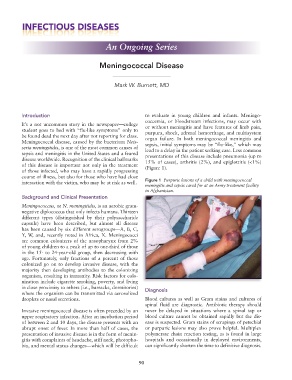
          disease worldwide. Recognition of the clinical hallmarks   15% of cases), arthritis (2%), and epiglottitis (<1%)
          of this disease is important not only in the treatment   (Figure 1).
          of those infected, who may have a rapidly progressing
          course of illness, but also for those who have had close
          interaction with the victim, who may be at risk as well.  Figure 1  Purpuric lesions of a child with meningococcal
                                                             meningitis and sepsis cared for at an Army treatment facility
                                                             in Afghanistan.
          Background and Clinical Presentation
          Meningococcus, or N. meningitidis, is an aerobic gram-
          negative diplococcus that only infects humans. Thirteen
          different types (distinguished by their polysaccharide
          capsule) have been  described, but almost all disease
          has been caused by six different serogroups—A, B, C,
          Y, W, and, recently noted in Africa, X. Meningococci
          are  common  colonizers  of  the  nasopharynx  from  2%
          of young children to a peak of up to one-third of those
          in the 15- to 24-year-old group, then decreasing with
          age.  Fortunately,  only  fractions  of  a  percent  of  those
          colonized go on to develop invasive disease, with the
          majority then developing antibodies to the colonizing
          organism, resulting in immunity. Risk factors for colo-
          nization include cigarette smoking, poverty, and living
          in close proximity to others (i.e., barracks, dormitories)   Diagnosis
          where the organism can be transmitted via aerosolized
          droplets or nasal secretions.                      Blood cultures as well as Gram stains and cultures of
                                                             spinal fluid are diagnostic. Antibiotic therapy should
          Invasive meningococcal disease is often preceded by an   never be delayed in situations where a spinal tap or
          upper respiratory infection. After an incubation period   blood culture cannot be obtained rapidly but the dis-
          of between 2 and 10 days, the disease presents with an   ease is suspected. Gram stains of scrapings of petechial
          abrupt onset of fever. In more than half of cases, the   or purpuric lesions may also prove helpful. Multiplex
          presentation of invasive disease is in the form of menin-  polymerase chain reaction testing, as is found in large
          gitis with complaints of headache, stiff neck, photopho-  hospitals and occasionally in deployed environments,
          bia, and mental status changes—which will be difficult   can significantly shorten the time to definitive diagnosis.


                                                          90

