


Page 109 - Journal of Special Operations Medicine - Spring 2017
P. 109
conceptualized by Maddi et al. as “the existential cour-  controversial, studies suggest that P2 may have to take
              age and motivation to cope effectively with stressful cir-  into account certain elements of a person’s social envi-
              cumstances.” 58,59  Likewise, the trait of risk taking is a   ronments and networks along with more conventional
              “critical component of judgment and decision- making   (e.g., physical and cognitive) domains of performance.
              in military operations.”  Although many of these traits   It is reasonable  to believe that  the frequency, quality,
                                  60
              have traditionally been difficult to quantify, new data   and kinds of social interactions and environments a per-
              collection tools and analytic approaches may help   son experiences shape their biology  in ways that could
                                                                                               61
                tomorrow’s P2 better incorporate individual differences   help bring further precision to guiding the appropriate
              in these historically intangible qualities.        kind of individualized HPO tool or intervention for P2.
                                                                 Further, the role of social networks and social influence
                                                                 may be important for better understanding the source of
              Individual Social and Environmental Differences
                                                                 certain behaviors or the spread and adoption of habits
              As creatures that have evolved to shape and be shaped   important for HPO within a group or unit. (This invites
              by their social environments, humans present further   discussion about having to consider the role of unit cul-
              challenges when one is trying to understand sources of   ture in how HPO programs are designed, but that is a
              individual differences that might be important for P2.   topic for a future article.) As with many efforts seeking
              Consider that the examples presented have not even   to understand human variability, it is important to note
              addressed potential interactions among the social and   that this area of social biology is still highly speculative,
              biological levels of human behavior, which may cre-  with research likely to invite many false starts and un-
              ate certain feedback loops that are increasingly being   supported claims. For example, several overstated asser-
              identified  as  important  for  understanding  why  people   tions about social epigenetics have been derived mainly
              differ under otherwise seemingly similar conditions and   from animal studies but either were not looked at or
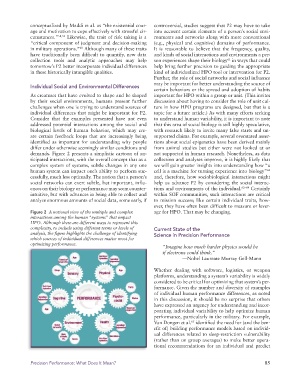
              demands. Figure 2 presents a simplistic cartoon of an-  not supported in human research. Nonetheless, as data
              ticipated interactions, with the overall concept that as a   collection and analyses improve, it is highly likely that
              complex system of systems, subtle changes in any one   we will gain greater insights into understanding how “a
              human system can impact one’s ability to perform suc-  cell is a machine for turning experience into biology”
                                                                                                               62
              cessfully, much less optimally. The notion that a person’s   and, therefore, how sociobiological interactions might
              social networks can exert subtle, but important, influ-  help us advance P2 by considering the social interac-
              ences on their biology or performance may seem counter-  tions and environments of the individual. 62–64  Certainly
              intuitive, but with advances in being able to collect and   within SOF communities, such interactions are critical
              analyze enormous amounts of social data, some early, if   to mission success; like certain individual traits, how-
                                                                 ever, they have often been difficult to measure or lever-
              Figure 2  A notional view of the multiple and complex   age for HPO. That may be changing.
              interactions among the human “systems” that impact
              HPO. Although there are different ways to represent this
              complexity, to include using different terms or levels of   Current State of the
              analysis, the figure highlights the challenge of identifying   Science in Precision Performance
              which sources of individual differences matter most for
              optimizing performance.
                                                                    “Imagine how much harder physics would be
                                                                    if electrons could think.”
                                                                            —Nobel Laureate Murray Gell-Mann

                                                                 Whether dealing with software, logistics, or weapon
                                                                 platforms, understanding a system’s variability is widely
                                                                 considered to be critical for optimizing that system’s per-
                                                                 formance. Given the number and diversity of examples
                                                                 of individual human performance differences, as noted
                                                                 in this discussion, it should be no surprise that others
                                                                 have expressed an urgency for understanding and incor-
                                                                 porating individual variability to help optimize human
                                                                 performance, particularly in the military. For example,
                                                                 Van Dongen et al.  identified the need for (and the ben-
                                                                                65
                                                                 efit of) building performance models based on individ-
                                                                 ual differences related to sleep-restriction vulnerability
                                                                 (rather than on group averages) to make better opera-
                                                                 tional recommendations for an individual and predict


              Precision Performance: What Does It Mean?                                                       85

