


Page 106 - Journal of Special Operations Medicine - Spring 2017
P. 106
the time it takes others to tackle just one. Hence, it may   to appreciate how assuming that average applies to any-
          seem self-evident, and, therefore, somewhat trivial, to   one can result in erroneous conclusions when data are
          note that people differ in terms of performance aptitudes   analyzed based on that assumption. In some cases, the
          and how they may respond to different interventions or   focus on group means can lead to the opposite conclu-
          training. Thus, individual differences might define what   sion of what the individual data are actually showing
          “optimal performance” means for any given person. Ac-  about different responses and their variability. Figure 1
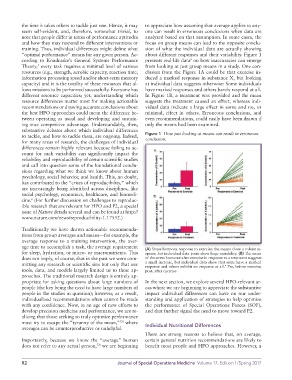
          cording  to  Kondraske’s  General  Systems  Performance   presents real-life data  on how inaccuracies can emerge
                                                                                9
          Theory,  every task requires a minimal level of various   from looking at just group means in a study. One con-
                 5
          resources (e.g., strength, aerobic capacity, reaction time,   clusion from the Figure 1A could be that exercise in-
          information processing speed and/or short-term memory   duced a marked response in substance X, but looking
          capacity) and it is the totality of these resources that al-  at individual data suggests otherwise: Some individuals
          lows missions to be performed successfully. Everyone has   have marked responses and others barely respond at all.
          different resource capacities; yet, understanding which   In Figure 1B, a treatment was provided and the mean
          resource differences matter most for making actionable   suggests the treatment caused an effect, whereas indi-
          recommendations or drawing accurate conclusions about   vidual data indicate a large effect in some and no, or
          the best HPO approaches could mean the difference be-  minimal, effect in others. Erroneous conclusions, and
          tween operating as usual and developing and sustain-  even recommendations, could easily have been drawn if
          ing true competitive advantage. Understandably, then,   only the means had been examined.
          substantive debates about which individual differences
          to tackle, and how to tackle them, are ongoing. Indeed,   Figure 1  How just looking at means can result in erroneous
                                                             conclusion.
          for many areas of research, the challenges of individual
          differences remain highly relevant because failing to ac-
          count for such variability can significantly impact the
          reliability and reproducibility of certain scientific studies
          and call into question some of the foundational conclu-
          sions regarding what we think we know about human
          psychology, social behavior, and health. This, no doubt,
          has contributed to the “crises of reproducibility,” which
          are increasingly being identified across disciplines, like
          social psychology, economics, healthcare, and biomedi-
          cine.  (For further discussion on challenges to reproduc-
              6
          ible research that are relevant for HPO and P2, a special
          issue of Nature details several and can be found at http://
          www.nature.com/news/reproducibility-1.17552.)

          Traditionally we have drawn actionable recommenda-
          tions from group averages and means—for example, the
          average response to a training intervention, the aver-
          age time to accomplish a task, the average requirement   (A) Stress hormone response to exercise: the means show a robust re-
          for sleep, hydration, or micro- or macronutrients. This   sponse but individual data point show huge variability. (B) The mean
          does not imply, of course, that in the past we were com-  of the stress hormone after exercise in response to a treatment suggests
          mitting any research or scientific sins but only that our   a small increase, but individual data show that some have a marked
                                                             response and others exhibit no response at all.  Pre, before exercise;
                                                                                              9
          tools, data, and models largely limited us to these ap-  post, after exercise.
          proaches. The traditional research design is entirely ap-
          propriate for asking questions about large numbers of   In the next section, we explore several HPO-relevant ar-
          people (the key being the need to have large numbers of   eas where we are beginning to appreciate the substantive
          people in the studies in question); however, as a result,   impact individual differences can have on our under-
          individualized recommendations often cannot be made   standing and application of strategies to help optimize
          with any confidence. Now, in an age of new efforts to   the performance of Special Operations Forces (SOF),
          develop precision medicine and performance, we are re-  and that further signal the need to move toward P2.
          alizing that those seeking to truly optimize performance
          must try to escape the “tyranny of the mean,”  where   Individual Nutritional Differences
                                                  7,8
          averages can be counterproductive or unhelpful.
                                                             There are strong reasons to believe that, on average,
          Importantly, because we know the “average” human   certain general nutrition recommendations are likely to
          does not refer to any actual person,  we are beginning   benefit most people and HPO approaches. However, a
                                         7,8


          82                                      Journal of Special Operations Medicine  Volume 17, Edition 1/Spring 2017

