


Page 108 - Journal of Special Operations Medicine - Spring 2017
P. 108
performance decrements can be introduced. However, it   bacterial species in various parts of the body is some-
          is worth emphasizing that P2 must be more than “HPO   what overwhelming and the data revealed by research
          by anecdote” and cannot be based solely on a person’s   are not always consistent. 10,49–52  However, differences
          subjective judgment about something like how much   in an individual’s microbiome may prove to have far-
          sleep  they  think they need.  Despite individual differ-  reaching consequences for the development of disease,
          ences, the importance of sleep as a biological imperative   from cognitive to sensory to physical effects, and hence
          cannot be denied,  and many studies have shown that   provide countermeasures  to mitigate  performance
                          35
          people are notoriously poor judges of how much sleep     decrements. 24,49,52  Likewise, unfavorable microorgan-
          they both require and actually get. A true P2 approach,   isms could potentially threaten a mission’s success. We
          therefore, would use objective data to determine how   know far too little to make any recommendations re-
          much sleep is likely optimal for any individual.   garding the microbiome, but accumulating evidence
                                                             suggests that it will become increasingly important as
          Response to physical training                      we move forward in both PMI and P2.
          and psychological stress
          Individual differences in response to physical and psy-  Individual Psychological Differences
          chological training and stress are well documented. Ex-
          amples include differential responses to exercise, such as   As debate continues about what may affect real-world
          peri- and postexercise levels of creatine kinase, 36–38  stress   performance outcomes, the contribution of individual
          hormones, 9,33,39–42  and immune markers ; psychological   traits and predispositions (i.e., who you came into the
                                            39
          stress (stress hormones) 41–43 ; and genetic predispositions   world as) with certain inclinations, tendencies and pro-
          for some individuals to lose, rather than gain, bone den-  clivities, remains a longstanding interest. Increasing evi-
          sity during exercise in basic training.  Other data show   dence indicates P2 approaches may have to factor such
                                          45
          a wide range of responses to the same exercise interven-  individual differences into approaches for training and
          tion; for example, some individuals are very responsive   performance. For example, it is well documented that
          to strength and/or aerobic training and others exhibit   maintaining attention when carrying out everyday tasks
          little to no response, 46–48  similar to what we described   is always challenging but it is potentially life threatening
          for  creatine  and  β-alanine  supplementation.  Table  1   in many mission situations. This would be particularly
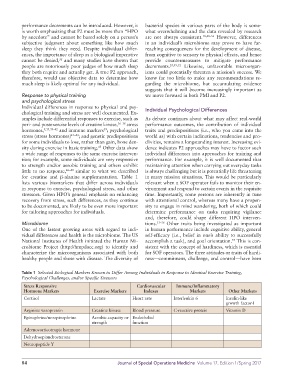
          lists  various  biomarkers  that  differ  across  individuals   relevant when a SOF operator fails to monitor their en-
          in response to exercise, psychological stress, and other   vironment and respond to certain events in the requisite
          stressors. Given HPO’s general emphasis on enhancing   time. Importantly, some persons are inherently in tune
          recovery from stress, such differences, as they continue   with attentional control, whereas many have a propen-
          to be documented, are likely to be even more important   sity to engage in mind wandering, both of which could
          for tailoring approaches for individuals.          determine performance  on tasks requiring vigilance
                                                             and,  therefore,  could  shape  different  HPO  interven-
          Microbiome                                         tions. 53–56  Other traits being investigated as important
          One of the fastest growing areas with regard to indi-  in human performance include cognitive ability, general
          vidual differences and health is the microbiome. The US   self- efficacy (i.e., belief in one’s ability to successfully
          National Institutes of Health initiated the Human Mi-  accomplish a task), and goal orientation.  This is con-
                                                                                                 57
          crobiome Project (http://hmpdacc.org) to identify and   sistent with the concept of hardiness, which is essential
          characterize the microorganisms associated with both   for SOF operators. The three attitudes or traits of hardi-
          healthy people and those with disease. The  diversity of   ness—commitment, challenge, and control—have been


          Table 1  Selected Biological Markers Known to Differ Among Individuals in Response to Identical Exercise Training,
          Psychological Challenges, and/or Specific Stressors
           Stress Responsive                              Cardiovascular   Immune/Inflammatory
           Hormone Markers              Exercise Markers    Indexes            Markers         Other Markers
           Cortisol                    Lactate          Heart rate       Interleukin 6        Insulin-like
                                                                                              growth factor-I
           Arginine vasopressin        Creatine kinase  Blood pressure   C-reactive protein   Vitamin D
           Epinephrine/norepinephrine  Aerobic capacity or  Endothelial
                                       strength         function
           Adrenocorticotropic hormone
           Dehydroepiandrosterone
           Neuropeptide Y


          84                                      Journal of Special Operations Medicine  Volume 17, Edition 1/Spring 2017

