


Page 145 - Journal of Special Operations Medicine - Summer 2016
P. 145
What Can TCCC Offer to                             CRASH-2: Timing of TXA
                       My Civilian EMS System?                                Dosing – Lancet 2011


               •  Tourniquets
               •  Hemostatic dressings
               •  Trauma airway approach
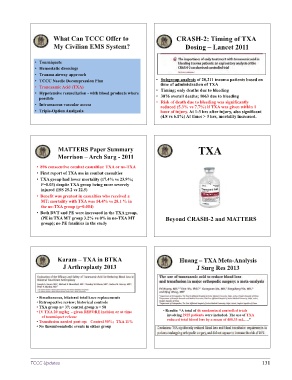
               •  TCCC Needle Decompression Plan                  •  Subgroup analysis of 20,211 trauma patients based on
               •  Tranexamic Acid (TXA)                            time of administration of TXA
               •  Hypotensive resuscitation - with blood products where   •  Timing; only deaths due to bleeding
                 possible                                         •  3076 overall deaths; 1063 due to bleeding
               •  Intraosseous vascular access                    •  Risk of death due to bleeding was significantly
                                                                   reduced (5.3% vs 7.7%) if TXA was given within 1
               •  Triple-Option Analgesia                          hour of injury. At 1-3 hrs after injury, also significant
                                                                   (4.8 vs 6.1%) At times > 3 hrs, mortality increased.


                         MATTERS Paper Summary                                     TXA
                         Morrison – Arch Surg - 2011

                •  896 consecutive combat casualties: TXA or no-TXA
                •  First report of TXA use in combat casualties
                •  TXA group had lower mortality (17.4% vs 23.9%;
                  P=0.03) despite TXA group being more severely
                  injured (ISS 25.2 vs 22.5)
                •  Benefit was greatest in casualties who received a
                  MT: mortality with TXA was 14.4% vs 28.1 % in
                  the no-TXA group (p=0.004)
                •  Both DVT and PE were increased in the TXA group,
                  (PE in TXA MT group 3.2% vs 0% in no-TXA MT        Beyond CRASH-2 and MATTERS
                  group); no PE fatalities in the study


                         Karam – TXA in BTKA                               Huang – TXA Meta-Analysis
                           J Arthroplasty 2013                                    J Surg Res 2013


                •  Simultaneous, bilateral total knee replacements
                •  Retrospective review; historical controls
                •  TXA group n= 37; control group n = 50
                •  IV TXA 20 mg/kg  - given BEFORE incision or at time   •  Results: “A total of 46 randomized controlled trials
                     of tourniquet release                              involving 2925 patients were included. The use of TXA
                •  Transfusion needed post-op:   Control 50%;  TXA 11%       reduced total blood loss by a mean of 408.33 mL….”
                •  No thromboembolic events in either group


              TCCC Updates                                                                                   131

