


Page 143 - Journal of Special Operations Medicine - Summer 2016
P. 143
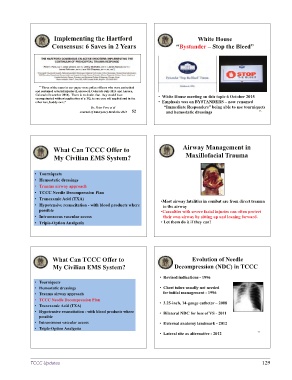
Implementing the Hartford                                   White House
                      Consensus: 6 Saves in 2 Years                       “Bystander – Stop the Bleed”


                    “ Three of the cases in our paper were police officers who were ambushed
                and sustained arterial injuries (Lakewood, Colorado July 2014 and Aurora,
                Colorado December 2014).  There is no doubt that  they would have   •  White House meeting on this topic 6 October 2015
                exsanguinated without application of a TQ, in one case self applied and in the
                other two, buddy care.”                           •  Emphasis was on BYSTANDERS – now renamed
                                                                       “Immediate Responders” being able to use tourniquets
                                       Dr. Peter Pons et al
                                  Journal of Emergency Medicine 2015   52          and hemostatic dressings   53


                       What Can TCCC Offer to                                Airway Management in

                       My Civilian EMS System?                                Maxillofacial Trauma


               •  Tourniquets
               •  Hemostatic dressings
               •  Trauma airway approach
               •  TCCC Needle Decompression Plan
               •  Tranexamic Acid (TXA)                            • Most airway fatalities in combat are from direct trauma
               •  Hypotensive resuscitation - with blood products where   to the airway
                 possible                                          • Casualties with severe facial injuries can often protect
               •  Intraosseous vascular access                       their own airway by sitting up and leaning forward.
               •  Triple-Option Analgesia                          •  Let them do it if they can!


                       What Can TCCC Offer to                                    Evolution of Needle
                       My Civilian EMS System?                           Decompression (NDC) in TCCC

                                                                   •  Revised indications - 1996
               •  Tourniquets
               •  Hemostatic dressings                             •  Chest tubes usually not needed
               •  Trauma airway approach                              for initial management - 1996
               •  TCCC Needle Decompression Plan                   •  3.25-inch, 14-gauge catheter – 2008
               •  Tranexamic Acid (TXA)
               •  Hypotensive resuscitation - with blood products where   •  Bilateral NDC for loss of VS - 2011
                 possible
               •  Intraosseous vascular access                     •  External anatomy landmark - 2012
               •  Triple-Option Analgesia
                                                                   •  Lateral site as alternative - 2012    57


              TCCC Updates                                                                                   129

