


Page 147 - Journal of Special Operations Medicine - Summer 2016
P. 147
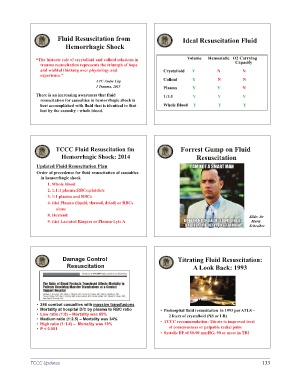
Fluid Resuscitation from                            Ideal Resuscitation Fluid
                            Hemorrhagic Shock

                “The historic role of crystalloid and colloid solutions in                        Volume      Hemostatic   O2 Carrying
                                                                                                                                      Capacity
                  trauma resuscitation represents the triumph of hope
                  and wishful thinking over physiology and           Crystalloid       Y                    N                    N
                  experience.”
                                                                                             LTC Andre Cap   Colloid              Y                    N                    N

                                                                                J Trauma, 2015   Plasma              Y                    Y                    N

                There is an increasing awareness that fluid          1:1:1                  Y                    Y                    Y
                  resuscitation for casualties in hemorrhagic shock is
                  best accomplished with fluid that is identical to that   Whole Blood     Y                    Y                    Y
                  lost by the casualty - whole blood.


                        TCCC Fluid Resuscitation fm                         Forrest Gump on Fluid
                          Hemorrhagic Shock: 2014                                 Resuscitation

                Updated Fluid Resuscitation Plan
                Order of precedence for fluid resuscitation of casualties
                  in hemorrhagic shock
                     1. Whole blood
                     2. 1:1:1 plasma:RBCs:platelets
                     3. 1:1 plasma and RBCs
                     4. (tie) Plasma (liquid, thawed, dried) or RBCs
                             alone
                     8. Hextend                                                                         Slide: Dr
                     9. (tie) Lactated Ringers or Plasma-Lyte A                                           Marty
                                                                                                        Schreiber


                           Damage Control                                 Titrating Fluid Resuscitation:
                             Resuscitation                                       A Look Back: 1993


                •   246 combat casualties with massive transfusions
                •   Mortality at hospital D/C by plasma to RBC ratio   •  Prehospital fluid resuscitation  in 1993 per ATLS –
                •   Low ratio (1:8) – Mortality was 65%                    2 liters of crystalloid (NS or LR)
                •   Medium ratio (1:2.5) – Mortality was 34%       •  TCCC recommendation: Titrate to improved level
                •   High ratio (1:1.4) –  Mortality was 19%
                •   P < 0.001                                              of consciousness or palpable radial pulse
                                                                   •  Systolic BP of 80-90 mmHG; 90 or more in TBI


              TCCC Updates                                                                                   133

