


Page 148 - Journal of Special Operations Medicine - Summer 2016
P. 148
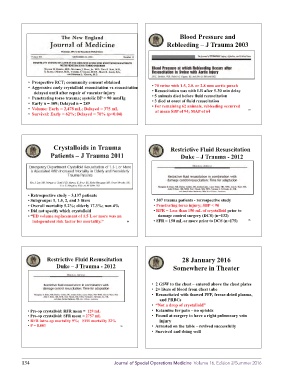
Blood Pressure and
                                                                      Rebleeding – J Trauma 2003


             •   Prospective RCT; community consent obtained
             •   Aggressive early crystalloid resuscitation vs resuscitation   •  70 swine with 1.5, 2.0. or 2.8 mm aortic punch
                  delayed until after repair of vascular injury   •  Resuscitation was with LR after 5-30 min delay
             •   Penetrating torso trauma; systolic BP < 90 mmHg   •  5 animals died before fluid resuscitation
             •   Early n = 309; Delayed n = 289                 •  3 died at onset of fluid resuscitation
             •   Volume: Early = 2,478 mL; Delayed = 375 mL     •  For remaining 62 animals, rebleeding occurred    83
                                                                   at mean SBP of 94; MAP of 64
             •   Survival: Early = 62%; Delayed = 70% (p=0.04)


                       Crystalloids in Trauma                          Restrictive Fluid Resuscitation
                      Patients – J Trauma 2011                              Duke – J Trauma - 2012


             •  Retrospective study – 3,137 patients
             •  Subgroups: 1, 1.5, 2, and 3 liters              •  307 trauma patients - retrospective study
             •  Overall mortality 5.2%; elderly 17.3%; non 4%   •  Penetrating torso injury; SBP < 90
             •  Did not specify which crystalloid               •  RFR = Less than 150 mL of crystalloid prior to
             •  “ED volume replacement of 1.5 L or more was an       damage control surgery (DCS) (n=132)
                 independent risk factor for mortality.”   84   •  SFR = 150 mL or more prior to DCS (n=175)   85


                    Restrictive Fluid Resuscitation                         28 January 2016
                         Duke – J Trauma - 2012                          Somewhere in Theater


                                                                •   2 GSW to the chest – entered above the chest plates
                                                                •   2+ liters of blood from chest tube
                                                                •   Resuscitated with thawed FFP, freeze-dried plasma,
                                                                       and PRBCs
                                                                •   “Not a drop of crystalloid”
             •  Pre-op crystalloid: RFR mean =  129 mL          •   Ketamine for pain – no opioids
             •  Pre-op crystalloid: SFR mean = 2757 mL          •   Found at surgery to have a right pulmonary vein
             •  RFR intra-op mortality 9%;   SFR mortality 32%          injury
             •  P = 0.001                          86           •   Arrested on the table – revived successfully
                                                                •   Survived and doing well


          134                                   Journal of Special Operations Medicine  Volume 16, Edition 2/Summer 2016

