


Page 150 - Journal of Special Operations Medicine - Summer 2016
P. 150
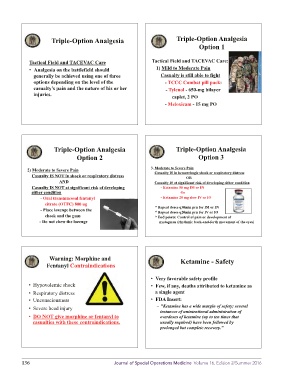
Triple-Option Analgesia                             Triple-Option Analgesia
                                                                                   Option 1


             Tactical Field and TACEVAC Care                    Tactical Field and TACEVAC Care:
             •  Analgesia on the battlefield should               1) Mild to Moderate Pain
               generally be achieved using one of three                Casualty is still able to fight
               options depending on the level of the                     - TCCC Combat pill pack:
               casualty’s pain and the nature of his or her             - Tylenol - 650-mg bilayer
               injuries.                                                        caplet, 2 PO
                                                                          - Meloxicam - 15 mg PO


                       Triple-Option Analgesia                            Triple-Option Analgesia
                                 Option 2                                          Option 3


            2) Moderate to Severe Pain                         3. Moderate to Severe Pain
                Casualty IS NOT in shock or respiratory distress        Casualty IS in hemorrhagic shock or respiratory distress
                                                                                                     OR
                                         AND                       Casualty IS at significant risk of developing either condition
                Casualty IS NOT at significant risk of developing          - Ketamine 50 mg IM or IN
              either condition                                                           Or
                       - Oral transmucosal fentanyl                     - Ketamine 20 mg slow IV or IO
                            citrate (OTFC) 800 ug
                       - Place lozenge between the                * Repeat doses q30min prn for IM or IN
                            cheek and the gum                     * Repeat doses q20min prn for IV or IO
                                                                  * End points: Control of pain or development of
                       - Do not chew the lozenge                        nystagmus (rhythmic back-and-forth movement of the eyes)


                     Warning: Morphine and                                  Ketamine - Safety
                    Fentanyl Contraindications


                                                               •  Very favorable safety profile
             •  Hypovolemic shock                              •  Few, if any, deaths attributed to ketamine as
             •  Respiratory distress                             a single agent
             •  Unconsciousness                                •  FDA Insert:
             •  Severe head injury                                – "Ketamine has a wide margin of safety; several
                                                                   instances of unintentional administration of
             •  DO NOT give morphine or fentanyl to                overdoses of ketamine (up to ten times that
               casualties with these contraindications.            usually required) have been followed by
                                                                   prolonged but complete recovery.”


          136                                   Journal of Special Operations Medicine  Volume 16, Edition 2/Summer 2016

