


Page 26 - Journal of Special Operations Medicine - Winter 2015
P. 26
patrols in the British Armed Forces.  The use of blood   Figure 8  Leukocyte-reducing, platelet-sparing filter for fresh
                                         65
          products in association with other advanced capabilities   whole-blood transfusions.
          on evacuation platforms has been associated with an in-
          crease in survival. 66–68

          Combatant-to-combatant “buddy” transfusions have
          been used successfully in US Military operations,  and
                                                     69
          may be life saving. Type O, low A-, low B-titer whole
          blood has been proposed as the universal donor for
          whole-blood transfusions, 62,63,70  and some Combat units
          are now actively working to implement this mode of re-
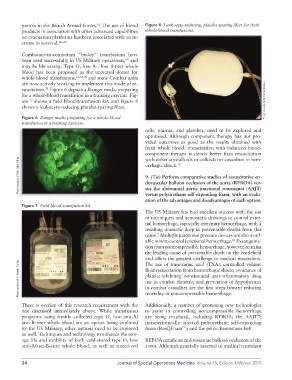
          suscitation.  Figure 6 depicts a Ranger medic preparing
                    71
          for a whole-blood transfusion in a training exercise. Fig-
          ure 7 shows a field blood-transfusion kit, and Figure 8                                             Photo courtesy of Dr Warren Dorlac
          shows a leukocyte-reducing platelet-sparing filter.

          Figure 6  Ranger medic preparing for a whole-blood
          transfusion in a training exercise.
                                                             cells, plasma, and platelets, need to be explored and
                                                             optimized. Although component therapy has not pro-
                                                             vided outcomes as good as the results obtained with
                                                             fresh whole blood, resuscitation with balanced blood-
                                                             component therapy is clearly better than resuscitation
                                                             with either crystalloids or colloids for casualties in hem-
         Photo courtesy of MAJ Ethan Miles                   orrhagic shock.
                                                                          12

                                                             9. (Tie) Perform comparative studies of resuscitative en-
                                                             dovascular balloon occlusion of the aorta (REBOA) ver-
                                                             sus the abdominal aortic junctional tourniquet (AAJT)
                                                             versus polyurethane self-expanding foam, with an evalu-
                                                             ation of the advantages and disadvantages of each option.
          Figure 7  Field blood-transfusion kit.
          The increasing emphasis on DCR and recognition of the   The US Military has had excellent success with the use
          need to provide hemostatic capability along with red   of tourniquets and hemostatic dressings to control exter-
          cells and volume have caused crystalloid and colloid use   nal hemorrhage, especially extremity hemorrhage, with a
          to decline in popularity, even in the prehospital setting.    resulting dramatic drop in preventable deaths from this
                                                         12
          This necessitates the continued development of new op-  cause.  Multiple junctional pressure devices are also avail-
                                                                  2
          tions for optimizing delivery methods for whole blood   able now to control junctional hemorrhage.  Exsanguina-
                                                                                                 23
          and blood-component therapy in the prehospital setting.  tion from noncompressible hemorrhage, however, remains
                                                             the leading cause of preventable death on the battlefield
          9. (Tie) Study methods for increasing the availability,   and offers the greatest challenge to medical researchers.
         Photo courtesy of Dr Warren Dorlac  platelets, and whole blood in the deployed combat envi-  fluid resuscitation from hemorrhagic shock; avoidance of
                                                             The use of tranexamic acid (TXA); controlled volume
          safety, efficacy, and shelf life of cold stored plasma,
          ronment—in particular, a cryoprotective agent to allow
                                                             platelet-inhibiting nonsteroidal anti- inflammatory drug
          type O, low titer, whole blood to be frozen for storage,
                                                             use in combat theaters; and prevention of hypothermia
          then used later with full hemostatic function of plasma
                                                             in combat casualties are the first steps toward reducing
          and platelets.
                                                             Additionally, a number of promising new technologies
          There is overlap of this research requirement with the   mortality in noncompressible hemorrhage.
          one discussed immediately above. While transfusion   to assist in controlling noncompressible hemorrhage
          programs using freshly collected type O, low anti-A/  are being evaulated, including REBOA; the AAJT ;
                                                                                                           ™
          anti-B–titer whole blood are an option being explored     intraperitoneally injected polyurethane self-expanding
          by the US Military, other options need to be explored   foam (ResQFoam ); and the pelvic hemostasis belt.
                                                                            ™
          as well. Techniques and technology to enhance the stor-
          age life and usability of both cold-stored type O, low   REBOA entails an endovascular balloon occlusion of the
          anti-A/anti-B–titer whole blood, as well as stored red   aorta. Although generally inserted in medical treatment


          14                                     Journal of Special Operations Medicine  Volume 15, Edition 4/Winter 2015

