


Page 22 - Journal of Special Operations Medicine - Winter 2015
P. 22
is used by the United Kingdom, France, Germany, The   hemorrhagic shock, especially those with noncompress-
          Netherlands,  and Israel, 12,36  but  there is  still no  FDA-  ible hemorrhage. This study would provide valuable in-
          approved dried plasma product available to US Forces.   formation about the magnitude of the lifesaving benefit
          The US Special Operations Command (USSOCOM)        derived from using plasma alone in the prehospital set-
          has spearheaded efforts to obtain approval for an FDP   ting. To better translate the findings of this study to the
          product  to  be  used  by  SOF  medics.  The  Commander   military setting, the study should preferably be done in
          of USSOCOM emphasized the urgent need for this ap-  emergency medical services systems that have relatively
          proval in a letter to the acting Assistant Secretary of De-  long prehospital evacuation times. The prehospital re-
          fense for Health Affairs in 2010.  In the absence of an   suscitation fluid choice may be less likely to improve
                                       37
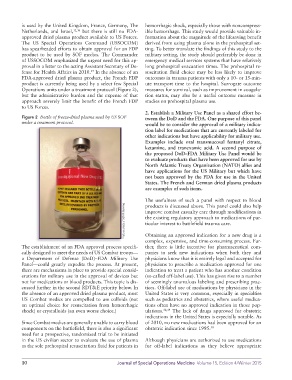
          FDA-approved dried plasma product, the French FDP   outcomes in trauma patients with only a 10- or 15-min-
          product is currently being used by a select few Special   ute transport time to the hospital. Surrogate outcome
          Operations units under a treatment protocol (Figure 2),   measures for survival, such as improvement in coagula-
          but the administrative burden and the expense of that   tion status, may also be a useful outcome measure in
          approach severely limit the benefit of the French FDP   studies on prehospital plasma use.
          to US Forces.
                                                             2. Establish a Military Use Panel as a shared effort be-
          Figure 2  Bottle of freeze-dried plasma used by US SOF   tween the DoD and the FDA. One purpose of this panel
          under a treatment protocol.                        would be to consider the approval of a military indica-
                                                             tion label for medications that are currently labeled for
                                                             other indications but have applicability for military use.
                                                             Examples include oral transmucosal fentanyl citrate,
                                                             ketamine, and tranexamic acid. A second purpose of
                                                             the proposed DoD–FDA Military Use Panel would be
                                                             to evaluate products that have been approved for use by
                                                             North Atlantic Treaty Organization (NATO) allies and
                                                             have applications for the US Military but which have
                                                             not been approved by the FDA for use in the United
                                                             States. The French and German dried plasma products
                                                             are examples of such items.

                                                             The usefulness of such a panel with respect to blood
                                                             products is discussed above. This panel could also help
                                                    Photo courtesy of SGM F. Bowling  improve combat casualty care through modifications in
                                                             the existing regulatory approach to medications of par-
                                                             ticular interest to battlefield trauma care.

                                                             Obtaining an approved indication for a new drug is a
                                                             complex, expensive, and time-consuming process. Fur-
          The establishment of an FDA approval process specifi-  ther, there is little  incentive for  pharmaceutical com-
          cally designed to meet the needs of US Combat troops—  panies to seek new indications when both they and
          a Department of Defense (DoD)–FDA Military Use     physicians know that it is entirely legal and accepted for
          Panel—could greatly expedite the process. At present,   physicians to prescribe a medication approved for one
          there are mechanisms in place to provide special consid-  indication to treat a patient who has another condition
          erations for military use in the approval of devices but   (so-called off-label use). This has given rise to a number
          not for medications or blood products. This topic is dis-  of seemingly anomalous labeling and prescribing prac-
          cussed further in the second RDT&E priority below. In   tices. Off-label use of medications by physicians in the
          the absence of an approved dried plasma product, most   United States is very common, especially in specialties
          US Combat medics are compelled to use colloids (not   such as pediatrics and obstetrics, where useful medica-
          an optimal choice for resuscitation from hemorrhagic   tions often have no approved indication in those pop-
          shock) or crystalloids (an even worse choice.)     ulations. 38,39   The lack of drugs approved for obstetric
                                                             indications in the United States is especially notable. As
          Since Combat medics are generally unable to carry blood   of 2010, no new medications had been approved for an
          components on the battlefield, there is also a significant   obstetric indication since 1995. 38
          need for a prospective, randomized trial to be initiated
          in the US civilian sector to evaluate the use of plasma   Although physicians are authorized to use medications
          as the sole prehospital resuscitation fluid for patients in   for off-label indications as they believe   appropriate


          10                                     Journal of Special Operations Medicine  Volume 15, Edition 4/Winter 2015

