


Page 23 - Journal of Special Operations Medicine - Winter 2015
P. 23
according to their clinical judgment, current FDA reg-  3. Efforts to leverage technology and to develop elec-
              ulations prohibit medications from being marketed or   tronic methods of capturing prehospital medical care
              packaged by their manufacturer for off-label uses. This   should be encouraged and funded.
              is an very significant problem on the battlefield, where
              combat medics, corpsmen, and PJs provide the vast   Reliable documentation of care rendered in the prehos-
              majority of prehospital combat casualty care under the   pital environment is critical but has proven difficult to
              most challenging circumstances imaginable. Medica-  accomplish. An accurate record of prehospital care ren-
              tions being used for off-label indications, such as sub-  dered is important for several reasons: (1) it may help
              dissociative doses of ketamine for analgesia, cannot be   guide further care that will be rendered to the casualty
              packaged in autoinjectors or other formats that facili-  at medical treatment facilities; (2) prehospital care is an
              tate their use for off-label uses. This regulatory anomaly   essential part of the casualty’s electronic health record;
              therefore  requires  Combat  medical  providers  to draw   and (3) accurate records of prehospital care are crucial
              up  doses  of medications  on the  battlefield  from  mul-  to combat casualty care performance improvement ef-
              tidose containers in the middle of battlefield casualty   forts conducted by the military’s JTS.
              scenarios, as depicted in Figure 3. This is clearly not op-
              timal practice. It slows the delivery of care for casualties,   There are multiple reports showing that prehospital care
              it increases the likelihood of dosing errors, and it may   documentation needs to be an area of increased focus in
              cause both medic and casualty to be at risk from hostile   the DoD, both on the part of medical leaders and of line
              fire for longer periods of time as suboptimal medication   commanders. 25,28,29,40
              administration practices are used.
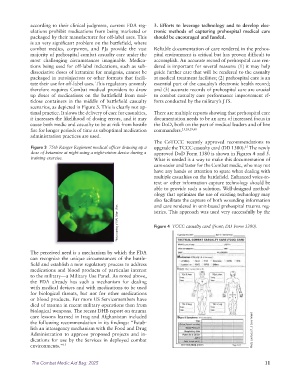
                                                                 The CoTCCC recently approved recommendations to
              Figure 3  75th Ranger Regiment medical officer drawing up a   upgrade the TCCC casualty card (DD 1380).  The newly
                                                                                                      25
              dose of ketamine at night using a night-vision device during a   approved DoD Form 1380 is shown in Figures 4 and 5.
              training exercise.                                 What is needed is a way to make this documentation of
                                                                 care easier and faster for the Combat medic, who may not
                                                                 have any hands or attention to spare when dealing with
                                                                 multiple casualties on the battlefield. Enhanced voice-to-
                                                                 text or other information capture technology should be
                                                                 able to provide such a solution. Well-designed method-
                                                                 ology that optimizes the use of existing technology may
                                                                 also facilitate the capture of both wounding information
                                                                 and care rendered in unit-based prehospital trauma reg-
                                                  Photo courtesy of MAJ Ethan Miles  Figure 4  TCCC casualty card (front; DD Form 1380).
                                                                 istries. This approach was used very successfully by the


              The perceived need is a mechanism by which the FDA
              can recognize the unique circumstances of the battle-
              field and establish a new regulatory process to address
              medications and blood products of particular interest
              to the military—a Military Use Panel. As noted above,
              the FDA already has such a mechanism for dealing
              with medical devices and with medications to be used
              for biological threats, but not for other medications
              or blood products. Far more US Servicemembers have
              died of trauma in recent military operations than from
              biological weapons. The recent DHB report on trauma
              care lessons learned in Iraq and Afghanistan included
              the following recommendation in its findings: “Estab-
              lish an interagency mechanism with the Food and Drug                                       Photo courtesy of US Government
              Administration to approve proposed projects and in-
              dications for use by the Services in deployed combat
              environments.” 15


               The Combat Medic Aid Bag: 2025                                                                 11

