


Page 27 - Journal of Special Operations Medicine - Winter 2015
P. 27
facilities under fluouroscopic guidance, with modifica-  soon as possible. Attention should also be directed to-
              tions, the device might be feasible for use by prehospital   ward determining the injury patterns and physiologic in-
              medical providers.                                 dicators that identify the casualties most likely to benefit
                                                                 from these interventions and application strategies that
              The AAJT can be used at junctional sites but is also   optimize this potential benefit. These devices should be
              cleared by the FDA for abdominal application, in which   evaluated, as appropriate, on animal models, and then
              configuration it controls distal hemorrhage by occlud-  transitioned to clinical use with careful monitoring of
              ing the aorta at the level of its bifurcation, distal to the   outcomes and further adjustments made based on initial
              level of the renal arteries. This eliminates flow to distal   clinical experience.
              abdominal, pelvic, and lower-extremity vessels.
                                                                 9. (Tie) Gather information from Combat medics,
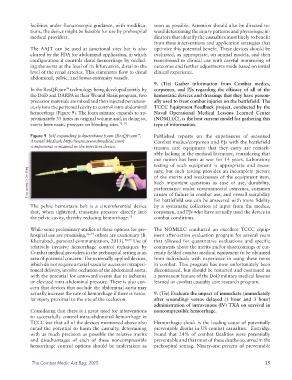
              In the ResQFoam  technology being developed jointly by   corpsmen, and PJs regarding the efficacy of all of the
                            ™
              the DoD and DARPA in their Wound Stasis program, two   hemostatic devices and dressings that they have person-
              precursor materials are mixed and then injected percutane-  ally used to treat combat injuries on the battlefield. The
              ously into the peritoneal cavity to control intra- abdominal   TCCC Equipment Feedback project, conducted by the
              hemorrhage (Figure 9). The foam mixture expands to ap-  Naval Operational Medical Lessons  Learned Center
              proximately 35 times its original volume and, in doing so,   (NOMLLC), is the best current model for gathering this
              exerts hemostatic pressure on bleeding sites. 72–74  type of information.

              Figure 9  Self-expanding polyurethane foam (ResQFoam ;   Published reports  on the  experiences of seasoned
                                                          ™
              Arsenal Medical; http://www.arsenalmedical.com)    Combat medics/corpsmen and PJs with the battlefield
              components contained in the injection device.      trauma care equipment that they carry are remark-
                                                                 ably lacking in the medical literature, considering that
                                                                 our nation has been at war for 14 years. Laboratory
                                                                 testing of such equipment is appropriate and neces-
            Photo courtesy Dr. David King                        of the merits and weaknesses of the equipment item.
                                                                 sary, but such testing provides an incomplete picture
                                                                 Such important questions as ease of use, durability,
                                                                 performance under environmental extremes, common
                                                                 causes of failure in combat use, and overall suitability
                                                                 for battlefield use can be answered with more fidelity
              The pelvic hemostasis belt is a circumferential device   by a systematic collection of input from the medics,
              that, when tightened, transmits pressure directly into   corpsmen, and PJs who have actually used the device in
              the pelvic cavity, thereby reducing hemorrhage. 75  combat conditions.

              While some preliminary studies of these options for pre-  The NOMLLC conducted an excellent TCCC equip-
              hospital use are promising, 73–77  others are cautionary (B.   ment after-action evaluation program for several years
              Kheirabadi, personal communication, 2015). 78,79  Use of   that  allowed  for quantitative  evaluations  and specific
              relatively invasive hemorrhage control techniques by   comments about the merits and/or shortcomings of cur-
              Combat medical providers in the prehospital setting is an   rently fielded combat medical equipment to be obtained
              area of potential concern. The externally applied devices,   from individuals with experience in using these items
              which do not require arterial vascular access or intraperi-  in combat. This program has now unfortunately been
              toneal delivery, involve occlusion of the abdominal aorta,   discontinued, but should be restarted and continued as
              with the potential for untoward events due to ischemia   a permanent feature of the DoD military medical lessons
              or elevated intra-abdominal pressure. There is also con-  learned or combat casualty care research program.
              cern that devices that occlude the abdominal aorta may
              actually increase the rate of hemorrhage if there is vascu-  9. (Tie) Evaluate the impact of immediate (immediately
              lar injury proximal to the site of the occlusion.  after wounding) versus delayed (1 hour and 3 hour)
                                                                 administration of intravenous (IV) TXA on survival in
              Considering that there is a great need for interventions   noncompressible hemorrhage.
              to successfully control intra-abdominal hemorrhage in
              TCCC but that all of the devices mentioned above also   Hemorrhagic shock is the leading cause of potentially
              entail the potential to harm the casualty, determining   preventable deaths in US combat casualties.  Eastridge
              with as much precision as possible the relative merits   found that 24% of combat fatalities were potentially
              and disadvantages of each of these noncompressible   preventable and that most of these deaths occurred in the
              hemorrhage control options should be undertaken as   prehospital setting. Ninety-one percent of   preventable


               The Combat Medic Aid Bag: 2025                                                                 15

