


Page 56 - Journal of Special Operations Medicine - Winter 2014
P. 56
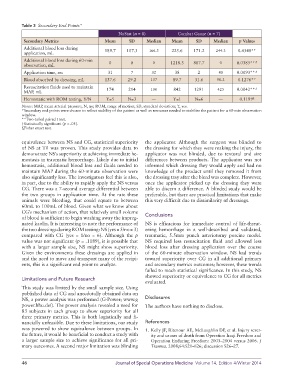
Table 3  Secondary End Points*
                                                  NuStat (n = 8)          Combat Gauze (n = 7)
           Secondary Metrics                Mean      SD      Median    Mean      SD     Median     p Values
           Additional blood loss during     189.7    107.3     166.3    225.6    171.2    244.3    0.4348**
           application, mL
           Additional blood loss during 60-min   0     0        0      1218.3    807.7      0      0.0385** ,†
           observation, mL
           Application time, sec              31       7        32       38        2       40      0.0093** ,†
           Blood absorbed by dressing, mL   137.6     29.2     137      89.7     31.6      90.2    0.1276**
           Resuscitation fluids used to maintain   174  214    100       842     1291      425     0.0042** ,†
           MAP, mL
           Hemostatic with ROM testing, Y/N  Y=5      N=3       —        Y=1     N=6       —        0.1189 §
          Notes: MAP, mean arterial pressure; N, no; ROM, range of motion; SD, standard deviation; Y, yes.
          *Secondary end points were chosen to reflect stability of the patient as well as resources needed to stabilize the patient for a 60-min observation
          window.
          **Two-tailed paired t test.
          †Statistically significant (p < .05).
          §Fisher exact test.


          equivalence between NS and CG, statistical superiority   the applicator. Although the surgeon was blinded to
          of NS at T0 was proven. This study provides data to   the dressing for which they were making the injury, the
          demonstrate NS’s superiority at achieving immediate he-  applicator was not blinded, due to textural and size
          mostasis in traumatic hemorrhage. Likely due to initial   differences between products. The applicator was not
          hemostasis, additional blood loss and fluids needed to   informed which dressing they would apply and had no
          maintain MAP during the 60-minute observation were   knowledge  of  the  product  until  they  removed  it  from
          also significantly less. The investigators feel this is also,   the dressing tray after the bleed was complete. However,
          in part, due to the ability to rapidly apply the NS versus   once the applicator picked up the dressing they were
          CG. There was a 7-second average differential between   able to discern a difference. A blinded study would be
          the  two groups in  application time.  At the  rate these   preferable, but there are practical limitations that make
          animals were bleeding, that could equate to between   this very difficult due to dissimilarity of dressings.
          60mL to 100mL of blood. Given what we know about
          CG’s mechanism of action, that relatively small volume
          of blood is sufficient to begin washing away the impreg-  Conclusions
          nated kaolin. It is interesting to note the performance of   NS is efficacious for immediate control of life-threat-
          the two dressings during ROM testing: NS (yes = 5/no = 3)    ening hemorrhage in a well-described and validated,
          compared with CG (yes = 1/no = 6). Although the  p   traumatic, 5.5mm punch arteriotomy  porcine model.
          value was not significant (p = .1189), it is possible that   NS required less resuscitation fluid and allowed less
          with a larger sample size, NS might show superiority.   blood loss after dressing application over the course
          Given the environments these dressings are applied in   of the 60-minute observation window. NS had trends
          and the need to move and transport many of the recipi-  toward superiority over CG in all additional primary
          ents, this is a significant end point to analyze.  and secondary metrics outcomes; however, these trends
                                                             failed to reach statistical significance. In this study, NS
                                                             showed superiority or equivalence to CG for all metrics
          Limitations and Future Research
                                                             evaluated.
          This study was limited by the small sample size. Using
          published data of CG and anecdotally obtained data on
          NS, a power analysis was performed (G-Power; www.g   Disclosures
          power.hhu.de/). The power analysis revealed a need for   The authors have nothing to disclose.
          83 subjects in each group to show superiority for all
          three primary metrics. This is both logistically and fi-
          nancially unfeasible. Due to these limitations, our study   References
          was powered to show equivalence between groups. In   1.  Kelly JF, Ritenour AE, McLaughlin DF, et al. Injury sever-
          the future, it would be beneficial to conduct a study with   ity and causes of death from Operation Iraqi Freedom and
          a larger sample size to achieve significance for all pri-  Operation Enduring Freedom: 2003–2004 versus 2006. J
          mary outcomes. A second major limitation was  blinding   Trauma. 2008;64:S21–S26; discussion S26–27.


          46                                     Journal of Special Operations Medicine  Volume 14, Edition 4/Winter 2014

