


Page 61 - Journal of Special Operations Medicine - Winter 2014
P. 61
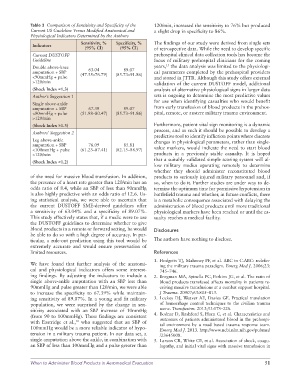
Table 3  Comparison of Sensitivity and Specificity of the   120/min, increased the sensitivity to 76% but produced
              Current US Guideline Versus Modified Anatomical and   a slight drop in specificity to 86%.
              Physiological Indicators Determined by the Authors
                                   Sensitivity, %   Specificity, %   The findings of our study were derived from single sets
              Indicators
                                    (95% CI)       (95% CI)      of retrospective data. While the need to develop specific
              Current DUSTOFF                                    prehospital clinical data collection tools has become the
              Guideline                                          focus of military prehospital clinicians for the coming
                                                                      13
              Double above-knee       63.04         89.07        years,  the data analysis was limited to the physiologi-
              amputation + SBP    (47.55–76.79)  (85.73–91.86)   cal parameters completed by the prehospital providers
              <90mmHg + pulse                                    and stored in JTTR. Although this study offers external
              >120/min                                           validation of the current DUSTOFF model, additional
              (Shock Index ≥1.3)                                 analysis of alternative physiological signs in larger data
              Author’s Suggestion 1                              sets is ongoing to determine the most predictive values
              Single above-ankle                                 for use when identifying casualties who would benefit
              amputation + SBP        67.39         89.07        from early transfusion of blood products in the prehos-
              <90mmHg + pulse     (51.98–80.47)  (85.73–91.86)   pital, remote, or austere military trauma environment.
              >120/min
              (Shock Index ≥1.3)                                 Furthermore, patient vital sign monitoring is a dynamic
              Authors’ Suggestion 2                              process, and as such it should be possible to develop a
                                                                 predictive tool to identify infliction points where discrete
              Leg above-ankle                                    changes in physiological parameters, rather than single-
              amputation + SBP        76.09         85.81
              <100mmHg + pulse    (61.23–87.41)  (82.15–88.97)   value markers, would indicate the need to start blood
              >120/min                                           products in a previously stable casualty. It is hoped
              (Shock Index ≥1.2)                                 that a suitably validated simple scoring system will al-
                                                                 low military medics operating remotely to determine
                                                                 whether they should administer reconstituted  blood
              of the need for massive blood transfusion. In addition,   products to seriously injured military personnel and, if
              the presence of a heart rate greater than 120/min has an   so, when to do it. Further studies are under way to de-
              odds ratio of 8.4, while an SBP of less than 90mmHg   termine the optimum time for permissive hypotension in
              is also highly predictive with an odds ratio of 12.6. Us-  battlefield trauma and whether, in future conflicts, there
              ing  statistical  analysis,  we  were  able  to  ascertain  that   is a metabolic consequence associated with delaying the
              the current DUSTOFF SME-derived guidelines offer   administration of blood products until more traditional
              a sensitivity of 63.04% and a specificity of 89.07%.   physiological markers have been reached or until the ca-
              This study effectively states that, if a medic were to use   sualty reaches a medical facility.
              the DUSTOFF guidelines to determine whether to give
              blood products in a remote or forward setting, he would   Disclosures
              be able to do so with a high degree of accuracy. In par-
              ticular, a rule-out prediction using this tool would be   The authors have nothing to disclose.
              extremely accurate and would ensure preservation of
              limited resources.                                 References
                                                                 1.  Hodgetts TJ, Mahoney PF, et al. ABC to C.ABC: redefin-
              We have found that further analysis of the anatomi-  ing the military trauma paradigm. Emerg Med J. 2006;23:
              cal and physiological indicators offers some interest-  745–746.
              ing  findings.  By  adjusting  the  indicators  to  include  a   2.  Borgman MA, Spinella PC, Perkins JG, et al. The ratio of
              single above-ankle amputation with an SBP less than   blood products transfused affects mortality in patients re-
              90mmHg and pulse greater than 120/min, we were able   ceiving massive transfusions at a combat support hospital.
              to increase the specificity to  67.39% while maintain-  J Trauma. 20907;63:805–813.
              ing sensitivity of 89.07%. In a young and fit military   3.  Lockey DJ, Weaver AE, Davies GE. Practical translation
              population, we were surprised by the change in sen-  of hemorrhage control techniques to the civilian trauma
              sitivity associated with an SBP increase of 10mmHg   scene. Transfusion. 2013;53:17S–22S.
              (from 90 to 100mmHg). These findings are consistent   4.  Bodnar D, Rashford S, Hurn C, et al. Characteristics and
                                                                   outcomes of patients administered blood in the prehospi-
              with Eastridge et al.,  who suggested that an SBP of   tal environment by  a road  based trauma  response  team.
                                10
              100mmHg would be a more reliable indicator of hypo-  Emerg Med J. 2013. http://www.ncbi.nlm.nih.gov/pubmed
              tension in a military trauma patient. In our data set, a   /23645008.
              single  amputation above the ankle, in combination with   5.  Larson CR, White CE, et al. Association of shock, coagu-
              an SBP of less than 100mmHg and a pulse greater than   lopathy, and initial vital signs with massive transfusion in


              When to Administer Blood Products in Aeromedical Evacuation                                     51

