


Page 60 - Journal of Special Operations Medicine - Winter 2014
P. 60
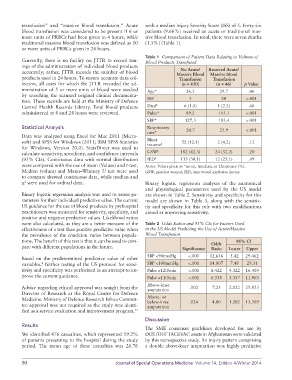
transfusion” and “massive blood transfusion.” Acute   with a median Injury Severity Score (ISS) of 5. Forty-six
          blood transfusion was considered to be present if 6 or   patients (9.66%) received an acute or traditional mas-
          more units of PRBCs had been given in 4 hours, while   sive blood transfusion. In total, there were seven deaths
          traditional massive blood transfusion was defined as 10   (1.5%) (Table 1).
          or more units of PRBCs given in 24 hours.
                                                             Table 1  Comparison of Patient Data Relating to Volume of
          Currently, there is no facility on JTTR to record tim-  Blood Products Transfused
          ings of the administration of individual blood products           No Acute/  Received Acute/
          accurately; rather, JTTR records the number of blood            Massive Blood   Massive blood
          products used in 24 hours. To ensure accurate data col-          Transfusion    Transfusion
          lection, all cases for which the JTTR recorded the ad-            (n = 430)     (n = 46)    p Value
          ministration of 5 or more units of blood were studied   Age*        26.5          29.7        .06
          by searching the scanned original clinical documenta-  †
          tion. These records are held at the Ministry of Defence   ISS        5            20         <.001
                                                                  ‡
          Central Health Records Library. Total blood products   Died        6 (1.4)       1 (2.2)      .68
          administered at 4 and 24 hours were reviewed.       Pulse*          89.2         115.1       <.001
                                                              SBP*           127.3         103.4       <.001
          Statistical Analysis                                Respiratory     20.7          25.9       <.001
                                                              rate*
          Data was analyzed using Excel for Mac 2011 (Micro-
          soft) and SPSS for Windows (2011; IBM SPSS Statistics   Blunt   ‡  52 (12.1)     2 (4.2)      .12
                                                              trauma
          for Windows, Version 20.0). StatsDirect was used to
          calculate sensitivity, specificity, and confidence intervals   GSW ‡  182 (42.3)  24 (52.2)   .20
          (95% CIs). Continuous data with normal distribution   IED ‡       133 (30.1)    12 (25.1)     .49
          were compared with the use of mean (Values) and t-test.   Notes: Values given as *mean, †median, or ‡frequency (%).
          Median (values) and Mann–Whitney U test were used   GSW, gunshot wound; IED, improvised explosive device.
          to compare skewed continuous data, while median and
          χ  were used for ordinal data.                     Binary logistic regression analyses of the anatomical
           2
                                                             and physiological parameters  used by the  US model
          Binary logistic regression analysis was used to assess pa-  are shown in Table 2. Sensitivity and specificity for this
          rameters for their individual predictive value. The current   model are shown in Table 3, along with the sensitiv-
          US guidance for the use of blood products by prehospital   ity and specificity for this rule with two modifications
          practitioners was measured for sensitivity, specificity, and   aimed at improving sensitivity.
          positive and negative predictive values. Likelihood ratios
          were also calculated, as they are a better measure of the   Table 2  Odds Ratios and 95% CIs for Factors Used
          effectiveness of a test than positive predictive value when   in the US Model Predicting the Use of Acute/Massive
          the prevalence of the condition varies between popula-  Blood Transfusion
          tions. The benefit of this test is that it can be used to com-                Odds       95% CI
          pare with different populations in the future.                    Significance  Ratio  Lower  Upper

          Based  on  the  predetermined  predictive  value  of  other   SBP <90mmHg  <.001  12.636  5.42  29.462
          variables,  further testing of the US protocol for sensi-  SBP <100mmHg  <.001  14.807  7.48  29.31
                  8
          tivity and specificity was performed in an attempt to im-  Pulse ≥120/min  <.001  8.422  4.322  16.409
          prove the current guidance.                         Pulse ≥110/min   <.001    6.338   3.357  11.963

          Advice regarding ethical approval was sought from the   Above-knee   .002      7.23   2.022  25.853
                                                              amputation
          Director of Research at the Royal Centre for Defence
          Medicine. Ministry of Defence Research Ethics Commit-  Above- or     .024      4.00   1.202  13.309
                                                              below-knee
          tee approval was not required as the study was identi-  amputation
          fied as a service evaluation and improvement program. 12

                                                             Discussion
          Results
                                                             The SME consensus guidelines developed for use by
          We identified 476 casualties, which represented 19.2%     DUSTOFF TACEVAC assets in Afghanistan were validated
          of patients presenting to the hospital during the study   by this retrospective study. An injury pattern comprising
          period. The mean age of these casualties was 26.76   a double above-knee amputation was highly predictive


          50                                     Journal of Special Operations Medicine  Volume 14, Edition 4/Winter 2014

