


Page 46 - Journal of Special Operations Medicine - Winter 2014
P. 46
The importance of training military medics in cricothy-    Secondary outcomes included complications and rea-
          rotomy has been previously highlighted. 13,14  The ma-  sons for cricothyrotomy failure, associated LSIs per-
          jority of military medics are trained to the emergency   formed, type of provider performing the procedure, and
          medical technician-B level with an additional 7 hours of   survival to combat hospital discharge.
          cricothyrotomy instruction, which includes at least 12
          insertions on a plastic mannikin.  Military medics are
                                       14
          taught this single advanced airway technique because it   Data Analysis
          can be used in nonparalyzed patients and requires less   For this descriptive analysis, non-normally distrib-
          training and equipment than orotracheal intubation.  uted data are reported as a median (interquartile range
                                                             [IQR]). The Wilcoxon test (nonparametric) was used for
          Combat cricothyrotomies between 2007 and 2009 have   data comparisons and the chi-square test for equal pro-
          been described in a case series.  However, this study was   portions was used for individual group data compari-
                                    16
          retrospective and did not include procedures performed   son; significance was set at p < .05 for both tests.
          en route to a combat hospital. Therefore, we performed
          an up-to-date prospective review of prehospital and en
          route combat cricothyrotomy with the aim of describing   Results
          the survival rate, complications, and associated lifesav-  Of the 1,927 patients enrolled in the LSI study, 34
          ing interventions to better inform future training and   (1.8%) were recorded as having had a prehospital or
          practice.                                          en route cricothyrotomy. The median age of cricothy-
                                                             rotomy  patients  was  24  years  (IQR:  22.5–25.0  years)
                                                             and 97% were male. Blast injury was the predominant
          Methods
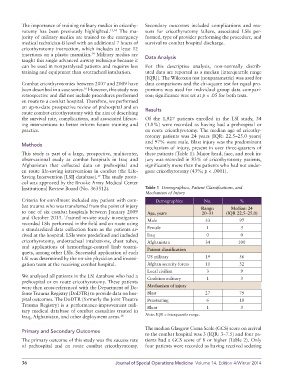
                                                             mechanism of injury, present in over three-quarters of
          This study is part of a large, prospective, multicenter,   these patients (Table 1). Major head, face, and neck in-
          observational study at combat hospitals in Iraq and   jury was recorded in 83% of cricothyrotomy patients,
          Afghanistan  that  collected  data  on  prehospital and   significantly more than the patients who had not under-
          en route life-saving interventions in combat (the Life-   gone cricothyrotomy (43%; p < .0001).
          Saving Intervention [LSI] database).  The study proto-
                                         17
          col was approved by the Brooke Army Medical Center
          Institutional Review Board (No. 363512).           Table 1  Demographics, Patient Classifications, and
                                                             Mechanism of Injury
          Criteria for enrollment included any patient with com-  Demographics       No.            %
          bat trauma who was transferred from the point of injury                   Range:      Median: 24
          to one of six combat hospitals between January 2009   Age, years          20–31     (IQR 22.5–25.0)
          and October 2013. Trained on-site study investigators   Male                33            97
          recorded LSIs performed in the field and en route using
          a standardized data collection form as the patients ar-  Female             1             3
          rived at the hospital. LSIs were predefined and included   Iraq             0             0
          cricothyrotomy, endotracheal intubations, chest tubes,   Afghanistan        34           100
          and applications of hemorrhage-control limb tourni-  Patient classification
          quets, among other LSIs. Successful application of each
          LSI was determined by the on-site physician and investi-  US military       19            56
          gation team at the receiving combat hospital.       Afghan security forces  11            32
                                                              Local civilian          3             9
          We analyzed all patients in the LSI database who had a   Coalition military  1            3
          prehospital or en route cricothyrotomy. These patients
          were then cross-referenced with the Department of De-  Mechanism of injury
          fense Trauma Registry (DoDTR) to provide data on hos-  Blast                27            79
          pital outcomes. The DoDTR (formerly the Joint Theatre   Penetrating         6             18
          Trauma Registry) is a performance-improvement mili-  Blunt                  1             3
          tary medical database of combat casualties treated in
          Iraq, Afghanistan, and other deployment areas. 18  Note: IQR = interquartile range.

                                                             The median Glasgow Coma Scale (GCS) score on arrival
          Primary and Secondary Outcomes
                                                             to the combat hospital was 3 (IQR: 3–7.5) and four pa-
          The primary outcome of this study was the success rate   tients had a GCS score of 8 or higher (Table 2). Only
          of prehospital and en route combat cricothyrotomy.   four patients were recorded as having received sedating


          36                                     Journal of Special Operations Medicine  Volume 14, Edition 4/Winter 2014

