


Page 43 - Journal of Special Operations Medicine - Winter 2014
P. 43
8
              Predisruption Versus Post-JETT Placement           lower extremities and the pelvis.  Such junctional injuries
              Reduction occurred in both AP and transverse planes,   are associated with massive and lethal  hemorrhage. The
              with the transverse differences being more dramatic.   military is seeking devices to control junctional hemor-
                                                                      7
              These differences were measured at both the inlet and   rhage.  The JETT was developed to provide temporary
              outlet of the pelvis in both planes.               control of hemorrhage for difficult inguinal bleeding
                                                                 and is based on a circumferential belt placed at the level
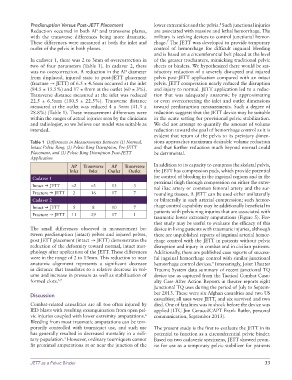
              In cadaver 1, there was 2 to 3mm of overcorrection in   of the greater trochanters, mimicking traditional pelvic
              two of four parameters (Table 1). In cadaver 2, there   sheets or binders. We hypothesized there would be sat-
              was no overcorrection. A reduction in the AP diameter   isfactory reduction of a severely disrupted and injured
              from displaced, injured state to post-JETT placement   pelvis post-JETT application compared with an intact
              (fracture → JETT) of 6.5 ± 4.5mm occurred at the inlet   pelvis. JETT compression nearly reduced the disruption
              (84.5 ± 15.5%) and 17 ± 0mm at the outlet (60 ± 3%).   and injury to normal. JETT application led to a reduc-
              Transverse distance measured at the inlet was reduced   tion that was adequately anatomic by approximating
              22.5 ± 6.5mm (100.5 ± 22.5%). Transverse distance   or even overcorrecting the inlet and outlet dimensions
              measured at the outlet was reduced 4 ± 3mm (41.3 ±   toward predisruption measurements. Such a degree of
              28.8%) (Table 1). These measurement differences were   reduction suggests that the JETT device may be suitable
              within the ranges of actual injuries seen by the clinicians   in the acute setting for provisional pelvic stabilization.
              and radiologist, so we believe our model was suitable as   We did not attempt to quantify the amount of volume
              intended.                                          reduction toward the goal of hemorrhage control as it is
                                                                 evident that return of the pelvis to its preinjury dimen-
              Table 1  Differences in Measurements Between (1) Normal,   sions approaches maximum desirable volume reduction
              Intact Pelvic Ring, (2) Pelvic Ring Disruption, Pre-JETT   and that further reduction much beyond normal could
              Placement, and (3) Pelvic Ring Disruption Post-JETT   be detrimental.
              Application
                              AP   Transverse   AP    Transverse   In addition to its capacity to compress the skeletal pelvis,
                              Inlet   Inlet   Outlet  Outlet     the JETT has compression pads, which provide potential
              Cadaver 1                                          for control of bleeding in the inguinal regions and in the
                                                                 proximal thigh through compression on either the exter-
              Intact g JETT    –2      –3      13       3
                                                                 nal iliac artery or common femoral artery and the sur-
              Fracture g JETT  2       16      17       7        rounding tissues. A JETT can be used either unilaterally
              Cadaver 2                                          or bilaterally in such arterial compression; such hemor-
              Intact g JETT    5       8       10       7        rhage control capability may be additionally beneficial to
                                                                 patients with pelvic ring injuries that are associated with
              Fracture g JETT  11      29      17       1
                                                                 traumatic lower extremity amputations (Figure 5). Fur-
                                                                 ther study may be useful to evaluate the efficacy of this
              The small differences observed in measurement be-  device in living patients with traumatic injuries, although
              tween predisruption (intact) pelves and injured pelves,   there are unpublished reports of inguinal arterial hemor-
              post JETT placement (intact → JETT) demonstrates the   rhage control with the JETT in patients without pelvic
              reduction of the deformity toward normal, intact mor-  disruption and injury in combat and in civilian patients.
              phology after application of the JETT. These differences   Additionally, there are published case reports of success-
              were in the range of 2 to 13mm. This reduction to near   ful inguinal hemorrhage control with similar junctional
              anatomic alignment represents a significant decrease   hemorrhage control devices.  Interestingly, Joint Theater
                                                                                         9
              in distance that translates to a relative decrease in vol-  Trauma System data summary of recent junctional TQ
              ume and increase in pressure as well as stabilization of   device use as captured from the Tactical Combat Casu-
              formed clots. 3,7                                  alty Care After Action Reports in theater reports eight
                                                                 Junctional TQ uses during the period of July to Septem-
                                                                 ber 2013. These were six Afghan casualties and two US
              Discussion
                                                                 casualties; all uses were JETT, and six survived and two
              Combat-related causalities are all too often injured by   died. One of fatalities was in shock before the device was
              IED blasts with resulting exsanguination from open pel-  applied (LTC Jim Geracci/CAPT Frank Butler, personal
              vic injuries coupled with lower extremity amputations. 6   communication, September 2013).
              Bleeding from most traumatic amputations can be tem-
              porarily controlled  with tourniquet use,  and such use   The present study is the first to evaluate the JETT in its
              has generally resulted in decreased mortality in a mili-  potential to function as a circumferential pelvic binder.
                            4
              tary population.  However, ordinary tourniquets cannot   Based on two cadaveric specimens, JETT showed prom-
              fit proximal amputations at or near the junction of the   ise for use as a temporary pelvic stabilizer for patients


              JETT as a Pelvic Binder                                                                         33

