


Page 97 - Journal of Special Operations Medicine - Spring 2014
P. 97
in dogs in the United States: results of a national clinic-
                                                                    based serologic survey. Vet Parasitol. 2009;160:138–148.
                                                                   5.  Otranto  D,  Dantas-Torres  F. Canine  and  feline  vector-
                                                                    borne diseases in Italy: current situation and perspectives.
                                                                    Parasit Vectors. 2010;3:2.
                                                                   6.  Otranto D, Dantas-Torres F, Breitschwerdt EB. Manag-
                                                                    ing canine vector-borne diseases of zoonotic concern: part
                                                                    two. Trends Parasitol. 2009;25:228–235.
                                                                   7.  Otranto D, Dantas-Torres F, Breitschwerdt EB. Manag-
             www.fundacionlahuellaroja.com                         8.  Pantchev N, Schaper R, Limousin S, et al. Occurrence of
                                                                    ing canine vector-borne diseases of zoonotic concern: part
                                                                    one. Trends Parasitol. 2009;25:157–163.
                                                                    Dirofilaria immitis and tick-borne infections caused by
                                                                    Anaplasma phagocytophilum, Borrelia burgdorferi sensu
                                                                    lato and Ehrlichia canis in domestic dogs in France: re-
                                                                    sults of a countrywide serologic survey.  Parasitol Res.
                                                                    2009;105(Suppl 1):S101–S114.
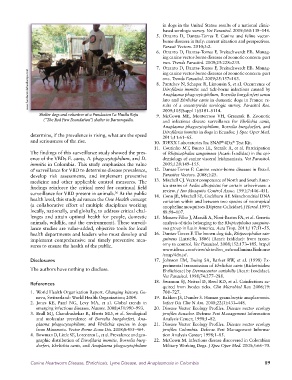
                 Shelter dogs and volunteer at a Fundacion La Huella Roja      9.  McCown ME, Monterroso VH, Grzeszak B. Zoonotic
                   (“The Red Paw Foundation”) shelter in Barranquilla.  and infectious disease surveillance for  Ehrlichia canis,
                                                                    Anaplasma phagocytophilum, Borrelia burgdorferi, and
                                                                    Dirofilaria immitis in dogs in Ecuador. J Spec Oper Med.
              determine, if the prevalence is rising, what are the speed   2011;11:61–65.
              and seriousness of the rise.                       10.  IDEXX Laboratories Inc SNAP 4Dx  Test Kit.
                                                                                                 ®
                                                                                             ®
                                                                 11.  Coutinho MT, Bueno LL, Sterzik A, et al. Participation
              The findings of this surveillance study showed the pres-  of Rhipicephalus sanguineus (Acari: Ixodidae) in the epi-
              ence of the VBDs E. canis, A. phagocytophilum, and D.   demiology of canine visceral leishmaniasis. Vet Parasitol.
              immitis in Colombia. This study emphasizes the value   2005;128:149–155.
              of surveillance for VBD to determine disease prevalence,   12.  Dantas-Torres F. Canine vector-borne diseases in Brazil.
              develop risk assessments,  and implement  preventive   Parasites Vectors. 2008;1:25.
              medicine  and  other  applicable control  measures.  The   13.  Mitchell CJ. Vector competence of North and South Amer-
              findings reinforce the critical need for continual field   ica strains of Aedes albopictus for certain arboviruses: a
                                                                    review. J Am Mosquito Control Assoc. 1991;7:446–451.
              surveillance for VBD present in animals.  At the public   14.  Conn JE, Mitchell SE, Cockburn AF. Mitochondrial DNA
                                                36
              health level, this study advances the One Health concept   variation within and between two species of neotropical
              (a collaborative effort of multiple disciplines working   anopheline mosquitoes (Diptera: Culicidae). J Hered. 1997;
              locally, nationally, and globally, to address critical chal-  88:98–107.
              lenges  and  attain  optimal  health  for  people,  domestic   15.  Moraes-Filho J, Marcili A, Nieri-Bastos FA, et al. Genetic
              animals, wildlife, and the environment). These surveil-  analysis of ticks belonging to the Rhipicephalus sanguine-
              lance studies are value-added, objective tools for local   ous group in Latin America. Acta Trop. 2011;117:51–55.
              health departments and leaders who must develop and   16.  Dantas-Torres F. The brown dog tick, Rhipecephalus san-
              implement comprehensive and timely preventive mea-    guineus  (Latrielle,  1806)  (Acari:  Ixididae):  from  taxon-
              sures to ensure the health of the public.             omy to control. Vet Parasitol. 2008;152:173–185. http://
                                                                    www.idexx.com/view/xhtml/en_us/smallanimal/inhouse
                                                                    /snap/4dx.jsf.
              Disclosures                                        17.  Johnson EM, Ewing SA, Barker RW, et al. (1998) Ex-
                                                                    perimental transmission of Ehrlichia canis (Rickettsiales:
              The authors have nothing to disclose.                 Ehrlichieae) by Dermacentor variabilis (Acari: Ixodidae).
                                                                    Vet Parasitol. 1998;74:277–288.
                                                                 18.  Swanson SJ, Neitzel D, Reed KD, et al. Coinfections ac-
              References
                                                                    quired from Ixodes ticks. Clin Microbiol Rev. 2006;19:
              1.  World Health Organization Report. Changing history. Ge-  708–727.
                neva, Switzerland: World Health Organization; 2004.  19.  Bakken JS, Dumler S. Human granulocytic anaplasmosis.
              2.  Jones  KE,  Patel  NG,  Levy  MA,  et  al.  Global  trends  in   Infect Dis Clin N Am. 2008;22(3):433–448.
                emerging infectious diseases. Nature. 2008;451:990–993.  20.  Disease Vector Ecology Profiles. Disease vector ecology
              3.  Beall MJ, Chandrashekar R, Eberts MD, et al. Serological   profiles Ecuador. Defense Pest Management Information
                and molecular prevalence of  Borrelia burgdorferi,  Ana-  Analysis Center; 1998;1–82.
                plasma phagocytophilum, and  Ehrlichia species in dogs   21.  Disease Vector Ecology Profiles. Disease vector ecology
                from Minnesota. Vector Borne Zoon Dis. 2008;8:455–464.  profiles Colombia. Defense Pest Management Informa-
              4.  Bowman D, Little SE, Lorentzen L, et al. Prevalence and geo-  tion Analysis Center; 1998;1–85.
                graphic distribution of Dirofilaria immitis, Borrelia burg-  22.  McCown M. Infectious disease discovered in Colombian
                dorferi, Ehrlichia canis, and Anaplasma phagocytophilum   Military Working Dogs. J Spec Oper Med. 2005;5:66–70.


              Canine Heartworm Disease, Ehrlichiosis, Lyme Disease, and Anaplasmosis in Colombia              89

